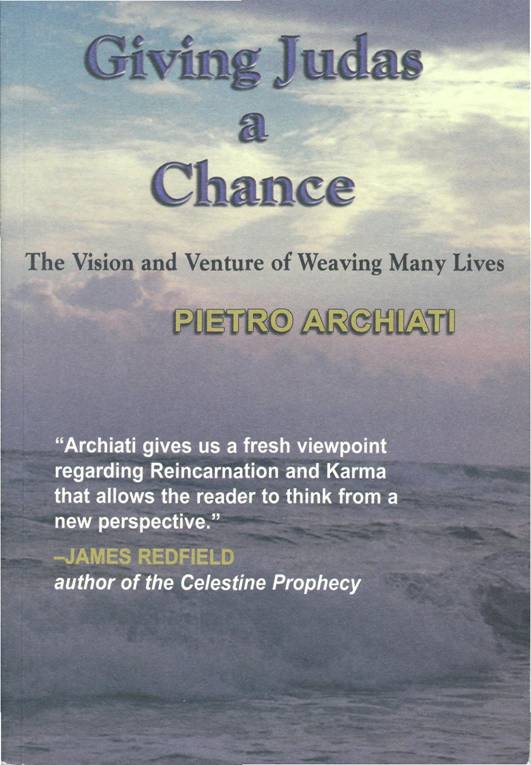
Giving Judas
a
Chance
The Vision and Venture of Weaving Many Lives
Pietro Archiati
Spiritual Science Publications
Published January 1999 by
Spiritual Science Publications
ISBN: 1-893843-00-9
Cover photos by
Robert Paul Kwapien
Cover Design and layout
by John Robert Shindelbower
Printed in Birmingham, Alabama
CONTENTS
Chapter 1 REVIEWING MY OWN LIFE (Black
Forest, 1998)
Chapter 2 SEEKING OUR TRUE SELF (Laos,
1970)
Chapter 3 CHANGING THE UNCHANGEABLE (Lake
Como, 1977)
Chapter 4 GIVING JUDAS A CHANCE (South
Africa, 1981)
Chapter 5 MERGING THE HUMAN WITH THE
DIVINE (Rome 1984)
Chapter 6 LOVING HUMANITY AS OUR SELF
(Berlin, 1990)
Chapter 7 HEALING OUR SUFFERING EARTH (Las
Vegas, 1994)
Of all the people
who have been kind in helping me with this book through typing and retyping,
through advice regarding content and language, I would like to mention the
following in particular: Joseph Bailey, Patty and Bruce Bourhill, Annegret
Kiel, Walter and Wulf Knausenberger, Brigitte Kolbe, Robert Kwapien, Joy
Redfield Kwapien. To these and to all who have helped me I express my deepest
gratitude. A special thanks goes to my life companion Karin Knausenberger for
her loving care and support.
by Joy Redfield Kwapien
It was on a warm
Southern weekend retreat two years ago that I met Pietro Archiati for the first
time. I will not elaborate upon the lengthy interplay of synchronistic events
that led us to this retreat and his lectures. In retrospect, our meeting was
against all odds, but thankfully I listened to “higher voices”, and made plans
to attend. I must mention how important it is for humanity to become more and
more aware of the pattern of events in our individual lives. How proud I am
that my brother James Redfield wrote such a book as the “Celestine Prophecy,”
and among other things awakened many to the importance of the subtleties of “synchronicity”.
I will try to give you a “glimpse” of Archiati, so that you may see the
relevance of what he brings to humanity. As a religious scholar, he
persistently searched for answers to the many questions of life that not only
he, but many of us encounter. With his innate gift for languages, he went
beyond the popular prose of the Scriptures and searched in the original Greek
and Hebrew texts.
I believe that many of us process “unknown” or “new” information in one
of two ways. We approach it analytically or intellectually, based on the sum of
our previous experiences; or we merely “feel” or “intuit” that the information
is believable. Those who exist in
the realm of the feelings are often uncomfortable intellectually analyzing new
data by “thinking” through them. Those in the thinking realm are often
uncomfortable trusting their intuition. How beautiful it is when we can blend
the two, and have a meeting of the head and heart. Thus, approaching spiritual
data with clear thinking is the brilliant blend we encounter in Archiati’s
work.
Pietro has taken elusive, controversial issues relevant to our time and
lectured on them from continent to continent, sharing his ideas with thousands
of people. He has seen a future when humanity will no longer need an
intercessor to determine communication between the Divine and themselves. As we
begin a new millennium, one can certainly feel a new awareness emerging.
That summer, Pietro travelled from coast to coast, lecturing and
answering questions from many Americans. For most of us, a lack of true answers
leaves our questions lying dormant, but never dead. Archiati enlivens us by
giving us fresh fuel with which to approach answers that lie at the divine
centre of our soul. Pietro Archiati has published several books in German and
Italian; they will be made available as needed in English. In this present
autobiographical work centering around the question of reincarnation and karma,
one can view Christianity from a new perspective. Archiati gives us a
convincing view of the natural alliance between the teaching of Christ and the
evolutionary laws of reincarnation and karma. In this age of enlightenment and
of the emergence of the conscious individual, we are ready to take Archiati’s
thoughts out of the realm of the hidden, isolated, and even heretical. As Henry
David Thoreau said: “We need to witness our own limits transgressed, and some
life pasturing freely where we never wander”.
In “Giving Judas a Chance,” Archiati suggests a pathway whereby each of
us may discover his individual truth. As we approach the laden mist of
spiritual data with new tools, we can wander new pastures with clear thinking,
so that, instead of merely absorbing more information, we emerge triumphant
with true inner knowledge. Knowledge that brings enlightenment to the whole of
our global family.
Joy Redfield Kwapien
This book is the
result of my trying to do justice to the inextricable intertwining of truth and
life, to the mutuality of what is universal and what is individual. It
constantly alternates between autobiography and imagination, between being
personal and seeking to disappear.
Many of us nowadays think that what our outer senses perceive is more
real than what we experience inwardly. I think the very opposite is true: what
goes on within us is more real to us and more consequential to our lives than
all external reality. It is this conviction that has guided me in writing every
page of this book.
In looking for an appropriate form to convey my experiences and
thoughts, I could find no better one than the form of conversation. The
Platonic dialogues have been the foundation of Western culture for nearly two
and a half millennia. In conversing with one another, human beings can perhaps
best look at reality from ever new points of view. A dialogue can be the most
dynamic experience, challenging us to remain alive and creative.
Black Forest (Germany), October 1998.
Pietro Archiati
I was glad it was Carol, Dan and Rita who rang the doorbell. Having set
my mind on writing a book specifically for America, I now needed some positive
input — so what better people to ask than these three?
Carol, Dan’s mother from New Jersey, keeps
a close track of what is going on in the world today, especially in the U.S.
She is rather pessimistic about the way Humanity is evolving at present, and
she is particularly concerned that moral standards have reached an all time
low.
Her son Dan represents the young American
fully immersed in today’s world of science and technology, keeping up on the
latest innovations and excited to live at the present time.
Rita, Dan’s German friend, is particularly
interested in the spiritual quest of Humanity, in the new awareness and vision
emerging in many people. So it is not surprising that it was she who eventually
turned the subject of our conversation to my book.
“How is your new book coming along?” she
asked with genuine interest.
“I’m not sure,” I replied. “I’ve been
writing and rewriting it. I want to say something meaningful, but nowadays you
don’t have a chance of being read unless you are entertaining at the same time.”
“What is wrong with that?” Rita asked.
“Well,” I replied, “everything I have
written so far seems to me too dry for the average American reader. Do you have
any suggestions?”
“I think there are many people out there,”
she answered, “who are sincerely searching. In increasing numbers, people are
looking for personal spiritual experiences. There really seems to be a new
awareness emerging in Humanity, but the danger is that many attempts to
experience the supersensible remain purely subjective. I think many are looking
for basic orientations to interpret their spiritual experiences, similar to the
orientations science gives us to understand the physical world. If you have any
contribution to give in this regard, I’m sure enough people will be interested
in what you have to say.”
“Can you give me a specific example of
what you mean?” I asked.
“Well, think for instance,” she answered, “of
the way an increasing number of people are now raising the question whether
each of us only lives once or more than once. Some claim to have past life memories
of themselves in former times. But who knows whether the images they see are
not of the same kind as the images of our dreams? We know we have to interpret
or properly read those images through our ‘waking thinking’, if we want to
reach objectivity. I think what is needed most today is an attempt to deal with
the question of reincarnation on the basis of ‘waking thinking.’“
I looked at Dan and Carol, and they didn’t
seem surprised at Rita’s answer. They both knew her well.
“I think I understand what you mean, Rita,”
I said. “And I must say I actually agree with you. I think what I’m afraid of
is the risk of turning off a lot of people by referring directly to spiritual
experiences or realities. Some might think they are being served the same old
pious stuff their parents preached.”
“So your problem is that you like to
please everybody,” Rita said matter-of-factly. “If you try to do that,
you will eventually please nobody. If you want to please everybody, you have to
put success first and truth second. Knowing you as I do, I think it’s safe to
say that you want the truth to prevail. So why don’t you just write the best
you can and let people make of it what they will?
“On our way here, we were discussing the
fact that never before have human beings searched harder for the truth than
today. Perhaps the reason is that there is so little of it to be found. The
exercise of power and the pursuit of outer success have become so pervasive,
that most people call you a fanatic or a fundamentalist if you dare to state
that there really is objective truth and that searching for it can be the most
fulfilling of activities. People say this, but I’ve never met a single
person who actually believed it. Deep down people really long for objective
truth. Their higher Selves are one with the words spoken a long time ago: ‘You
shall come to know the truth and the truth shall set you free’.”
“Pietro,” Carol said at this point, “isn’t
one of your main concerns to address the issue of materialism?”
“Yes, Carol, very much so,” I answered. “But
how can one do that without giving a sermon and without boring the readers?”
“What you folks call materialism isn’t
boring at all to me,” Dan intervened. “I don’t want to hear how bad materialism
is; every day I experience its value. Everyone enjoys the advantages that
modern science and technology bring into our lives. Just think of the phone
calls you make: would those who condemn materialism be ready to live without a
phone? From the many conversations with Rita on this issue, it has become apparent
to me that the real question of materialism is not what we have, but what we
are missing.”
“What do you think you are missing, Dan?”
Carol asked. “I see you absorbed day and night in keeping up with all that is
happening, with the latest scientific theories and the most recent
technological innovations. How could you possibly find time or interest for anything else?
Do you really mean it when you talk about missing out on something?”
“If you had asked me that question some
years ago, before I met Rita,” Dan replied, “I would have answered that I did
not miss anything. Life was full of excitement and fun. Since I’ve known Rita,
I’ve become more and more familiar with her world. This world is gradually
becoming no less fascinating to me than the material one. She can explain with
her theories all kinds of phenomena science cannot explain, but that’s not what
attracts me. I’m not particularly impressed, say, when she uses the concept of ‘karma’
to make everything that happens in life seem reasonable or rational. No, what
impresses me is how her convictions affect her, or I should rather say what
they make of her. She has a loving acceptance of every person she meets,
and she treats events, even the bad or painful ones, as gifts sent to us so we
can make the best of them ...”
I think Dan would have kept going, but
Rita interrupted him: “Dan, I’m just at the beginning of what you are
describing. I’m really just trying to live that way.”
“And that’s what makes you so trying for
me!” Dan answered. “But I like this kind of challenge very much. It seems like
I have been looking for it for a long time, without even knowing it.”
“One thing in particular would interest
me, Pietro,” Carol said. “You’ve mentioned on a number of occasions that one of
the most important things we must do to overcome the one-sidedness of
materialism is to become aware that we live more than one life, and that our
lives are connected by the laws of destiny you and Rita call ‘karma’. When I
hear that, I get the impression that it is something important, but I have
difficulty comprehending it. I want to hear more about it.”
“Let’s go back to Dan’s suggestion,” I said,
“that we consider materialism from the point of view of what many people are
missing in their lives. I think what people are missing most is a positive view
of materialism itself. They consider only its negative aspects. True happiness
can only be found if we are able to see everything positively. This is
possible, but our materialistic outlook has convinced us that everything painful,
everything difficult is simply negative. For instance, we tend to consider
illness merely as a negative experience, implying that life would be better
without it. Also, look at the way our whole culture rejects the basic reality
of death. I’ll never forget being begged in a funeral home in New York not to
mention the word ‘death’ in the short
address I was to give.”
“I like such direct references to
life-experience,” Carol said. “This helps me understand what you are trying to
say.”
“I think I see what you mean,” I said. “What
if I read to you some of what I have written so far? I refer to life-experiences and I
try to convey how reincarnation can work into our daily lives.”
“Yes, please do that,” was the unanimous
reaction. “By referring to life-experience,” Dan added, “each of us is left
free to look at the facts from his own point of view, without excluding the
points of view of others. I think this is the best way to avoid all
one-sidedness and dogmatism.”
So I began to read.
Some years ago, when I was in Berlin shortly after the Wall was torn
down, there was a group of teenagers who were on their way to visit an elderly
man whom they called Opa, or “grandfather.” They found a Russian woman, a young
American man and me talking together about human freedom and they persuaded us
to go along.
Shortly thereafter, we were sitting in a
cafe, engaged in a conversation. It was easy to understand why the kids loved
Opa. I had rarely met anybody so wise and loving. He had been talking about
loving what is truly human in each person and loving Humanity as a single
organism. He had just quoted the last lines of Goethe’s Faust for
emphasis.
All of a sudden, the door flew open. In
came five young men with shaved heads, dressed in black leather pants and
jackets. The metal plates under the soles of their shoes gave an eerie military
sound to their rhythmic steps. They encircled us and stared at us, their hands on their
hips, as if we owed them some explanation for being in the cafe. Their look was
deft’ ant, and seemed to betray an inner insecurity.
Opa stood up, went to the one standing
closest to him and said: “May I shake hands with you?” His calm and loving
manner was disarming. After a short moment of hesitation, the first shook his
hand and then the others followed. Opa then told them:
“It would be nice if you could join us,
even for just a few minutes. We were talking about important things and I’m
sure we would also like to hear what you have to say about them”
“We don’t give a damn about your talking,” said the one who seemed to be
the leader.” There has been enough ‘sweet talking’ around here. We want to see
something happening. It’s time you do something, like smashing a table
or the head of some bastard foreigner.”
He banged on the table with a baseball bat.
Where did that thing come from, I wondered. Only now did I notice that
two of the others also had bats hanging down behind them.
“I can appreciate you enjoying yourselves
by beating on and smashing whatever comes your way,” Opa said matter-of-factly.
“But what if all of us here were to start swinging back at you with bats as big
as yours?”
“Yeah! That’s what you wanna do man!” was
the answer, “Not just talk about it without doing it.
Come on! We’ll just beat your head in and
bust you into little pieces. Come on! We’ll show you who is better at it. It
was a crazy S.O.B. like you that said: I think, therefore I am. I say: I
thrash, therefore I am.”
He gave the table an even harder whack,
and I thought: thank God that’s not someone’s head.
“If you do nothing but hammer everything
to bits all the time” Opa said as if he were having the most relaxed
conversation, “you will never be able to really enjoy what you do. You can only
enjoy it by giving yourself a break every once in a while so you can look at
the results of your beating.”
“You better give us a break, you old wise
guy”, the young man said. “Or else we are going to give you a break as
well.”
“Of course I can give you a break,” Opa
said, “and maybe a better one than you have ever had before. But you have to
give me at least a couple of minutes. Why don’t you please sit down with us for
a few seconds? Show that you can also mix with normal human beings; don’t just
stick to yourselves as if you were some kind of gods.”
Most of the youngsters were standing up to
make room for them. For a moment, though, I was anything but sure that they
would accept the invitation. The leader of the five said: “You have your beard
to thank if we do. But I tell you: you better damn make sure you come up with
something that makes sense to us, not just to you and your fans around
here, got
it?”
“Whether I make sense to you or not all
depends on how sensible you guys are, not just on me,” Opa replied. By now all
were sitting. The five looked uneasy and ready to get up and leave any second.
But Opa did not give up: “I have one question to ask you, and it is up to you
to give me an answer that makes sense: what are you looking for with your
baseball bats? Is there anything at all you want to accomplish? Do you care to
tell us what it is that you’re after? If what you are striving for makes sense
to you, there is no reason it shouldn’t make sense to us, as well.”
“Look,” said another of the young men, “I’m
twenty seven years old now. When I was growing up I was promised everything
good you can think of. I was promised I would find a steady job, earn a lot of
money to buy all the things I want. I was promised by the government that I
would have a happy life, make all my dreams come true. And here I sit: no work,
not even enough cash to buy smokes or booze so I can party with my buddies. You
tell me what I’m supposed to do?”
“Well if all you want money for is
cigarettes and alcohol,” the Russian woman said, “it means you at least have
enough to eat and a place to sleep. Think of the many people in the world who
don’t. What would you do if you were one of them? What would you do if you were
forced to go to another country in order to keep yourself and your family from starvation and
persecution — and the people there beat you up?”
Suddenly, the door opened again. A young
man barely poked his head in to look inside. “Salaam,” one of the girls shouted
after him, but he was gone. She ran after him and before long they reappeared.
She had convinced him to come back.
When Salaam returned, the five men stood
up, as if ready to give him a beating. Once again, the situation became
dramatic; once again, Opa managed to get them all to sit down. Salaam, whose
arm the girl was holding to calm him, was still wide-eyed and trembling.
“Now, let’s get down and really do
something,” Opa said. “There are some important issues on the table that we can
only tackle together, and it could be a long time before we get another chance
like this to talk. Salaam, let me ask you why you left your Muslim country to
come to Berlin.”
Salaam answered with hesitation: “I left
home for two reasons: the first was to make some money so I could support my
wife and my three children. But more importantly because I wasn’t allowed any
personal freedom at home. Lately, though, I’m experiencing much hatred around
here, but I can’t just go back to where I was born.”
“We’ll help you go back, don’t worry”, the
leader of the five said. “Wait until the taste of this bat gets closer to your
bones.”
“Let me make a suggestion at this point,”
Opa said with determination. “My suggestion is that both parties, the one who
fears being beaten and those who threaten to beat, consider for a moment what
you have in common. You may have only seen what divides you so far, but there
is something much deeper that unites you.”
“Yeah,” the one in charge said, “when we
get the good wood with our little Turk ticklers here, we sure experience what
unites us. It is that magical touch that creates the connection. Is that what
you’re trying to say, old geezer?”
“What I’m trying to say is plain enough,”
Opa answered, “if you would only please listen for a change. I mean business no
less than you; only mine is different from yours. This is what I’m trying to
say. We live in a modern society, where many things are automated, and
everything is globalized.
All those machines are doing
more and more work for us, and they do it better than we because they are more
reliable. So there aren’t any jobs out there, right? But the real problem is
not lack of employment. We don’t need more jobs. We need a more just
distribution of our wealth and resources. I don’t mean that striving towards a
more just distribution of wealth among human beings will be easy, or that we
can solve all our problems from one day to the next. What I mean is that each
person must make a fundamental decision whether he wants a fairer distribution
or whether he resists it in favour of his own personal or group
interests. So the first big step we have to take is to become aware of this
fundamental choice each one must make. Everybody makes it anyway, whether he
knows it or not.”
“Oh, so now you’re a shrink telling us how
we work inside our heads, huh?” the spokesman of the five said. “Why don’t you
do that with your own head? Why don’t you do something for a fairer
distribution of wealth? And who gives a s*** about that, anyhow? All we care
about is busting up stuff, got it?”
He swung the baseball bat playfully in a
full circle and hit the table once again.
“One of the main strategies of the
power-game, wherever it comes from,” Opa continued unfazed, “is to deceive one’s
victims by setting them up one against the other. This way they blame one
another and do not see how their common manipulator keeps them diverted from
action against him. So you find yourselves beating up someone who is in the
same position as you-or even worse off, because he’s struggling for his daily
food, while all you are struggling for is your daily schnaps.
“But the moment you stop emphasizing what
makes you different and start focussing on what unites you as human beings, you
will sense a tremendous purpose in your lives. Never heard this before? That’s
the very reason I’m telling you. If you’d only care to take it seriously: you
do have an awesome task lying ahead of you. Even if you don’t think you’re up to
it, or you’re good enough for it, I do.”
“We been good enough already just
listening to your B.S. for so long,” the spokesman said. He got up, the other
four with him, almost simultaneously. They went towards the door, slapping the
palms of their hands with their baseball bats. “Next time around we wanna see
more action around here, okay?” They clomped out onto the street.
It took a while for the company to regain
the inner calm that had existed before the skinheads came in. Salaam stayed,
and Opa calmly resumed speaking to us. He sensed our deep interest in his
words.
“It is unfair to complain about society
not giving us jobs to make a living,” he said. “We cannot expect any more from
society than that it take care of our material needs. After that, it is up to
each of us to discover our life path. Each of us has a totally unique task to
accomplish, and this is why it cannot be assigned to him by society. Each
individual has to understand the special unfolding of his own biography and
work on it himself. A good artist never needs to copy a model. The meaning and
the purpose each individual can give to his life cannot be copied either. It
can only come from his own unique being.
“The restlessness a lot of people
experience nowadays comes from the very dynamism of human nature. It is never
satisfied; it is always striving for more. The easiest way to strive is to accumulate material
things. Eventually, we realize that possessing things becomes boring, no matter
how much we own. We recognize that being is more rewarding than having.
So then we try to be everything, only to find out that doesn’t work,
either.
“So we are called to realize that there is
something even more interesting than being, and that is the experience of
becoming. By steadily evolving, we experience the pure joy of striving, of
working hard at something, of conquering it through the exercise of our
freedom. The deeper meaning of life is realized by constantly expanding our
knowledge and dedication to the world around us. This is what can give us a
sense of fulfilment.”
“But what a person can become in his life
is very limited,” Salaam said. “The drives and the desires each experiences
within himself are limitless, yet we can realize only the smallest part of them
in our lifetime. Why do we carry such a contradiction within us:
“It is a contradiction only if we limit
ourselves to one single life,” Opa answered. “The unlimited drive each of us
experiences is something new in Humanity. It is actually the result of modern science
and a society that emphasizes the supreme value of each individual person. In
former times, the individual felt embedded in a larger community or in a
particular culture. A person was content with just being a member of a larger group.
But in modern society each of us wants to be a unit by himself, and this
aspiration is a God-given one, it is part of human nature. Each individual now
senses the desire to integrate within himself all the potential of human
nature. And it is no mere desire; rather, it is a calling. And if we
cannot experience all facets of human existence at once, we would like to be
able to do it over the course of time. Can any of you tell me how this can be
done?”
The silence that followed was intense.
Everyone appeared fascinated at Opa’s unusual question. It was as if each was
trying to come up with an answer. I was reflecting, how little each of us can
experience the potential in human nature in just one life. After a pause, Opa
said as if confiding to us something most sacred:
“The striving to make our own everything
that belongs to human nature is God-given. If we love all peoples and
religions, all languages and all colours of the skin, we can assimilate them
into our own being in the course of our evolution. The youth of today are
restless and unhappy. They have yet to find their mission in life. There is a
new vision emerging in Humanity, and with it the sense of a new mission. This
mission lies in attaining the awareness that we all live on Earth many times,
so that we can freely evolve and experience the entire spectrum of life as a
human. Each of us is called to assume direct responsibility for the entire
evolution of Humanity as well as of the Earth by taking part in it all through
repeated Earth lives.
“This is the new vision sought by today’s
youth. Cherish this, for it will give new meaning and purpose to your lives.
Taking hold of these limitless opportunities will fill your hearts with
unending joy. The law that binds together the fabric of our many lives is the
law of love. If you embrace this incredible drama more deeply, you will
intuitively transform your present life to live according to these truths.
“Broaden your minds to seek truth and
transform your lives to experience love: let this twofold journey be the unending
task of your freedom and the everlasting feast of your heart. This is the
decisive question for the survival of today’s Humanity: will there be enough
people who will follow this path now, and lead the way for others? So I
ask you: will you belong to those who have the courage to venture out
into this spiritual frontier and become the pioneers of the new human quest? I
say to you: each of you can do it, each of you wants to do it in your
innermost being, in your true Self.”
A long moment of silence followed, then
the American said: “I have a close friend who doesn’t like being a male; he is
doing everything he can to be female. And I have another friend who is just the
other way around. Are you saying that the meaning of multiple earth-lives could
be the chance for one and the same person to alternate between being female and male?”
“This is one of the main reasons why each
person has more than one life,” Opa answered. “The desire to experience
directly both genders is legitimate; after all, both sexes belong to human
nature. None of us can be complete if he or she experiences only half of what
is human. Even the Bible says that God created the human being in his image by
making it both female and male. The original human being was both at
once, and the separation of the sexes came later. If each of us were to
experience only one gender, we would only be half of God’s image. In order to
experience both we need alternate lives. If we were to try to be male and
female at the same time, we would end up being neither the one nor the other.
Whether we like it or not, we have our gender for a whole lifetime. So the
possibility of another life must exist for us to experience the contribution of
the opposite sex.
“This is the real meaning of death: it
gives us the possibility to form another body, and allows us to live through
what we could not experience with the old one. If more people were to gain this
new awareness, questions of gender would be understood and debated in a
different way than in our society. The relationship between the two genders
could grow in tolerance and mutual understanding, because each of us would
acknowledge and accept their one-sidedness. This acceptance alone would enable
each of us to look forward to living as the opposite sex in the next
life.”
“Opa,” a young girl said, “we have been
talking with friends about love of self and love of our neighbour. We thought
it would be ideal to be perfect at both, but we seem to be very far from that
goal.”
“This is why we are still on our way, my
child,” Opa answered with gentleness. “One of the main reasons we need more
than one life is that each of us has to make a choice also in this regard. Some
of us give priority to our own development, some of us feel the urge to be
primarily at the service of others. Of course all of us must strive towards a
balance between self-love and love of others. But if you look at the overall
emphasis of a person’s life, you will see that each emphasizes the one over the
other. We cannot do justice to both equally at the same time.
“One of the ways an individual’s repeated
lives are interconnected is, if we do something one way this time around, the
desire for what we lack will enable us to do the opposite in the next lifetime.
Aware of this, the one who in this life puts self-development first will not
need to justify himself by trying to convince others that everyone should
do the same. Not only will he realize that the ‘other’ way is just as
legitimate, but he will furthermore be grateful to those that dedicate themselves
primarily to the service of others. He will realize that he is allowed to concentrate on his own
advancement thanks to the primary concern of others who emphasize unselfish
activity. The meaning of all that I do for myself, of all the skills I acquire,
is that I’ll be able to subsequently put it all at the service of others.
“The one primarily devoted to serving
others will in turn realize: what I am now able to be and do for others I owe
to the fact that in the past I was allowed to concentrate on my self-development
thanks to the dedication of others. Imagine how beautiful social life could
become and how meaningful our relationships could be if more people could grasp
and internalize these convictions and make them a part of daily life.”
“What about social justice,” Salaam asked,
as if enthralled by what Opa was unfolding. “Why is there so much injustice in
the world? What have I done wrong that my life is so difficult and threatened?
Why do good people often have to suffer more than evil ones?’
“How can our eyes behold the higher
justice governing our lives, my son,” Opa answered with deep empathy, “if we
consider this one life alone? It would be like looking for justice in the
events of a single day without considering yesterday and tomorrow. We go to sleep
at the end of each day leaving many things unfinished, but we wake up to
continue our work, to reap the results of what we prepared yesterday, and to
undertake things we will again only be able to complete tomorrow. Modern man
boasts of his knowledge and mastery of the world of matter, yet where his own
life is concerned, he lives like somebody who has no idea today what he was or
did yesterday and what he is to do tomorrow.
“If we assume we only live once, the
appalling injustice we see everywhere in the world can only drive us to
rebellion and violence, or else to resignation and depression. Today’s increase
in both violence and depression is an alarming signal. It shows us how urgently
we need a new vision enabling us to find meaning in all that appears absurd or
unjust. We need to learn that everything we do to another person will fall back
on ourselves, even if centuries later. This long-term justice is a far cry from
the court-appointed justice we now experience. A more meaningful justice considers
destinies over greater cycles of time.”
The American interrupted him at this
point: “I don’t think the people who need these ideas the most are going to
accept them. The ones who are most unjust to others, the ones who ruthlessly
pursue power or possessions, are not going to be impressed by your nice
theoretical attempt to enlighten them. They won’t listen to the fact that any
evil or harm they do to others will come back to them in a future life.”
“I agree with you,” Opa answered with
amazing presence of mind. “Waiting until the powerful or the wicked are ‘converted’
will help neither you nor me very much. Our situation will never improve if we expect that they change
before we change. However, my own life will improve swiftly and noticeably if I
myself act on the conviction that there is absolute justice running through our
recurring lives. It is my problem only to the extent that I have been envious
of the powerful and the rich, wanting what they have. If I am convinced that
envy doesn’t pay in the long run, if I become aware of the justice running
through many lives, I will not want to treat others unjustly, I will stop
wanting to pursue only power and possessions. I will have greater things to
strive for and I will be reconciled with the life tasks assigned to me by my
current destiny.”
At this point, a young man asked, with a
tinge of melancholy: “What about our temperaments, Opa? They last a whole
lifetime, too; they also make us one-sided. A melancholic person has a hard
time with someone who is constantly cheerful, and the go-getter loses his
patience with the slow-poke so easily.”
“You can find the answer yourself,” Opa
answered him. “What must we have in mind when we plan to come down to Earth for
another life? Each of us must say to himself: I now want to be the kind of
person I have never been in the past. The purpose of our many lives is to
experience human life and human nature from many points of view. If for
instance I was an aggressive, hyperactive person in my last life, and I always
ranted at those unambitious phlegmatic guys, I did that because I could never
experience life as a real phlegmatic myself. I can only do that by having the
corresponding physical constitution. Our temperament is to a large extent the
result of the way we experience our own body. This is why none of us can be all
the various personality types at once. In each life we have to set a priority.”
The Russian woman seemed to be quite
surprised at what she was hearing. She seemed to be wavering between her
traditional faith and her fascination with these new ideas. She asked at this
point: “Does this apply to the polarity of faith and science, as well? There is
so much intolerance there, too! Listening to you, it dawns on me for the first
time that also people of faith can be intolerant of the scientists by despising
them or by thinking science lives only in the visible. Until now I had only
experienced the other type of intolerance: scientists who claim that faith is
outdated and good only for those who are not capable of logical thinking.”
“What you call faith and science refers to
two basic ways of human self-experience,” Opa answered her. “Although the West
has been treating them as two separate domains of life-faith is private,
science is public-the issue is much deeper than that. Rather than two realms of
life, these are two basic ways of being. The faith-person lives more on
the basis of intuition and feeling; the science-person relies more on
rationality and abstract thinking. For the faith-person to prove something means
to experience it personally by living it out; for the science-person the
proof has to be objectified so as to be logically valid and verifiable for
everybody.
“But none of us can be both basic types at
the same time, in one and the same life. Each of us is particularly ‘at home’
in one of them. Without an awareness of recurring lives, the one who lives
primarily by feeling or intuition might easily call the scientist a cold and
dry academic with no understanding of life. While the one who better appreciates
scientific knowledge might consider the other an irrational dreamer who cannot
think properly. Much of ‘political correctness’ consists in the accepted rule
not to say such things even if we think them: as if our behaviour had more to
do with what we say than with what we think!
“Social life would change considerably if
the reality of multiple earth lives became a conviction for large numbers of
people. We would know that each of us has to alternate between the
dominance of a life of science and a life of faith. We would stop believing
that one way of living is better or worse than the other. And we would not get
depressed or angry at what we cannot be in this one life, knowing we will get a
chance in the next.
“One basic trait of the faith person is to
approach life with a sense of trust and openness. The original meaning of faith
is to have trust. The scientific person on the other hand wants to control the world through rationality
and technology. Letting go and taking charge: both these basic attitudes belong
to human nature, but they can only be exercised in succession.
“Just as being a male means being
attracted to the female and vice versa, being intuitive or feeling deeply calls
forth a longing for logical thinking; conversely, being rational evokes a
desire for warmth of heart. In a following life, this previous longing
reappears as the reality of one’s own being. What we are in the present is
always the fulfilment of what we longed for most intensely and with the
greatest endurance in the past. Isn’t this the true meaning of the words in the
Gospel: seek and ye shall find?”
“What is the meaning of illness and good
health?” one teenager asked. “Some people are healthy all their lives and
others struggle from one illness to the next. Can we also explain this in terms
of the succession of different lives?”
“Our western culture has become very one-sided,”
Opa answered, “by narrowing the horizon of our awareness to just one life. We
know nothing of what happens with us before birth and after death; and we don’t
even seem to care. In our materialism, we focus almost exclusively on outer
achievement here on Earth. Just as we overvalue science and underestimate
faith, we overemphasize outer success and think of illness and suffering as
being only negative. We only see how an illness hampers our outer activity; we fail to
consider the inner activity it can promote. We appreciate only the strong side
of life: the vitality of youth, the myth of success, the resilience of
prestige and fame. But this one-sidedness has caused us to repress the deep
side of life: the better half of ourselves, which expands spiritually as
the body declines, as illness and suffering come our way.
“Strength and good health are chances for
us to be more at the service of others; illness and suffering summon us to work
more on ourselves, to strengthen our inner being, to forge our character. By
going through the difficulties of life, we can generate within ourselves the
forces and skills that will make us capable, even if in a later life, of even
greater achievements in the service of Humanity.”
It seemed now as if Opa was no longer
speaking in answer to questions, but meditating aloud on the very foundations
of our human existence:
“The masculine approach to life may be
called strong, but the feminine should never be called weak. The living
counterpoint to outer strength is not physical weakness, but depth of
character. Cultivating inner strength calls for a greater endurance than
required for physical exertion.
“Western culture should now overcome the
one-sided thinking in which we emphasize outer achievement and belittle those
who are ill or cannot be materially productive. The engineer of our interwoven
earthly lives is aware that these two fundamental human experiences are needed
polarities. If we feel a profound sense of gratitude for all physical
suffering, we can look with no less gratitude at the weak among us, or at those
who are handicapped. For then we know that the true Self of these persons is
seeking to cultivate the most precious qualities of human nature and is
preparing them for the great tasks of the future. Those acquired virtues and
abilities will later be made visible in the great achievements of human
civilization.
“If we can look at our suffering, at our
struggles and setbacks as our best chance to give priority to inner growth, we
will not feel the need to boast about our outer performance. We will know that
we have been able to acquire all our skills only thanks to the sacrifice of
others. We will never need to be ashamed of the suffering that comes our way,
knowing that it is our best opportunity to become inwardly rich. We will stop
seeing good health as good and illness as bad: we will see both as equally
good, as equally necessary for the overall development of each person.
“If we take to heart this more
comprehensive view of life, we fulfil the purpose of modern science and
technology, which give us the outer instruments we need to enhance the inner
human being. The perfection of what is outside of us finds its true fulfilment
in the perfecting of our spirit. Our culture now thirsts for a knowledge of the
spiritual realms that is every bit as thorough and scientific as our knowledge of what is visible. This is
the great new vision dawning across the planet at the dawn of the new
millennium.”
I had the impression that Opa could have
gone on forever. The teenagers, the Russian woman, the young American, Salaam,
and myself all seemed to have become oblivious to time. Our differences seemed
to have disappeared. It was as if Opa’s words had made us one mind. He had
taken us step by step into the new vision, into the fascinating adventure
waiting for all those who want to make it the primary goal of their lives.
As I read these last words to Carol, Dan
and Rita, I felt that we were engulfed in a similar moment right now. It was as
if the intensity of the encounter with Opa were repeating itself through the
very strength of his words, even without his physical presence.
“But tell me one thing,” Dan asked after
some silence. “Did the five guys ever return, or did they disappear for good?
Your Opa doesn’t seem to have achieved much with them...”
“I was asking myself that very question,”
I replied, “and I was curious to find out. So I called up one of the young men
about two weeks later. He told me that the same five skinheads had shown up
twice in the meantime, and that Opa had managed each time to have them stay a
bit longer. He thought that eventually they might begin viewing life somewhat differently.”
“I’m now thinking of what lies ahead of
us,” Dan said thoughtfully: “the beautiful but difficult task of overcoming the
materialism of our culture. It is a powerful challenge, but Western man likes a
challenge as much as he likes an adventure. And who knows? This might just be
the most fascinating adventure we have ever known.”
“The first thing we have to do,” Carol
said, “is to understand more clearly what materialism really is. I think its
most basic feature is that it lacks knowledge and experience of anything that
is not sense-perceptible.”
“Yes, that’s what materialism really is
all about, Carol,” Rita exclaimed. “Human beings fight over material things
because they do not know that there is something much better in life. They do
not experience the reality of the spirit. Nowadays, when you talk of spiritual
realities, most people think you have gone berserk. Look at the way you refer
in English to something as being ‘immaterial’. You can go through all the words
beginning with “im”... and you will find that they always mean the opposite of
what follows. Immature is the opposite of mature; impatient is the opposite of
patient; impartial is the opposite of partial, and so on. So what should the
actual meaning of ‘immaterial’ be? It should mean the opposite of material,
which is spiritual. What is immaterial or non-material is spiritual.
“Ask any American what he thinks of when
he hears the word ‘immaterial’! He knows that it means something unimportant,
insignificant. It’s immaterial to me, means, I don’t care, or it doesn’t make
any difference to me. The experience of what is spiritual has so completely
vanished that what is immaterial or spiritual is for today’s human beings of no
consequence. We say that something doesn’t matter; Plato would have said: It
doesn’t ‘spirit’. So, matter is what is real and important to us. Matter is the
only thing that ‘matters’ for us... Can you imagine yourself saying: as a
spirit of fact, instead of: as a matter of fact? It’s really amazing how our
materialistic outlook has permeated our very language. We say ‘there was nobody
in the room’; it would never occur to us to say that there was no-soul or
no-spirit in the room. No, the ‘body’ is the only thing that is real to us.”
I loved Rita’s linguistic considerations.
Carol and Dan also seemed to enjoy them and to find them convincing. Still, I
thought I noticed a slight expression of sadness in Dan’s face.
“If this is all true, we have zero appreciation
of our own experience of spirituality. We’ll have to start from scratch ...”
he said.
“But that insight is the most exciting
side of the story,” Rita interrupted him. “One of the things I like most about
America is the ideal of the pioneer. What kind of people were the Founding
Fathers and all the pioneers who came to the New World? Individuals who had the courage to
start all over again in life, to start from scratch! That’s what makes them so
great in our eyes. So the most terrific side of materialism is precisely that
it gives us the chance to start from scratch, the challenge of fulfilling
America’s most powerful dream: that of the human being who is given nothing,
who starts out empty-handed, and sets out to conquer everything.”
“Yes,” I added, “I remember when I was in
the States the last time. I was raving about American materialism! I went
around asking people: what do you think is most important in overcoming
materialism? People would answer all kinds of things, but nobody would think of
my answer. They would say things like ‘we need to start praying again’,
or ‘we have to be kind to each other’. When they stopped guessing, I said: the
most important thing in order to overcome materialism is to have it in the
first place! Everyone would laugh of course, not being able to object to that.
I was serious, though. Only someone who has thoroughly experienced materialism
will sooner or later feel such an emptiness, such a sense of bereavement, that
he will out of his own free impulse set out on the quest for the spirit. He
will do this not in order to obey some law or commandment, not out of fear of
going to jail or to hell, but out of his own free will, as an expression of the
unquenchable thirst of his own spirit.”
“Pietro,” Dan said, “I feel deeply moved
by the beauty
of all this. Somehow, the response it evokes in me is a sense of both
thankfulness and yearning. But what did Opa actually mean when he said that
awareness of repeated lives interwoven by the basic laws of our destiny is
indispensable for our culture? How can such an awareness wrench us out of the
constraints of materialism?”
It struck me all of a sudden that Dan’s
remark was less a question than a plea. He wasn’t trying to learn
something unknown to him. Rather, he seemed to be looking for help to change
his life so that it would be more fulfilling. So the real question for me now
was, how can I help? Can I really help?
“Dan,” I said, “I cannot answer your
question in terms of some theoretical truth. The only thing I can do is to tell
you the vision of my own life, a vision that is woven of thousands of
encounters with human beings all over the world. I have known the suffering of
the poor and the hungry. I have had teenagers at school in Laos who had known
nothing but war since their birth. I lived in South Africa with people who
defined themselves in terms of race and the colour of their skin. But the
poorest of all human beings were those I found among the rich and the powerful,
whose every material need was fulfilled, but who had little happiness. I have
asked for the strength not to despise these poorest of the poor. I have tried
to love them by striving to make their untold suffering and their unvoiced
longing my own. “The question I
often asked myself is: how can the rich and the powerful become less selfish,
if they know of nothing more fulfilling than earthly power and material possessions?
What can I do to help these poorest among us discover the unending riches of
invisible worlds, and experience the pure joy of loving and truly caring for
one another?
“We have become innovative and
enterprising in our use of natural resources and in the deployment of economic
power. We have experienced our freedom up to now by subduing the material
world. But this is only the beginning of a much more rewarding exercise in
freedom. Now we desire to become enterprising and creative in the way we deal with
the inexhaustible resources of our minds and hearts.
“This is my vision, Dan: that each human
being can feel the deep joy of creativity in the invisible realms of life. What
would our daily lives be like, if more people dealt with one another as friends
who have known each other through centuries and millennia? What would our
encounters be, if each of us knew that everything we are and all that happens
to us makes sense out of our own evolution in past lives? Would people be
depressed because of aging or death, if they experienced birth and death as
alternating states of consciousness guided by a higher Self that can never be
born and can never die?
“Would we still see violence in our cities
if more people knew that whatever we do to others we do in actual fact to ourselves, that the way we treat others exerts the most
profound influence on our own being? If we do find the inner strength to
prepare a whole life long for our greatest achievements, will not their sheer
beauty engender in us the courage to wait until a next life to see the fruits
of our endeavour? Is not our spirit woven with the stuff of eternity? Are not
impatience or decay unknown to the one who has millennia at his disposal and
knows that nothing is ever wasted or lost?”
We were silent for some time, until Rita
said: “Pietro, I think the truth you have to express in your book is the truth
of your own life. Don’t be afraid of being personal if you write for Americans.
And if the truth of your life is your passionate love for human beings, if your
personal suffering is for the suffering of the poorest among us, your desire to
help will fill your words with truth: it will set many free.”
“I agree with Rita,” Carol added. “Only by
referring to your own life-experiences can you avoid making abstract theories.
I think a lot of information about spirituality today runs parallel to life,
inducing people to live in two different worlds. What we urgently need is a
real transformation of our way of living.”
After my friends departed, I was left with
the resolution to begin with a chapter that could grant the reader a glance
into the basic values of my own life. It was not an easy decision to
make, for the glance into my life would have to take more of an inward look
than just an external one. I thought I would start with the years I spent in
Laos, where the very foundations of my existence first began to clarify.
Rachel was driving her father’s jeep very slowly: it was raising great
clouds of dust and the road was quite bumpy. We had a few miles to go to visit
our friend Savang, a Buddhist monk at the pagoda of a small village.
I had been in Laos almost two years by
now, and the three of us had already met on many occasions. Daily life was
dangerous due to the Vietnam war, and one often felt lonely due to the cultural
and geographical isolation. I was all the more grateful for the few meaningful
relationships I had, for friends like these two, to whom I knew I could speak
openly.
There had been a recurring theme in our
conversations: it was as if each time we would start somewhere at the
periphery, to then be drawn to the same magical centre. And this centre was the
question of the Self, of the free human individual. Rachel and I were both
convinced that, of all the differences between East and West, the most
significant is the emergence in the West of the autonomous individuality.
Although Savang’s command of English was by Laotian standards exceptional, we
were both often left wondering whether he could understand what we meant
when referring to a self-determining and reliable human being.
Rachel mentioned this again while driving,
and once again I voiced my conviction that each of us can only truly understand
what he can directly experience in his own life. I said, the most specific and
significant contribution the West has made to the evolution of Humanity has
been the creation of the life-conditions that make it necessary for each person
to experience himself as an independent human being. The concrete and daily
experience of having to act as a responsible and ethical individual, not just
some abstract theory on freedom, seemed to me the most important bestowal of
the West on human evolution.
“Take your father for instance,” I said to
her. “By holding a position of responsibility such as his, he is constantly
challenged to behave as a free and independent individual. He has to take
personal responsibility not only in making the decisions required, but even
more so in carrying them out.”
We were silent for a while. I was thinking
of the conversation that lay ahead with Savang.
“I hope you were able to copy the text of
Emerson we were talking about,” I said.
“Yes, I have it with me,” she answered. “I
am looking forward to hearing Savang’s comments. It will be a good point of
reference for our exchange of ideas.”
“Here in the East the whole culture,
especially the language, is imbued with spirituality,” I said. “What is your
impression when Savang criticizes Western materialism?”
“He certainly has a point there,” she
replied. “No matter what we do, we cannot conceal our far greater concern with
material affairs. Spiritual concerns that are so important to them hardly seem
to exist for us. I’m not saying that one way of life is better or worse than
the other; I’m just stating the obvious fact of the great difference. It’s your
criticism of Western materialism that really puzzles me. I’m not sure how
things are in Europe, but in America there is a lot of spiritual renewal taking
place. I don’t mean certain movements within the traditional Churches; I’m
thinking more of the many new movements pleading strongly for a
spiritualization of Western culture by revaluating the old wisdom of the East.”
I had always found it hard to explain to
Rachel my viewpoint on Western materialism. I thought it even expresses itself
in Western spirituality. I assumed that Rachel was attributing my attitude to
my conservative upbringing within the Church. I thought that this ride would
allow me to gain greater clarity about what she called “Western Spirituality.”
So I said:
“This subject has been bothering me for a
long time, Rachel. I can’t find any peace until I get to the bottom of it. Are
you interested in hearing what I’ve come up with so far?”
“Of course I am,” she replied, as she
began to slow the jeep down. “You know me well enough. Our conversations are
one of the few things I really enjoy in this remote and dangerous place. If
there were no need for me to keep my father company, I would have stayed here
only a few days.”
“What intrigues me the most,” I began, “is
the cultural contradiction I see in the West. The West affirms the free and
enterprising individual, yet it borrows an old spirituality from the East,
which basically views the ego as an illusion one should overcome. I wonder whether
this is just a new form of the classic separation between faith and science.
Faith is considered everyone’s private business, which means it should not
interfere with real life, and science has the leading role in social and ‘real’
life. I ask myself whether the West is setting up a new kind of luxury
spirituality, again intended to run parallel to life, so that it doesn’t
disturb it in its materialistic approach to daily affairs. This seems to me
like a new version of the classic relationship between Church and State: as
long as they leave each other alone, they can coexist. The Church takes care of
the spiritual life once a week; the State takes care of real life the
rest of the time. Or do you think the new spirituality you refer to can
directly affect our way of living?”
“Are you saying,” she asked, “that you see
a contradiction in the fact that we have on one hand a full appreciation for
each individual’s role in shaping the visible world — this being what you call Western
materialism — and on the other hand an Eastern spirituality aloof from life,
because it doesn’t recognize the importance of the individual? Am I
understanding you correctly?”
“That’s more or less what I’m trying to
say,” I answered.
“I never thought of it that way before,”
she said, “but it’s an interesting idea. I can’t say whether you are right or
wrong; I would have to think about it. Are you also implying that fostering a
kind of spirituality that runs parallel to life, without interfering with it,
is actually in the interest of a materialistically oriented life and of the
exercise of worldly power?”
“It certainly makes one look better than
those communists who are supposed to be godless and to have no spirituality at
all, doesn’t it?” I replied. “But don’t get me wrong. I’m not trying to make a
case for bringing religion back into public life. What I mean is something very
different. The question I’m asking is: why should the human being be capable of
all the great accomplishments of science and technology in mastering the material
world, yet at the same time have to remain in an infantile stage in regard to
spiritual matters? We rave about evolution and all the progress we have made,
and rightly so. Everything is evolving, nothing stands still; the inventions of
science and technology can only be admired. But the question is: if our
spirituality is meant to enliven our modern lives and not just be a decoration to life, how can
a spirituality that was suited for human beings thousands of years ago still be
good for us today? So much has changed since then.
“Think of another basic contradiction: the
West considers the material world to be the only reality. Eastern spirituality
has always claimed matter to be pure illusion, ‘maya’, having no reality at
all. By simply taking over eastern spirituality we repeat the same cultural and
psychological schizophrenia brought about by the separation between faith and
science. If we adopt a spirituality that declares the material world an
illusion it can only remain aloof from our lives, to be in direct contradiction
to our whole way of living. We shape our existence according to our ability to
experience only what is material, and we adopt at the same time a spirituality
in which the spiritual is considered the only reality, and matter a pure illusion.”
“Maybe we in the West have been conquering
the world of matter by losing sight of the world of spirit. This thought came
to me suddenly as you were talking,” Rachel said thoughtfully. “Why do you
think we have been told all along that objective, or scientific knowledge is
possible only within the world of matter, but is not applicable to the
invisible world? In my Jewish upbringing this was an absolute dogma, and in
your Catholic background, where the spiritual can only be approached by faith and
not by science, I imagine it must have been pretty much the same.”
“But this is precisely what I call the
basic contradiction of our culture,” I said excitedly. “The same person who is
able to investigate scientifically the world of matter, who can be reliable and
responsible for all tasks concerning material life, is considered totally
incapable of acquiring knowledge of what is spiritual except by divine
revelation and grace. I can’t help thinking that both religious and civil
powers are pursuing a similar interest here. Could the explanation be that the
church would like to continue to exercise spiritual power over the individual,
while worldly powers do not want people to find out that there is something
more rewarding than just focusing on the material world?”
“That sounds pretty much like the kind of
dangerous stuff your famous guy came up with 2000 years ago,” Rachel said with
the kind of dry humour I liked in her. “Don’t you think you are being too
idealistic by emphasizing the calling of the individual to become independent
as far as spiritual matters are concerned? I think we have enough fanaticism
and fundamentalism, enough dogmatic ideologies in the United States due to the
fact that nearly everyone claims to be an infallible pope in matters of truth.
Isn’t the Catholic Church more sensible in deciding to have only one?”
“You know well enough the kind of
difficulties I have with the Church,” I answered her. “They sent me here to show the
Buddhists their ‘error’ and to convert them to the ‘truth’ of Christianity, or
rather I should say of Catholicism. Instead, I am coming to love and appreciate
Buddhism and the Buddhists more and more. But there is one thing that troubles
me about Western spirituality, which I think also explains why this war is taking
place: in this new Western spirituality, there is hardly any place for the
Being that has been the most important in my life since I was born. You know
from our past conversations which Being I’m talking about. I often feel very
lonely, because not even among the missionaries do I find one that understands
me.”
We had discussed on several occasions
whether or not there is a single spiritual Being guiding the whole of Humanity’s
evolution. I had been arguing in favour of it from the point of view of Judaic
and Christian monotheism. All that exists or happens has to be explained by
referring to individual — monotheistic! — spiritual Beings, which alone can
envision worlds and perform actions out of their own inventive intuition. In
the chain of causation, each cause is in turn brought on by other causes. In
order to explain it, one has to go all the way back to a first cause, which can
only be a Being capable of originating all things out of itself, without itself
being in any respect caused from outside. This kind of exclusively original
creation is only possible through independent thinking and willing. So I kept
saying that there must be a Being who has conceived and set in motion Humanity’s evolution as
a whole unit. I had been insisting that it is of no importance which name we
give to this Being, and that we would be better off by using several names to
characterize this being, to prevent dogmatizing any single one of them.
“For my mother,” I continued, “the Being I’m
referring to was more real than the daily polenta we had, or sometimes didn’t
have, to eat. When I went to the seminary at the age of ten, I suffered very
much over a sense of being uprooted; it took me a long time to understand this
feeling. It seemed to me that within the Church, the way I experienced it, that
Being was less real than he was for my mother. If it weren’t for this Being I
would not be here, trying to help these people the best I can. Can you
understand what it feels like to see a spirituality taking hold in the world,
in which this Being is practically unrecognized?
“I think you know me well enough to
realize that I do not mean that any one religion is better or worse than any
other. Only people can be better or worse, not religions. What I mean is the
awareness of the reality of the all-encompassing Being of Love, who was more
present than anything else in my mother’s life, giving her strength through all
of life’s difficulties.
“If what you are calling ‘Western
spirituality’ were to put this Being at the centre, one could be a truly spiritual person only
by striving to really love the whole of Humanity as one’s own family. This kind
of spirituality would for instance give absolute priority to the question: how
do the industrial and economic powers of the West influence Humanity? Is our
money really expressing our love for Humanity, or is our first priority to get
the highest possible returns on our investments? If our own interests come
first, then we should be honest enough to admit that our money is more
important to us than our spirituality. It is used to exploit Humanity, not to
love or foster it. And if we go on speaking of love of Humanity, we indulge in
a spirituality that is no less aloof from real life than the faith of many of
those in the church. Can you understand my sadness at what you call Western
spirituality and what I call Western materialism? Can you understand what I
mean when I say that love of Humanity must not remain a theory but should
become an actual way of living?”
She looked ahead at the road as she answered:
“This is the first time you’ve ever talked to me in this way about yourself.
But as I was listening, it was as if you were not talking about yourself at all
...”
We spent some time in silence, then she
suddenly dared a side glance at me and said excitedly: “Why, Pietro, you are
crying!”
It was as if something pent up for a long
time was pouring forth, like a large reservoir of water pushing a dike aside.
The words I had just said to Rachel had been living in me for a long time and I had never been
able to share them with another person in such a simple and direct way. Now,
these words had found their way from one heart to another.
“I’ve always thought of myself as being
the most unsentimental person in the world,” she said, leaning forward on the
steering wheel and still looking straight ahead. “When I was growing up we were
simply not allowed to cry. I guess people didn’t know how to handle it. So I
wonder why your crying now isn’t embarrassing me in the least. It feels as if
it were some event of nature, as if the sun were allowing the rain to take care
of all this dust that seems to permeate down to the very marrow of our bones.
But I want to tell you something that has been living inside me for a long time
as well; I feel that I can now find words to share it with you.”
She paused without looking at me. It was
indeed as if she was searching for words that would convey something that had
been living in her for years, waiting to be spoken and shared.
“I feel as if ideas that I’ve been struggling for years to grasp are
suddenly becoming clear to me. It’s as if I had been struck by a bolt of
lightning and I now see the meaning of what you and Savang have been calling
our ‘higher Self. Yes, there must be an invisible Being in each of us who
speaks a universal language of love and wisdom. It all depends on how much or
how little each of us is in touch with this deeper side of themselves.
We can only understand our true nature if we look at it from the point of view
of a very long evolution. I remember that you said this again and again and I
had always agreed. But now it seems to me that I actually understood very
little.
“If we have gone through a long evolution
to get where we are now, there must have been a first stage in our journey at
which each of us was directly connected with his invisible Self, a time when we
were living mainly in the realm of spirit and just beginning to experience the
world of matter. Isn’t this the stage we observe our children repeating
somehow? After all, they are much more at home in the world of fairy tales than
in the matter-of-fact world of adults. And isn’t this the stage the East has
somehow preserved? After all, its spirituality is imbued with the memory and
the nostalgia of times long past, when we were more at home in the beautiful
world of spirit than in the muddled world of matter.
“Yet we had to leave that stage behind in
order to become separate and independent individuals, for each to become a
reliable and responsible person. What we were lacking in the first stage was
self-awareness and personal freedom: these can only be acquired by entering the
world of matter, which creates beings separate from each other, and where human
beings can exercise their individual talents in freedom while helping each
other through the shaping of the material world. “But then there must also be a
third stage lying ahead of us, and I think this is what you have been trying to
say all along. In the first stage we were connected with our spiritual Self,
but we lacked self-awareness and individual freedom. Now that we have acquired
self-awareness, we are acting freely within the material world, but we have
lost the connection with our own spiritual being, with our true Self and with
all spiritual reality. So whether we know it or not, we long to reconnect with
our spiritual Self. But we want to do this without losing our self-awareness
and freedom, quite to the contrary: this long process of reuniting ourselves
with our true Self should amount to the most encompassing exercise of our
individual freedom, bringing it ever closer to perfection.”
It filled me with joy to hear Rachel speak
out of her unfolding awareness.
“Our Western culture,” she continued, “is
now getting to the end of its second stage, or rather to the beginning of the
third. Our earth-bound self is now deeply longing to reunite with the spiritual
Self. We have gone through our youth and are now reaching the point of
maturity. We have become intoxicated by our physical strength and by our power
to conquer the Earth. But at a certain time the universal wisdom intervenes and
a point of reversal comes about: as a plant grows, it eventually reaches a
point of maturity and then begins to decline; the building up of an animal body
is at some point reversed and it begins the process of death and decay.
Likewise, it is the law of human life that early adulthood has to give way to
maturity and old age, compelling us to reverse our direction. The single
life-cycle is really a parable, a telling image of Humanity’s evolution at
large: the very same physical forces that have once been growing and
determining the course of events, later reverse their course and begin to
dwindle.
“At this point of our evolution, we are
called to grasp the positive meaning of this reversal both in our single
lives and in our culture at large. What has previously been built in the
physical realm, later has to become the foundation or the instrument for
something higher, like all that is dead becomes the foundation of what is
living. What previously was the goal of evolution, later becomes the tool for
the next goal. We reach this next goal by using the instrument we built.
So all that is material is there to be used for our spiritual evolution.
Physical forces are built up in the first part of life to be used in the
second: their diminution or loss can serve our growth in wisdom and
love.
“All that is material eventually reaches a
point of saturation. At that point, we are called on to invert our course: to ‘convert’
ourselves by using all that is material as an instrument with which to
cultivate more carefully the quality of our minds and souls. All our outer
achievements in shaping the Earth are but a preparation for the greater work of
our life: the fashioning of our inner being. And since we are barely at the
beginning of this third stage, we fear and resist it unconsciously. We are
afraid of the consequences the great cultural ‘conversion’ will have for our
lives.”
After a moment of silence, Rachel looked
at me again. She saw that the flow of my tears continued. She stopped the car,
then turned towards me and stretched out her arms to hold my face between her
hands.
“Pietro,” she said, “you are here because
you love these people; my father and I are here because there is a war going
on. In a single year you have learned their language, to the point that now you
are teaching in Laotian. I tell you, many people will come to you in your life
because they are unconsciously looking for the Being of Love. Let him speak to
them through you and allow his love to heal human suffering. Let him be the ‘higher
Self within you, placing your lower self increasingly at his service.
“You will want each person to become
independent so that each might fulfil their mission in life. But you too will
stand alone; and yet you will not feel lonely, if only you learn to experience
ever more deeply the universal communion in the realms of the invisible. As I
hold you, I think I understand for the first time what the word ‘holy’ really
means. Your tears are holy, but their holiness belongs to your mother no less
than to you. It belongs to us all.”
What Rachel was telling me brought to my mind similar words my
mother had told me many times. I wanted to tell Rachel, but I was unable to
speak.
“Be patient with human beings,” she
carried on, “be loving to them. Your great temptation will be impatience. Even
when you feel as if you are on a mountaintop with no one to share your vision,
do not let your loneliness close your heart. Even when you see human beings
inflicting unending suffering upon one another, do not let your sadness harden
you. Never become bitter. You can only heal Humanity’s wounds with love, and
love is always merciful and gentle. Do not count the seeds of truth and of love
that you sow; let the invisible Beings decide on the time of the harvest. Do
not look for the results of your sowing, for they do not belong to you. They
belong to the Being of Love who is alive in each person.”
While hearing these words, I was thinking:
isn’t this the proof that there truly is a wise and loving Self living in each
of us? Rachel now withdrew her hands and leaned her elbows on the steering
wheel. She continued looking straight ahead, as if talking to herself:
“There are so many who hardly experience
the joy of love because they are addicted to outer sensation and success. You
will be able to heal their fear of failure only with an unconditional love. You
will learn that love has the whole of eternity at its disposal. The farmer
knows that when he sows seeds he must wait until they sprout and grow. And between the
sowing and the reaping he comes to know the caring and the waiting. Don’t
parents know that they could not experience the joy of being parents if their
children were born as adults? We are called to be there for one another like
the well at the roadside, which out of its abundance gives water unselfishly to
the good and the bad alike. It restores the pilgrim without asking for anything
in return. Rather, it enables him to leave it behind without guilt and continue
his journey.
“There will be much suffering for
Humanity, which you may think you cannot heal. You will learn, though, that we
are not called to abolish suffering, but rather to make it holy in the eyes of
men. When we realize how precious suffering is in the eyes of God, we kneel
down before each suffering person and behold the beauty of each human tear
which is given to us to keep alive the yearning for what is everlasting. If we
walk through life with a heart filled with idealism, we will find that many
react with cynicism and scorn. Love never scorns in return, but returns the
scorn with forgiveness.
“If we experience within us an
unquenchable thirst for truth, we will be led to truths so beautiful and
liberating that we will know that our knocking at many doors was not in vain.
But I warn you, Pietro: the more meaningful the truths we discover, the
stronger the temptation to go out and tell everyone.
So you will come to learn the truth about
all truths: that even the most beautiful truths are worth very little if they
remain in the head and do not transform the heart, if they enhance our pride,
but do not change our life. Real inner change can never be brought about by
merely telling people the truth. Look at the truths of Christianity that have
been preached for 2000 years. How much of that has become integrated into
practical life?”
Very little, I thought. But who am I to
reproach others, knowing how little of that spirit I have been able to make a
part of myself? Rachel drew me back into the flow of her thoughts and words:
“You will learn that the forces of evil
are shrewd enough not to fight directly against the truth. It would be much too
easy to unmask them if they tried to inspire us with outright lies. Rather,
they want us to know and to proclaim the truth, but they render it harmless by
making us indifferent to it, so that we don’t draw any consequences for our
individual lives. They know all too well that a truth proclaimed is less
dangerous than one kept secret, providing that people do not strive to live
according to it and consider it to be naive idealism, lacking all sense of
reality. The dogma which decrees that a comfortable and easy life is a good
life is not an outright lie. It is a half-truth. It serves to hide the better
half of the truth, which is that the purpose of making our lives materially
easier or more comfortable is to give us the possibility of dedicating more time and
energy to our inner journey and to our spiritual growth. True inner growth can
never be easy or comfortable. On the contrary, it gives us joy and satisfaction
only to the extent that it is not easy or comfortable.
“Look now at the way many of us live: we
have turned that half-truth into the whole truth of our lives. Taking it easy
and being comfortable is all we live and strive for. Our heart would be deeply
saddened if we were to realize how many people are indifferent to the sacred
realities of life. We are called to ask the Being of Love for strength not to
loath the indifference of human beings, but to dedicate our love to their
poverty of spirit. By loving the Being of Love, who is present in everyone, we
can stir within them their unseen longing for the spirit.”
I was overwhelmed at the flow of words
coming from Rachel. I knew she was speaking from the vastness of a world filled
with wisdom and love. I listened quietly while she continued:
“Political allegiance prohibits us
questioning power. True love can never be powerful, for its desire is to set
all human beings free. It leaves each person free by allowing him the
opportunity to ignore even the most beautiful truths. By commending each person
to the inner guidance of the Being of Love, we transform our love into
surrender and make each encounter an experience of our own death and rebirth.
We die to ourselves by leaving each person unconditionally free and
are born again when we behold the face of the Being of Love in each human face.
Does this all make sense to you, Pietro?”
In saying this, she turned toward me, as
if expecting an answer. I nodded repeatedly, still unable to speak. She
continued, keeping her elbows on the steering wheel, with her face now resting
on her clasped hands:
“In the great reunion, when we join
together our innermost Self with the true Self of others, there will be no
barriers. When we help people transcend all that divides them, we help them
experience what they all have in common. And there is nothing more common to
all human beings than the call to love. Let each person address the ‘Being of
Love’ in their own way, for he is the one we all seek. May I beg you not to call
him by the name of ‘Christ’? This name has been appropriated by the Christian
Churches who claim that we can find the Being of Love only through them, thus
making themselves more important than he. Will you forgive them and so help me
find within myself the strength to do the same?”
These words touched me deeply. Suddenly I
realized that the wound dividing Judaism and Christianity can only be healed if
each individual makes up his mind to cast aside all that divides human beings
and to forgive, out of the strength of the love that unites us all. Rachel
continued:
“Forgive them for having caused this name
to be ignored
or even hated by many. We give the Being of Love different names that we use in
fighting one another, because we only have the names on our lips and we carry
little of his transforming love in our hearts. We do not understand that truth
can only be something we are all called to seek unceasingly, and not something
we already possess. Love is not something we can call our own, for it is the very
call to love that sends us forever on a path. Be merciful with those Christians
who consider the Being of Love their private property, and who think that all
others have to bow before them in order to find him.
“Tell all those who call themselves ‘Christians’,
that this is the simple truth of those who call themselves ‘Jews’: that we are
all seekers, that we are all pilgrims like the Founding Fathers, that we can
only be saved if we keep growing, that the Messiah, the Being of Love, can only
be said to have visited us already if we experience him as coming ever anew. We
are called to heed his voice warning us never to become self-satisfied. The
Being of Love we all carry in our hearts is all-encompassing and he embraces
all human beings equally through his love, for in his loving embrace we all
belong together.”
By now, the flow of my tears had stopped.
Rachel’s words were like a healing symphony.
“Deep in my heart I always knew,” she
concluded, “that the Being of Love is a real living Being. But his invisible
and loving presence is becoming a reality for me today more than ever. You didn’t try to
teach me the truth about the Being of Love. You allowed his words, words I
never knew before, to flow from the depths of my heart. Oh, I hope I will never
forget these words, so I can say them again when I see tears filling the eyes
of human beings. Will those tears be able to repeat this magical wonder and
call forth these very words again and again from the depths of my soul?”
Rachel paused. We spent a few moments in
silence; then she started the jeep again. She drove on and we soon reached the
pagoda.
Savang was waiting for us, and greeted us
joyfully upon our arrival. “Sabahee dee”, he said, joining his hands before his
forehead and bowing with that indescribable oriental grace that makes any
Western imitation of it appear awkward and clumsy.
He had prepared tea for us; Rachel pulled
out her notes from Emerson. She had made three copies of the text I had chosen.
I had suggested that we take time to comment on each sentence, sharing with one
another its meaning to us. This text, taken from Emerson’s ‘Spiritual Laws’, is
one of my most cherished. I find Emerson to be marvellous in his emphasis of
the endless resources of the free individuality. For by free individuality he
means not just the resources the person has for dealing with the physical
world, but also the calling to be no less at home and creative in the reality beyond space
and time.
Rachel asked Savang to read aloud the text
to us. He complied and read slowly, solemnly, giving each word its due weight.
It was the first time I was hearing these most “Western” of thoughts from the
mouth of the most Eastern of my friends.
A man’s genius, the quality that
differences him from every other, the susceptibility to one class of
influences, the selection of what is fit for him, the rejection of what is
unfit, determines for him the character of the universe. A man is a method, a
progressive arrangement; a selecting principle, gathering his like to him
wherever he goes. He takes only his own out of the multiplicity that sweeps and
circles round him.(...) Those facts, words, persons, which dwell in his memory
without his being able to say why, remain because they have a relation to him
not less real for being as yet unapprehended. They are symbols of value to him
as they can interpret parts of his consciousness which he would vainly seek
words for in the conventional images of books and other minds. What attracts my
attention shall have it, as I will go to the man who knocks at my door, whilst
a thousand persons as worthy go by it, to whom I give no regard.
When Savang ended, we remained silent for
a while. The majestic statue of the Buddha, with his inward smile, seemed to be
meditating with us, echoing his presence from 2500 years ago.
Savang was the first to break the silence:
“Oh, how wonderful these words are! How can we merely converse with one another
on these deepest of truths? Are they not meant to be meditated upon day by day
and to disclose their meaning to us little by little in the course of time? I
will cherish them as my new mantra, Rachel. It seems to me that these words
express well the true calling of each of us, but I think we are barely at the
beginning of the road leading us to our true Self, the Self which this text
calls our Genius.”
“Savang,” Rachel kindly asked him, “these
words of Emerson seem to be very meaningful to you. Yet I think they speak of a
human self-experience which was not yet possible at the time when Buddha lived.
At that time, the individual was still upheld and guided by the larger
community, like the child today. Don’t you think Buddha himself would speak to
us quite differently today, calling each individual to take personal
responsibility for his or her own evolution?
“Was not the meaning of the teaching of
the Buddha at that time to lead us out of our infancy into adulthood? Was he
not the first to teach human beings that each of us has to walk the eight-fold
path out of his own assent and free will? Don’t you think he has continued to
inspire Humanity since his death? Something tells me that the important
question we have to ask is: where is Buddha now? What is he saying to us now? Wouldn’t
his teaching have been in vain, if after 2500 years we were still the same and
needed the same advice? Would we not consider him to be dead if we wanted only
to hear from him today the same words he told us then?”
Hearing these words, I looked up at the
statue of the Buddha again. Those timeless eyes now seemed to open a little, as
if to look at me. That indescribable smile now seemed to be directed at me. I
asked him from my heart: where are you now, great Buddha? How can we find you
today? Why don’t you speak to us again in our time, telling us the words we
need to hear for our life today, a life with different challenges than at the
time you walked the Earth? Are you not still a great teacher of Humanity? Are
you not to this day one of the great friends of the Being of Love, you who
preached compassion and love for all beings?
As if in answer to my silent question,
those mysterious lips now seemed to move. For a moment, I thought I heard him
gently whispering to me: “I am still alive and I am with you always. Even now,
my voice is speaking to all human beings who can hear me, saying things I could
not say in the past, because the time was not ripe. The great Being of Love now
lives within each one of you since he walked on Earth. Since that time I, too,
speak with new words to each human heart and inspire each human mind to new
actions.
“When I spoke to human beings a long time ago, I warned them to
beware of the physical world. They were like children, still too weak and
unable to fully immerse themselves in the world of matter without getting lost
or being damaged for the rest of their evolution. But now you are called to
behave as adults: you are called to no longer fear what is material, but to
love it as the realm where you experience your freedom and your love. You are
called to no longer flee from all elements of the earth, but to transform them
while transforming yourselves through love.
“When I spoke in the past, I said that the
I, the individual human Ego was an illusion and a temptation that had to be
overcome. At that time, it would have been a danger and a presumption to claim
to be already an independent individual, at the beginning of such a long
journey of becoming. Now, since the Being of Love has been at work for a long
time in each person, I am helping each of you to see the true individual Self
as the most sacred calling and responsibility: not only as a right, but even
more as a duty. Uniting with the higher Self in a more intimate way is the
great task of your evolution in freedom and love.
“It is not my voice that has become
silent: rather, the ears of human beings have become deaf to my words. Will you
cleanse your heart enough to be able to hear the words I speak at the present
time, those words of wisdom and love for which all human beings now living on
Earth hunger?” I
promised the Buddha I would do all I could to listen to his voice, to heed his
new and comforting words.
I was jolted out of this moment of ecstasy
by the sound of a Land Rover approaching rapidly and braking sharply to a halt.
Savang remained calm, but Rachel and I exchanged a worried glance. We heard
hasty steps outside; then her father stood in the doorway, frantic.
“Rachel,” he called out loud, coming to
join us, “I’ve been in agony for over an hour. I received news that two people
were killed. I didn’t know where you were until somebody told me they had seen
the jeep driving along this road. We are too close to the jungle here.” He
looked exhausted. Having sat down on the thin bamboo mat, he lowered his head
toward his knees, speaking as if to himself:
“Sometimes I wonder what we are doing
here. I’m the one in charge; I find myself having to make decisions on my own,
mostly in emergency situations, with no one to consult. Where is wisdom
supposed to come from? You hope that the voice of conscience will be good
enough. You young people do not have that responsibility, that’s why you simply
get up and go, without so much as asking whether the area is safe.
“As I see so many people being killed on
both sides, I try not to become insane by considering more closely what we are doing
here or by asking further questions. I find it absurd to divide human beings
into two categories, with the bad guys over there and the good guys over here
(on our side, of course). How can we be so naive in our thinking? Each person,
no matter what side he is on, has a lot of good and bad within himself. Aren’t
we supposed to be on Earth to help each other, instead of fighting and killing
each other? By thinking we are the good guys, we are no better than those
Catholic missionaries around here. They think they have the whole truth and go around
selling it to others without searching for it themselves. By unquestioningly
thinking we are the good guys, we make sure we don’t have to work on ourselves
to become good.
“I’m supposed to be here in the service of
my Country and to act in the name of my Country. But of late I have been fed up
with having to resort to the bottle each evening to remain sane, so I started
asking myself: what is my Country, who is my country? Is it not made up
of people, of human beings like you and me? Who decided to wage this war? Who
has wanted it? Who wants it now? We speak of the interests of our
Country all the time: who actually has an interest in this war and what kind of
interest is it? There must be somebody who has an interest; otherwise, we would
drop it immediately. There must be somebody interested in America
running the whole world. Am I here to serve these interests at the risk of my own life without even
knowing them?
“The words J. F. Kennedy said seven years
ago still ring in my ears: Not a Pax Americana enforced on the world by
American weapons of war ...’, he was saying, ‘not merely peace for Americans
but peace for all men and women’. He was talking of peace as ‘the product of
many nations’. Is this why he was killed? Here was a man who still seemed to
understand that Humanity is a single organism. He was saying that no nation,
however big or powerful, can in the long run thrive economically or otherwise
by overpowering or exploiting others. I can’t help thinking that behind this
crazy war there are not so much ideological or political reasons, but the
economic interests of a few very powerful people whose identity we perhaps don’t
even know.
“Don’t we just use the word ‘Nation’ to
obliterate the individual and make him disappear into the impersonal? Do not
dark forces take over when the reasons given for doing something refer to
necessity instead of freedom? I keep hearing from all sides: we have no other
choice, we must act this way. And we still claim to be the land of freedom?
“Each individual of a country or a Nation
experiences two basic tendencies within himself pulling him in two opposite
directions. It’s almost like having two personalities or two selves. It doesn’t
matter which name you give them: you can call the one force egoism, the other
love; you can call the one the urge for power or fame, the other one the will to care and to
share. I don’t care how you name these two basic forces, but they are there,
they are at work in each of us. Sometimes I have the impression that all this
emphasis on the group, on the Nation, is to make the individual give up his
personal responsibility.
“Beware when a person says ‘I’ve done my
duty, I’ve obeyed my superiors’, without making the effort to assess the moral
quality of what is asked of him. Doesn’t the Catholic Church require a person
to obey and do his duty without questioning, to leave the decision to the
Church concerning what is good and what is bad, what has to be done or not? I
think when a person is satisfied with just obeying orders, all he is doing is
surrendering himself to human power, to the will of other human beings who are
no less human than himself. If he wants to preserve his inner freedom and
dignity, he must be able to stand alone. He cannot simply identify with what
human power wants to achieve through swallowing the individual. I think each of
us eventually has to choose for himself between impersonal power and personal
responsibility. Necessity is neither a reason nor an excuse here. Each person
is free to decide for himself; each person does in fact decide, whether he
knows it or not, and bears the consequences for his own life.”
I was overwhelmed at the words of Rachel’s
father. Each one rang so true for me. I had always liked this man from the time
we had met, but now for the first time I felt a deep spiritual affinity to him.
We sat silently for some time, until he
broke the silence again: “Rachel, you drive Pietro home. Then make sure you
park the jeep inside the gate, so it won’t be seen from the outside.”
On the way back, we were both silent. When
we reached the wooden house next to the grade school where I lived, Rachel got
out of the jeep and came around to the other side where I was standing. “I don’t
think I’ll be seeing you again, Pietro,” she said. “This place is getting too dangerous.”
She stretched out her arms and kissed me gently on the forehead. Suddenly she
turned, and, without looking back, got into the jeep and disappeared.
Four years later, on the day of my
ordination to the priesthood back in my home village, Rachel’s gentle face
appeared to me again. As I looked up at the bishop anointing me to be a priest
of the Church, it was her face I saw, surrounding him like a radiant aura of
light. I knew she was coming to bless me to be a priest of the Being of Love,
calling me to love all human beings without distinction or preference. The
words she told me never ceased echoing in my mind, for she had spoken to my
heart out of the longing for the love that unites us all.
I had difficulty concentrating on the
words of the bishop. Although he was speaking loudly enough, Rachel’s words of
wisdom and love were echoing even truer and louder in my mind and heart. The bishop was
speaking to me in the stern language of the Church; Rachel was speaking to me
with the winged words of the human heart. The bishop was charging me to go out
and teach people the truth, Rachel was begging me to go out and let people
teach me out of the yearning of their souls. The bishop was reciting words
centuries old, Rachel had words welling up as fresh as living water from the
spring of her heart, thoughts so new she hadn’t known she could express them.
The bishop was telling me to convert people to Christ; Rachel was telling me to
convert myself to the Being of Love that lives in each person, to let my heart
be open to the unquenchable craving of all human beings, the longing to behold
one day the face of the Being of Love, and to hear his words, which alone can
give us wings to fly.
For a moment, it was as if I wasn’t
hearing the bishop any more. I heard only Rachel’s words. I vowed in my heart
to do all I could to help all human beings experience in each other and through
each other the Being of Love.
It was a beautiful, sunny day. I was pacing up and down the narrow path
bordering the water. I had been here since leaving New York a few months
earlier: this lake, which was now glittering in the gentle breeze like a
magical cascade of musical notes, had become the domain of my hermit life. I
was making a rare exception of spending time with visiting friends, and I felt
all the happier for it.
Waiting for Dieter and Tom, I was
reviewing all the things that had happened since the great change in my life:
from the daily experience of the New World’s teeming melting pot, to this
lonely place. I still couldn’t believe that a man by the name of Rudolf Steiner
had become so important to me, that I was now reading nothing but his works. I
had never heard or read about him before. Never had I imagined there could be
something as vast and as beautiful as this man’s work, in which both my mind
and my heart now found inspiration.
Everything I read seemed to me to
gravitate around one single, central truth. This central truth, as I perceive
it, is that each one of us must have at his disposal as many lives on
Earth as he needs, in order to make all the skills and experiences that are potential
to human nature — his own. This can only take place through his
individual and free striving: it lies in the very essence of human freedom that
each person becomes in the course of time what he himself makes of himself.
Each of us is at the present moment the result of his own free decisions and
actions made during a long past; in the future, each of us will be what he
makes of himself now through the exercise of his free will.
But whenever I thought of this central
truth, the words Rachel had spoken to me in Laos would come to my mind: that
truths only become meaningful for us to the extent that they transform our
lives. I felt that I was at the very beginning of this process of inner change
myself, and I wondered how long it would take for the whole of Humanity to go
through this process of self-transformation, a process that must necessarily be
long, but immensely rewarding.
Multiple lives on Earth — which is called “reincarnation”
— and “karma”, the earnest but irresistible calling to a self-determining
freedom: this twofold law and reality of human evolution was opening up vast
horizons for me. I was scarcely beginning to fathom the consequences of this
realization for my own life, let alone the consequences for humankind at large.
What fascinated me most was that I wasn’t
finding only one more truth to be placed beside others familiar to me, like the
Catholic, the Marxist or the Buddhist teachings. No, what captivated me was the
fact that there was no boundary being defined here at all.
Everything rested on the basic assumption
that reality is absolutely inexhaustible, that the legitimate points of view in
looking at it are infinite, and that the bliss of evolution consists in
experiencing and making one’s own as many points of view as possible. Although
they will all be different and partial, they can all be objective and true —
like the many human beings who are all different but are all real and true,
each being “objectively” what he actually is. It’s like looking at a huge tree
or at a mountain or a landscape: the possible points of view are infinite, but
they are all legitimate and objective. They can be compared to one another and
brought into an ever broadening picture, which in the process becomes ever more
whole, but remains open in principle.
No one will ever experience all the
possible viewpoints a mountain can offer, but someone might have experienced
more of them than someone else, and can bring them together into a coherent
picture. It’s like putting together the pieces of a giant puzzle, creating a
larger and larger picture that is coherent, and yet so huge that you never run
out of pieces and you never “complete” the job. It is the beautiful experience
of a never-ending puzzle or a game of unending fun.
This quality of “unending fun” was the one
that convinced me the most. It can of course only be fun if the different
pieces do fall one after the other into the right place and the picture
unfolding makes sense. What a beautiful way, I had been saying to myself again
and again, to avoid both the dogma of relativism — which decrees that no objective
truth at all exists or can be found — and dogmatism or fanaticism — which claims
to have found and to possess the whole truth! I had gained the
conviction that life is like a beautiful game. The relativist doesn’t even
start playing, he gives up before beginning. The dogmatist stops playing,
claiming to have won the game already. Between lazy resignation and illusory
victory, though, there is the joy of continuous play, which can be as
unending as the pulsating of our blood or the breathing of our lungs.
At this point in my reflections, I could
once more experience within myself the impatience and the temptation to go out
and shout to everyone how life could become more meaningful if we all were to
live “according to reincarnation and karma”. But then I would remind myself of
the basic reality of freedom in our lives. Each of us is called to freely forge
his own destiny. We want to decide on our own which help or which influence we
want to welcome, and which we want to reject. No one can make others into
seekers by just telling them truths.
Then I would once more review Steiner’s scientific
study of the world beyond our senses, which I saw as his truly unique
contribution to Humanity. Ancient writers claimed to have direct experience of
the spiritual, but what we know as modern scientific thinking created by the
individual human mind was not yet possible at that time. In modern times,
plenty of scientific thinking has been applied to sense experience. To my
knowledge, however, no claim has been made anywhere to combine modern
scientific thinking with a direct perception of the invisible. I thought, what
a gigantic task lies ahead for Humanity: applying the same method of scientific
thinking to a direct perception of the spiritual, with the same intellectual
rigor we demand for investigating the physical world.
The two friends I was waiting for were now
coming down the steep pathways of the park. We had agreed we would meet near
the water under a small pergola of roses. Tom had just flown in from America
and Dieter was coming from Switzerland, just north of Lake Como, not far from
where I was living. Tom was a real seeker, ever eager to learn. I had written
him about my fascinating discoveries, and he had conveyed that he had found the
truth of reincarnation in reading Emerson. Dieter I had come to know recently
on my search for inexpensive books by Steiner. He had read much more of Steiner’s
works than I and was eager to “convert” all who would listen to the new truth.
We had no sooner sat down in the shade of
the rose-tree, than the two were already intensely debating the best way to prove
reincarnation.
“Why do we need Steiner for America if we
have Emerson,” Tom was asking, “and also others, like H. D. Thoreau or B.
Franklin — who all lived before him. They all believed in reincarnation. B.
Franklin even stated it on his epitaph. I have copied one particular text of
Emerson, which I would very much like to read to you both.”
“That may well be,” Dieter answered, “but
there is no way you can compare some rare and vague hints you find in American
writers to a full-fledged, scientific worldview all based on reincarnation.”
“I agree with you,” Tom replied, “that the
real meaning of a truth lies in the way it affects life. But the question is
whether you are just believing something because Steiner says it or whether you
can account for it out of your own conviction and life experience. What is the
difference between the way a good Catholic believes what the Church tells him
and the way you believe what Steiner tells you?”
“But reincarnation is something you can
prove,” Dieter answered emphatically, “it is not something you just have to
believe.”
“You can prove reincarnation?” Tom asked
incredulously. “How do you mean that? People in the past have been proving the
existence of God, for instance. They also thought you don’t have to just
believe it. But it turned out that their ‘proof only convinces those who
already believe in the existence of God and need no proof. Those who are not
convinced of God’s existence have never been impressed by anyone trying to
prove it. Can you prove that this Lake exists to somebody who has never
experienced it?”
“May I make a suggestion?” I pleaded. “I
know each of you has brought along a particular text for us to talk about. Tom,
you told me you would be bringing one from Emerson’s ‘Nominalist and Realist’.
And Dieter, you have a reference from Steiner. Maybe we should hear what both
have to say. I’m sure that will provide plenty of further thoughts for us to
share with one another.”
They readily agreed. Tom began reading
Emerson with deliberation and emphasis, sometimes reading an entire sentence
over again, especially toward the end:
Nature keeps herself whole, and her
representation complete in the experience of each mind. She suffers no seat to
be vacant in her college. It is the secret of the world that all things subsist
and do not die, but only retire a little from sight and afterwards return
again. (...) All persons, all things which we have known, are here present, and
many more than we see; the world is full. As the ancient said, the world is a
plenum or solid; and if we saw all things that really surround us, we should be
imprisoned and unable to move. (...) Nothing is dead; men feign
themselves dead, and endure mock funerals and mournful obituaries, and there
they stand looking out of the window, sound and well, in some new strange
disguise. Jesus is not dead; he is very well alive; nor John, nor Paul, nor
Mahomet, nor Aristotle; at times we believe we have seen them all, and could
easily tell the names under which they go.
“My goodness,” Dieter exclaimed after some
moments of reflection, “I didn’t know you had people of such calibre in
America. I’ve been in the States more than once, but I never heard anybody
refer to thoughts such as these; I’ve never even read anything like them. How
can such a thing be so totally unknown to Americans — unless maybe this is just
some obscure hint that Emerson dropped only once or twice, without he himself
drawing any real consequences from it for his own life...”
“But Dieter,” I intervened, “maybe we
should also hear your Steiner reference, so we can better compare the two”.
“You’re right of course,” he readily
agreed. “What I’m trying to say about the difference between Emerson and
Steiner will become evident once you hear this. It is the description of a real
case, not a made-up one. I’ll try to summarize something I have here in German.
Steiner speaks of a person who had been mentally handicapped in his previous
life, and then
came back as a genius of humanitarianism in the next. This account presupposes
Steiner’s ability to perceive both lives, and to see that it is the very same
individuality living out both. He also needed to be able to see that the reason
for the first, painful life was the positive result it would bring about
in the next. What Steiner emphasizes in relating this case is the positive
meaning of karma, always choosing what helps to develop further towards the
future.
“All forms of suffering or illness are
certainly in accord with the past of the person who goes through them, but they
are never meant as a punishment. They are always meant as a positive challenge
to grow further. If a mentally handicapped person was able to become a genius
of humanitarianism thanks to the self-chosen suffering of a whole lifetime, it
could even be that there are human beings not capable yet of living out such a
destiny. The true meaning of karma always lies in the future and in what we
freely make of it, never in the past. What I would like to emphasize by
referring to this example from Rudolf Steiner is the fact that reincarnation is
not stated here as an abstract theory without real consequence for life. On the
contrary, it shows that the whole life of a person only makes sense in
the context of his repeated lives, like one day only makes sense in the context
of the previous and the subsequent ones. One particular day may be full of
hardships, because we prepare something. But then we reap the positive results
of our efforts”.
“The case you’ve quoted is a quite
impressive one, Dieter,” Tom said. “But where does someone like Steiner get all
that from? How can one verify his assertions? You say this was written at the
beginning of the 20th century, so why is it that Steiner is still pretty much
unknown, even in Germany?”
“Well, I do everything I can,” Dieter
answered, “to make him more known. He does have some following throughout the
world, but many people consider his followers more like a sect and his thoughts
are often terribly distorted by those who do not want him to become more widely
known”.
“If Steiner’s contribution to Humanity,”
Tom said, “is as vast as both of you are implying, I imagine that after some
time one has to distinguish between the original impulse and what the followers
make of it. I guess it’s like having to keep apart original Christian spirit
from what the Churches or even the Christians have made of it in the course of
time. I would not be surprised if most people project on Steiner the picture
they gain of his followers, without ever getting to know the source directly”.
I suddenly caught sight of Angela who was
waving to us from the house that it was time to catch the ferryboat. We had
planned an outing on the lake for the rest of the day, and she was one of two
other friends joining us. As a young woman, she had been deeply disappointed by the
Catholic Church and had turned against the clergy, as had many of her fellow
Italians. She had been particularly saddened through her conviction that the
Church conceals basic truths for the sake of power. She was fond of quoting to
me with particular emphasis the different passages from the Bible that to her
clearly support the truth of reincarnation.
The uncrowded ferryboat and the beautiful
weather gave our small company a better opportunity to enjoy the ever-changing
panorama of the Lake, the interplay of water and light, and each others’
company. Angela had brought along her friend Maria. We were sitting at a small
table behind the navigator’s cabin and, not unexpectedly, the conversation
returned to our previous subject.
“I mean,” Angela was saying as if it should
be clear to everyone, “what Christ said about John the Baptist couldn’t be
clearer. It is stated plainly in all the Gospels, to be read the world over by
all Christians of all confessions, that John the Baptist was the Elijah who was
supposed to return. How could Christ say more clearly that there is reincarnation?”
She started going into other quotations
from the Gospels to prove reincarnation.
“But the Bible,” Dieter said interrupting
her, “has also been studied and hallowed through the centuries by people who
have been condemned by the Church. How come none of them seem to have noticed
these things you say are so clearly stated?”
“And are you sure, Angela,” Tom added, “that
it is due to the power drive of the Church that certain truths haven’t as yet
been discovered? The fact that power is exercised doesn’t automatically mean
that it is the direct or principle cause of what happens in history. Assume,
for example, that the father of a family is a very dominating person,
constantly exercising power on his five-year-old child. This alone cannot
explain why the child is still unable to grasp certain truths. The father may
well dominate his child, but you cannot say that the reason the child still
cannot understand certain things is because the father prevents him from
discovering them. The one reality is not the cause of the other; they are
independent of each other, each has a separate cause.”
“If we take the example of John the
Baptist,” Dieter said, “we cannot say that the Church has concealed the truth
expressed by the gospel. Anybody can read the text. And the Church has given
her own explanation of the statement you quoted, an interpretation which has
been accepted by many people to this day. This explanation runs as follows:
Christ is saying that one and the same spirit is at work both in John
the Baptist and in Elijah. God’s spirit is manifesting itself in the same way
in both. What does that have to do with reincarnation as such?”
“But Christ is saying,” Angela insisted, “that
Elijah and John the Baptist are one and the same person!”
“You say that, you read that into it,”
Dieter countered, “but the text doesn’t put it that way. It has been and still
is a puzzle to me why Christ does not state plainly: dear folks, I tell you
something which is very important: there is reincarnation, each human
being does live repeated lives on Earth. If reincarnation is a reality
with tremendous consequences for our lives, as I believe it to be, why doesn’t
Christ, who claims himself to be the Truth, simply say that? Why does he
for instance take recourse to fiction all the time by telling stories or
parables that everyone then interprets in a different way?”
Everyone was silent. Maria seemed to be
the only one thoroughly enjoying the splendour of the lake. She had been
carefully and quietly listening, yet she also seemed to be somewhere else.
Every few seconds she would look towards the middle of the lake where she saw
somebody swimming.
“Do you also believe in reincarnation,
Maria,” Tom asked her, trying to draw her into the conversation.
“Well,” Maria replied as if searching for
words, “saying I ‘believe’ in it might be easily misunderstood. Let me say
instead that I am absolutely convinced of it.”
“In that case you believe in it,” Tom was
pleased to add.
“For me, believing in something and being
convinced of something are two very different things,” Maria explained. “I ‘believe’
in something if I consider it to be true without actually experiencing it
directly in my own life. When people say they believe in God, for instance,
they mean they have no direct experience of him. But a mother doesn’t say she ‘believes’
she has a child if she really has one. She is busy with him the whole
day, she never doubts for a second out of her own experience that she has the
child; she doesn’t ‘just believe’ it.”
“Do you mean to say by that,” Dieter
asked, “that reincarnation is a real experience for you? Do you have an
experience of your past lives perhaps?”
“No, no,” Maria was quick to add, “I am
talking about the way we all can experience this life we now have at our
disposal. The way we can experience love in particular leaves no doubt in my
mind that we live on Earth many times and that our lives are wisely connected
with each other like the many single days of one life. And speaking of love:
can you prove that you love someone? If you do love a person, you’ll show your
love, and you’ll need no proof. And if you don’t love him, what is there
to be proved? The same goes with believing: if you really experience your love
for a person, you will not say you just believe you love him”.
“So you are saying,” Dieter asked, “that
you get the certainty of repeated Earth lives from the way you experience love
in daily life? If that’s correct, I’m very interested to hear more concretely
how you explain that.”
“The easiest way to explain it is perhaps
to take one of the parables from the Gospel,” Maria said, “for instance the one
of the Good Samaritan. The ‘Great Samaritan’ — as I would like to call the one
who tells this parable — had been asked by a Jewish lawyer what the most
important thing in life is. The Great Samaritan answered: your Torah tells you!
What do you read there? Well, the lawyer replied, it says that love is
the most important thing in life: love of God and love of neighbour. So the
Great Samaritan told him: and you need more? Your Torah is right: if you truly
love, you’ll find everything you need. But the lawyer wanted to set a trap for
him, because the current interpretation of the Torah did not consider everyone
to be one’s neighbour, but only the Jews and those fully integrated into the
Jewish people. So he asked further: and who is my neighbour?
“At this point the Great Samaritan told
him the beautiful story of the Good Samaritan, which you all know, I’m sure.”
“I’m not too sure I remember it,” Tom
said. “Would you be so kind as to tell us the story and then say where you see
the connection with reincarnation?”
“I’ll gladly do that,” Maria answered. “In
my youth I made my own German and English translations of it directly from the
Greek, trying to be as faithful and precise as possible, if sometimes at the
expense of the flow of modern language. It has accompanied me through my whole
life. I know it by heart like a text one uses for meditation. Listen: ‘A human
being was descending from Jerusalem towards Jericho and fell among robbers, who
stripped him of his raiment, gave him blows, and went away leaving him half
dead. By coincidence, a priest was descending along that way and, seeing him,
he passed by on the other side. Likewise a Levite, coming upon that place and
seeing the man, passed by on the other side. But a Samaritan (a foreigner), who
was on a journey, chanced upon him and seeing him was deeply moved to
compassion. He came to him and bound his wounds, pouring on them oil and wine.
He put him on his own mule and brought him to a hostel and took good care of
him. The next day he took out two silver coins (the wages of two days), and
gave them to the lord of the hostel and said: take good care of him and upon my
return I will give you in return all that you have given out”.
Maria told the story with the loveliness
of a grandmother telling a fairy tale to her grandchildren. I was enchanted as
if I was hearing that story for the first time. It took some time for Tom to
repeat his plea:
“You wanted to tell us what this story has
to do with reincarnation ...”
“Well,” Maria said hesitantly, “when he
finished the story, the
Great Samaritan asked the lawyer which of the three who had
passed the injured man had become his neighbour. Obviously, it was the one who
was moved to compassion, the lawyer answered. So the Great Samaritan told him:
go and do the same and you will come to know what love is. And the lawyer must
have gone away angry, because he could find no objection to this. On one hand,
he thought his neighbour to be only he who belonged to the same blood or to the
same people, on the other hand he couldn’t object to a foreigner saving the
life of a Jew. If he himself had been the one lying there half dead, he
certainly would not have refused the help even if coming from a stranger like
the Samaritan. So the Great Samaritan was actually telling him that true love
knows no barriers and embraces all human beings without exception or
distinction.
“And now I must tell you something,” Maria
added. “I had been meditating on this story for years when one day it suddenly
dawned on me, as if in a great flash of light, that the Great Samaritan had
actually reversed the question he had been asked. The lawyer had asked: who is
my neighbour? And the Great Samaritan turned his question upside down by
asking him at the end: who of the three was able to become the neighbour
of the man in need? I even remember the place in the woods were I was sitting
as this insight came to me. I thought: the Great Samaritan is then saying that
no one can just be my neighbour. It is I myself who have to become his
neighbour by treating each person I encounter as lovingly as the Samaritan
treated the person who was lying half dead. Nobody can be my neighbour
unless I work on myself in order to transform myself into his neighbour.”
“I still do not see any connection with
reincarnation,” Dieter said with visible impatience.
“I’m coming to it right now,” Maria
answered without losing her composure. “According to this parable, I think we
only have two choices. The first would be that the ideal presented in the story
is nice in theory, but totally unrealistic and naive, and that no one can in
actual reality become as loving as the Good Samaritan. In this case, what the
Great Samaritan is saying would be excellent in theory, but no more applicable
to practical life than a fairy tale.
“The second possibility is that the Great
Samaritan is absolutely serious in giving us this ideal toward which to strive.
In this case, we are really meant to become as loving as the Good Samaritan
with each person we meet. But if we are to become in actual fact as loving as
the Good Samaritan with every person we encounter, we must have at our disposal
more than just one life, for in one life alone no human being can possibly fulfil
this ideal. So if we want Christianity to become a reality for our lives and
not just remain an abstract theory or an unreachable and unpractical ideal,
each of us must be given more than one life.
“This is what I meant when I said that I
am absolutely certain of reincarnation, without needing to just ‘believe’ in it or to
prove it theoretically. The love of which I am now capable, I find it to be so
weak and imperfect, that I have no doubt that I would need many, many lifetimes
of work in order to acquire the love of the Great Samaritan. I have no doubt
that in his abundant love for each of us he is giving us the gift of life over
and over, thus making the beautiful ideal of love really attainable for us. I’m
sure he gives us all the necessary time, experiences, and challenges we need to
attain the perfection of love. He certainly doesn’t want us to be plagued by
our conscience for falling short of an ideal that seems unreachable. Neither
does he want us to look for excuses to give up altogether.
“What I’m saying about the story of the
Samaritan holds true for everything else we find in the Gospels. Christ is less
concerned about stating the theoretical truth of reincarnation than in helping
us experience it through love. If he were to simply state it, we would have to ‘believe’
him without making progress in our own understanding of human nature. But if we
come to know through our own experience of loving others what the ideal he
gives us implies, we will know for certain that we need more than one life to
make it a reality”.
I was so taken by Maria’s words, that I
had almost forgotten we were on a boat. I really wanted her to continue. She
was clarifying for me issues that I had been struggling with for months. I realized
now that the depth out
of which Maria spoke can only be reached through gradual inner growth.
At this point in our conversation
something incredible happened.
Not far from us, a motorboat buzzed by,
and Maria immediately noticed that the woman she had been watching, swimming a
scant 50 yards away, had been caught in its wake. She started knocking at the
cabin, making signs to the captain that this was an emergency. He didn’t want
to be bothered; no doubt he thought she was exaggerating. Maria persisted, and
at length he lost his patience: “Why don’t you go and save her yourself? A
ferry is not allowed to stop for anyone swimming in the lake”. “But I cannot
swim,” Maria had replied in desperation.
She came back to us, insisting that we do
something. I kept looking at the woman swimming in the turbulent water; I
couldn’t tell whether she really needed help. But Maria’s determination made me
think that she perceived a danger.
In those few dramatic seconds, I knew this
was an extraordinary coincidence, and that Maria was not going to give up. I
assessed my capabilities: I could swim, but I was by no means a good swimmer. I
saw no way for me to help the woman. The odds that both our lives would be lost
seemed to me far too high. Still, the sight of her made me apprehensive,
because something similar had happened to me once. While I had been swimming, a
motorboat had gone by too closely, and I had nearly drowned.
As these thoughts flashed across my mind,
Maria jumped into the water, without so much as taking off her shoes. I plunged
in immediately after her, having heard her say she couldn’t swim. There was one
important thing I remembered: never allow a drowning person to grab your waist,
especially if you are untrained in lifesaving. So I grabbed one of her hands
and tried to pull her toward the boat while at the same time signalling for a
life preserver. Maria was absolutely determined to reach the other woman.
When in her clumsy efforts she started
pulling me away from the ferryboat, I began to realize that she was at least
able to stay afloat. I was amazed at how fast she was actually learning to
swim. By now, she was pulling me towards the other woman. She didn’t seem to
doubt for a second that she would reach her; rather, she bent her full will on
doing what needed to be done. Her swimming was getting better and better. I signalled
to the friends, who were anxious to help, that we could manage, and that
everything would be all right.
Shortly, we emerged from the wake of the
ferry, and I had no doubt we would reach the other woman. But could she manage
to stay afloat that long? I kept seeing her bobbing head and I just hoped.
When we were about half way to the woman,
it dawned on me that I had long since dismissed the old belief in miracles. But
what I am experiencing now, I thought, is clearly beyond the normal or even the
possible, according to the laws of nature. Maria said she couldn’t swim, and
now she is pulling me more than I am pulling her...
We were getting very close, to within some
30 yards. I could see the other woman much better now and it became clear to me
that Maria had been right: the woman was exhausted and was flailing about in
panic. I couldn’t understand how she had managed to stay afloat. And what was
just as incomprehensible: we were moving faster and faster towards her.
We finally reached the drowning woman. A
few seconds later, and we would have been too late. I was too busy with both of
them to be able to wonder at the miracle taking place. It was as if some mighty
force field had been drawing these two women toward each other across the
water. The surface of the lake was calm now, and I managed to get the woman to
lie on her back. Maria was still making all kinds of funny movements, but only
now, as I relaxed knowing we were all safe, did I notice that she was smiling
and as fresh as a young woman. She showed no signs of exhaustion in helping
support the other woman, as if she were the most experienced lifesaver in the
world.
I looked around and saw a fishing-boat at
the other side of the lake. It took some time but I managed by waving and
calling to catch the attention of the old man sitting in it. He gave a sign
that he had seen
us and began rowing in our direction.
Once we were safely in the boat, we laid
the exhausted woman on a makeshift mat of fishing nets. Her head was propped up
a bit, her eyes closed. She seemed to be sleeping. Now, Maria sat beside her,
beaming and fresh as if she had not exerted herself at all. She was lovingly
caressing the other woman’s forehead and smoothing her hair. The lake was calm
and beautiful, the evening sun turning from gold to red.
“Three days ago,” Maria started telling me
with a calm voice, her face lighting up, “I had a dream. I saw the Good
Samaritan walking down the road again and being moved to compassion. I saw him
helping the man half dead. I have had this same dream several times , but this
time something was different. As the Samaritan and his neighbour were sitting
on the mule on the way to the inn, they started talking in my dream for the first
time. As soon as the wounded one had recovered enough strength to be able to
speak, he clasped the arms that held him and said: ‘You have been so good to
me. You cannot imagine how grateful I am to you. I’m sure I would have died if
you, a stranger had not helped me. Not even the priest of my own Jewish people
stopped to help me. I wish with all my heart that there were something I could
do to help you in return for what you have done for me’. “Then I heard the Good
Samaritan say to him: ‘Your gratitude and desire to help me is very strong and
real. If you keep nourishing it, in the course of time it will create such a
bond of love between the two of us, that it will draw us to each other again
and again. Without your knowing, you will be drawn to the place where I in turn
will need your saving help, just as I have been drawn towards you in a way I
could not resist.’ When I awoke from my dream I was filled with joy because the
Good Samaritan had spoken to me”.
Maria paused and looked at the woman, who
was now beginning to open her eyes. She had recovered sufficient strength to
move her arms a little and slowly she managed with both hands to grasp Maria’s
hand on her forehead. She lowered it to her lips and gave it a gentle kiss,
looking up at her for the first time with a wonderful smile.
After a while, Maria said to me, her eyes
filled with joy: “When I heard the Good Samaritan speak to me in my dream for
the first time, I knew he was calling me to save his life, to show my gratitude
for his having saved my life in the past”.
Hearing Maria’s words, I could now compare
two very different ways of dealing with reincarnation and karma. On the
ferryboat, we had been discussing the subject as a theoretical truth. We were
asking how one can “prove” it. We had hardly touched on the far-reaching
consequences for daily life. Now Maria stood before me as one whose
strong convictions about reincarnation and karma moulded her very existence.
She made visible for me the spiritual forces which united her with the other woman
in a bond so strong that it must have taken many lives to form. Isn’t this, I
thought, what the word “karma” actually means?
Once more I felt helpless in the face of
the question: what can I do to help human beings become aware of the reality of
reincarnation and karma? How can I show the beauty and meaning of a life lived
according to these realities? How can I convince human beings that this
awareness is urgently needed to subdue the ever increasing waves of violence
and depression, caused by the lack of meaning in our lives?
The old fisherman was rowing slowly, as if
living not in time but in eternity. I broke the silence by asking Maria: “Have
you ever heard of someone by the name of Rudolf Steiner? He has become very
important for me at this time in my life”.
“Oh, yes,” she said, becoming more
enlivened. “My parents knew him personally and I grew up in Southern Germany
surrounded by many memories of him”.
“Why didn’t you make any reference to him
earlier,” I asked, “when we were discussing reincarnation?”
“Because you were discussing!,” she
answered without any hesitation. “I know that discussion doesn’t bring us to
the truth. Reincarnation and karma can only become realities for a person if he begins to live
according to them. If someone ‘believes’ in reincarnation, but behaves like
those who do not ‘believe’, well, for him it still doesn’t exist, it hasn’t
become a reality yet for that person. What is the point in theoretically ‘proving’
reincarnation and karma, if our lives remain the same? This is why the Great
Samaritan did not directly state such a truth to us, but rather wanted to help
us mature morally, so we arrive at that truth through our own life experiences.”
“And yet,” I said, “nothing seems to be
more desperately needed by Humanity today than this awareness. It alone can
give the moral strength necessary to change our lives. Only by knowing that we
live repeated lives will we stop wanting to grab everything in one life. We
will stop complaining about injustice, knowing that from one life to the next
each of us reaps what he has sown. Only if we know that the way we treat others
shapes our very being more than anything else, and that each of us is today what
he has done to others in the past, will we find the strength to be less
inhuman to one another. We would deal more responsibly with our mother Earth,
if we knew that we come back to her again and again, to fashion our body in
accordance with what we have made of her body. We would know that we
find in the realms of nature the results of our moral behaviour...”
Maria was looking at me intensely. We were
both silent for a while, knowing that no words could express what we wanted to
say. Then, looking at the calmness of the lake now set afire by the evening
sun, she said:
“It is not easy to have a sense of urgency
and to be patient at the same time. There is only one thing that can help us
keep the two together, and that is love. If we strive to love humankind and
each human being more deeply every day, we find the right inspiration for each
moment of our lives. The more we love, the more we find the wisdom and the
strength to turn the sense of urgency towards ourselves, and become ever more
patient and gentle with others. As we become aware of how slow our own
spiritual progress is, we can better understand the weakness of others.”
“Maria,” I said, “earlier, you told us
that we can only know through our own experience that we are in the middle of a
sequence of recurring lives on Earth. How does one come to that kind of
experience?”
“I have nothing against the discussion you
were having on the ferryboat,” she answered. “What I meant is that all theory
is but a preparation for real life experience. Let me give you an example from
my own life. I had not been married for many years and had small children, when
another man came into my life. I had no doubt that a deep karmic connection was
uniting us, because the attraction was strong for both of us and did not
subside.
“I started reading again the epic of
Tristan and Isolde
and one day, I realized that this was a story about reincarnation. Isolde has
to be faithful to king Mark, since she is his wife; yet she cannot renounce
Tristan, due to the magic-karmic love potion. The only solution is to live out
in a later life what cannot be lived out in the present one. I could not
believe that the strong conviction of repeated lives can generate in us the
strength to remain loyal inwardly by waiting until the next life to live out
externally a meaningful relationship. I felt the inner connection to that man was
becoming even deeper after I decided that I wanted to wait until the next life
to live it out. But these are questions that each person must decide on his
own. If you tell other people as a moral injunction that they ought to behave
this way, some will laugh at you, some will get angry, saying you are crazy.
But the two well-known solutions are not satisfactory: if you follow what the
more morally conservative people advise, you would avoid the situation
completely. But in this way you end up repressing something real within you.
The more liberal people would say: go ahead, live it out. But there are
definite limits to what we can live out in one life”.
“Is there anything we can do to help other
people,” I asked her, “turn theory into life-experience? Have you ever been
able to convince anyone else of reincarnation?”
“We are here for each other,” she
answered, “what the farmer is for the plants. There is a lot of help we can give in terms
of theoretical reflection. When I was younger, I tried harder to convince
people of my viewpoint. Later I realized that it only makes sense to offer an
answer when the other person asks a question. The spiritual poverty of today’s
Humanity consists in the fact that many people are too distracted or too busy
to ask deeper questions. Their time and energies are all consumed with the
material necessities of life. Years ago, one of my best friends got pregnant in
her late twenties. She seemed to be convinced of reincarnation, at least in
theory, yet she was determined to have an abortion. We had been talking about
one of the basic alternations of repeated lives: that the persons who are blood
relatives to us in one life, as a rule, become the persons we choose freely as
our friends in the next. The total lack freedom due to blood ties engenders a
strong desire to experience the same people through a relationship based on
freedom. “I’ll never forget the day my friend told me she had decided not to
have an abortion. She said elatedly that for weeks she had been conversing with
her future child, and that he had been telling her of their freely chosen
friendship in a former life. He told of all the good intentions he had in order
to make up for all his selfishness towards her in the past. She said she felt
such renewed strength, she had no doubt that this future child was giving her
all the help necessary for her to want to be his mother, so they could
continue their relationship and their mutual karma by loving one another as
mother and child.
“That day, I saw the difference between my
trying to ‘prove’ reincarnation to her as a theoretical truth, and the reality
of her own inner growth, which brought to her the real forces and the moral
maturity to live it out as the reality of her life. We cannot make people
mature morally just by telling them truths. Each is entrusted to the mystery of
his own individual evolution, which has a long past and a long future”.
“I think I understand better now,” I said,
“what it means to find the right balance between having a sense of urgency and
being patient. For the growth of others, we can only give help from outside,
but our own growth is our individual responsibility”.
“I believe the Great Samaritan sent us
someone like Rudolf Steiner,” she said, “to make Humanity aware of the
mysteries of reincarnation and karma. Rudolf Steiner maintained that without
this awareness and its application to life, we will plunge ourselves into an
abyss of unending self-destruction and suffering. This is why I beg the Great
Samaritan each day to send us enough human beings who find the strength to be
pioneers of this new vision and moral renewal. Humanity at large can only make
progress if there are enough pioneers not only showing the way but going the
way themselves.
“And the Great Samaritan embraces in his
universal love the pioneers and those who follow alike. He comes to each of us
each day, finding us only half alive in the middle of our evolution: living only in the
half of the world that is material and being dead to the better half, which is
spiritual. He heals our wounds with a love that can be patient and gentle, for
it generously gives us through many lives the opportunity to become true
Samaritans for one another. His everlasting love can change what seems
unchangeable to us: he transforms our hearts of stone into hearts of love.”
We were now approaching the shore, at a
place where the mountains plunge steeply into the water. Looking at the ageless
face of the silent fisherman and the timeless stroke of his oars, I thought: “And
who were you when we met in a past life, what did we do with you, for you to
turn for us this time into a fisher of men?”
As I was asking myself this question,
words from Emerson’s “The Over-Soul” were rising from memory to mind and
descending from mind to heart:
Oh, believe, as thou livest, that every
sound that is spoken over the round world, which thou oughtest to hear, will
vibrate on thine ear! Every proverb, every book, every byword that belongs to
thee for aid or comfort, shall surely come home through open or winding
passages. Every friend whom not thy fantastic will but the great and tender
heart in thee craveth, shall lock thee in his embrace. And this because the
heart in thee is the heart of all; not a valve, not a wall, not an
intersection is there anywhere in nature, but one blood rolls uninterruptedly
in endless circulation through all men, as the water of the globe is all one
sea, and, truly seen, its tide is one.
As I watched Maria now embracing the other
woman to help her to the shore, the words of Emerson resounded again: “Every
friend, whom not thy fantastic will but the great and tender heart in thee
craveth, shall lock thee in his embrace.” So is the embrace of the Good
Samaritan, I thought, so is Maria’s loving embrace, so is the universal embrace
of love, holding and uplifting us all and making us one.
”What do you think about reincarnation?” I was teaching philosophy and
theology in a Catholic seminary near Pietermaritzburg in South Africa when I
was asked this question. It was at the beginning of a lecture I was giving for
students from various religious orders preparing for the priesthood. “You have
asked an interesting question”, I replied, “and a very important one as well.”
It was clear to me that I was not going to
hold a theoretical lecture on reincarnation. I did not believe in proving or
convincing, but I was willing to give some basic orientation on the subject, so
that each student could deal with it out of his own thinking.
“I have an idea,” I said. “How about
acting out what happens to Judas right after his death? Some of you fellows are
born actors. Come on, this may help you answer some of your questions, and you’ll
get to skip today’s lecture.”
Among the students was a microcosm not
just of South African society, but of Humanity at large. There were different
ethnic groups of Blacks, Coloured, Indians, Boers and Europeans from various countries. Their age ranged
from early twenties to late fifties.
The students decided who would take which
role, and I was curious to see who would play Judas. We had God the Father, his
son, Mary (some suggested she should plead in a motherly way for Judas not to
go to eternal Hell). I was delighted at the one who volunteered to play Judas.
He will do a good job, I told myself.
And he did. He started out by addressing
God the Father like someone who was condemned to death, has nothing left to
lose and is seeking desperately to save his life. And he was not mincing words
or being polite, either.
“What do you mean I betrayed your son?” he
asked God. “You are the great God sitting on your throne up here on the clouds;
you are supposed to be the smart one, who is aware of all that happens
on Earth. You should know better than to believe the kind of’ B.S.’ human
beings come up with.”
There was absolute silence in the room. In
a matter of a few minutes, Judas had everyone spellbound. It was difficult even
for God to stop him, not only because he talked non-stop, but also because God
had been caught off guard and did not know how to respond.
“You know very well that I wasn’t trying
to betray your son,” Judas went on. “I had been with him for three years. I had
witnessed his spectacular miracles. Just think of him bringing his friend
Lazarus back to life! I knew the kind of powers he had at his disposal. I
wanted to force him to show the Romans and the Jews his power, so that he could
deliver us from political and religious oppression and set us free.”
Judas briefly caught his breath. Everyone
seemed too shocked to interrupt. He then went on with the same fervour:
“I’m positive he could have delivered us,
if he’d only wanted to. But no, he showed that we were not important to him in
the least. It was more important for him to look good before God the Almighty,
whom he was raving about as being his personal father. At first he taught us
the nice prayer “Our father”; but later he kept referring to his father,
as if you only belong to him. And instead of smashing those bastards, he
surrendered himself and left us in the lurch, showing that we didn’t mean a
thing to him. He is the one who betrayed us all, not me. He played it big right
up to the last moment as the Son of God, but when he could have done something
for us he behaved like a son of a b****.”
Judas’s last word was drowned out by a
sudden uproar. Nearly everyone in the room started shouting at him. The
students suddenly seemed to have remembered they were in a Catholic seminary.
The strong message to Judas was: you’d better watch your blasphemous tongue.
“You people had better watch your tongues,”
he roared, banging with his fist on the lectern. “I’m the one being Judas here,
not you. You folks don’t have the faintest idea what Judas is like. And if you
don’t like what you see, you might just as well get the hell out of here.”
There was complete silence again; everyone
was too stunned to reply. As Judas stopped momentarily to savour the silence,
God the Father recovered his composure:
“But you did get 30 silver coins for
betraying him. So obviously you were out for money...”
“You know as well as I,” Judas retorted, “that
I threw the money back into the temple. I couldn’t have cared less about the
money. Nobody has ever bought Judas, is that clear?”
“But Judas,” Mary pleaded with a
compassionate ‘male’ voice, “why did you take your own life? How could you
resolve to choke your own breath? How could you deny yourself the sunlight of
the day and the sight of the stars at night? I can understand your bitterness
in seeing that my son refused to make the Earth his kingdom. I have pity for the
desperate kiss you gave him. But why has your pain led you to destroy what is
most sacred to every human being: your own life full of hopes, your life that
my son also loved so dearly? Why, Judas, why have you betrayed your own life?”
This remark silenced even Judas. It was as
if Mary, with a few
words, had helped everyone realize that suicide weighed far more in Judas’
destiny than a disputable betrayal. For a few moments, Judas seemed to be
looking for an argument to defend his suicide. The intense silence seemed to
indicate that none of us wanted him to be condemned to eternal damnation for
suicide. I am sure everyone hoped he would find a way to defend himself here,
as well.
“My dear mother,” he said to Mary “are you
the only one not to accuse me? You are the only one concerned about the life I
threw away. If your words are true, my tragedy is not the betrayal of others,
but of myself...”
Judas began moving about the stage with
open arms, as if looking for something. He reached the far end, then turned
toward us:
“Where now is the life that I have
forsaken? You bring it back to memory, dear Mother, the very life I have
abandoned. In these strange heavens I see it far away on the horizon, like the
tail of a broken comet. To whom does that life now belong? What will become of
it, if I have done everything wrong and am now dead, dead forever?...”
Judas paused, the rest of us were still.
Everyone seemed uncomfortable about this turn in the discussion, not just
because Judas’ pleading guilty might mean the end of the show. Rather, we didn’t
like the idea of Judas being guilty, period. I think each of us felt a part of
Judas in ourselves. His guilty plea would incriminate us all.
He must have felt our sympathy, for when
he resumed, he spoke with the inner strength of our combined voices:
“Okay... okay, let us suppose I’ve done it
all wrong. Now after death I can see my whole life from a new perspective. What
I couldn’t do while I was alive, I can do now: be objective, look at my life as
if from outside. I can see above all the illusion and the tragedy of my
suicide. I can see that I have been greedy, that I have been concerned only
with myself much of the time, that I stole and cheated and told lies...
“But we have always been told that you are
the God of love. You are said to care lovingly for the birds of the air and the
lilies of the field. It is said of you that you love human beings above all
creatures of the Earth, as being your own children. I come here before you
after my death to look at my life for the first time as an objective spectator.
“You are the One who forged human nature,
you have decreed that to be human means to grow by trial and error. I have done
so much wrong and I would like to have a second chance. I was expecting you to
help me assess my life, lovingly, so that I might improve. Instead, I hear you
talking about eternal punishment... How can you be the God of love? You are so
lavish with the colours of the flowers and sunsets, with the fish in the depths
of the sea. You are so beneficent with all plants and animals, giving them endless
opportunities to repeat their lifecycle.
“Why then are you so miserly with us
humans that you don’t give us even a second chance? Why have you given us
unlimited drives and aspirations, if you only allow us to realize an
infinitesimal part of them? Each of us dies barely at the beginning of his
development. I can’t believe this is true. If you have been so clever, or I
should rather say so devilish as to invent eternal Hell, you are the first one
who belongs there. I can only imagine you are joking-or are you really serious
about it?”
“Who is demanding a second life here?” God
the Father said with visible satisfaction at having found a good
counter-argument. “Is it not the very Judas who has thrown away the life he had
in the first place? Shall I grant you a second life, so you can throw that one
away as well?”
“You don’t need to be sarcastic,” Judas
said, somewhat resigned. “In your omniscience, you should know very well what
goes on in a human being in those last terrible moments. If only I could have
severed the cord of my death as easily as the umbilical cord of birth is
severed! What kind of God are you, if in order to reign over me you need to
cast me into an abyss of fire for all eternity?”
His low, sad voice had gradually become
louder, again. The students on the improvised stage seemed to have all
forgotten they were actors; they stood there motionless like spectators under a spell. Only God
the Father, being addressed directly, was not allowed this privilege. All eyes
were fixed on him. Everyone in the room was glad someone else had to answer
Judas’ daunting question. Judas broke the silence by repeating his question
with a forceful voice: “I’m asking you, dear, loving God: Will you really not
give me so much as a second chance? Do you really want to punish me in hell
forever?”
There was no way God could dodge that
question any longer. He had to come up with something. What would it be?
“Judas,” he said hesitantly, as if trying
to gain time to think of something that would make sense, “you were told all
your life that after death there is eternal reward for the good and eternal
punishment for the bad, weren’t you?”
“Yes sir,” Judas snapped, “I have been
told all kinds of bull all my life. But even if I had believed it during
life, you knew all along that it is not true. Why do you con human beings into
believing such nonsense, if you come up with a new divine revelation every
couple of years? The point is not what I believed during life, but whether or
not you are giving me another try at a life on Earth and a chance to learn from
my past mistakes.”
“Judas,” Mary said with a whispering
voice, “don’t you think you are being a bit too harsh on our heavenly father?
He is not used to being treated like that, you know. You might want to be a bit nicer to him-please7.”
“The hell with being nice,” Judas
retorted. “If he wants me to roast in his hell forever he cannot expect me to
be polite to him. I remember you as being the most loving of mothers: you know
what love is all about. Now tell me: if your son had hurt himself when he was a
child and had come to you with his head bleeding, would you have punished him
by slapping him in the face so that he bled even worse? Well, isn’t this what
our dear loving father is doing to me, after I’ve hurt myself as badly as a
human being can? If he is the father of us all, am I not supposed to be his
child like everyone else? If I have hurt myself more than others, why should he
punish me forever? Is that why you expect me to be respectful to him?”
“But Judas,” Mary gave it another try, “don’t
you remember the last words my son said to you before you left the Last Supper?
He said to you: ‘What you are to do, do it quickly’. Was he not telling you to
go on with your life task without wavering or hesitating?”
“Dear Mother,” Judas answered her, “please
reflect properly on the words you just quoted. Don’t you understand that one of
the twelve had to point out to the enemies the one they were looking
for? They promised me money not to indicate to them where he was, but which
one he was. Have you ever asked yourself why they could not identify him
themselves, and were afraid of arresting the wrong one? With his words to
me, your son meant that it was my job to point him out to them.
“And don’t you think he also knew that as
a consequence of having to hand him over I would fall prey to despair and take
my own life? I have no doubt he knew all that, yet he didn’t do anything to
keep me from doing it. On the contrary, he simply said, ‘What you have to do,
do it quickly’. After saying that one of us would have to hand him over, the
one to whom he would give his bread to eat, he gave it to me. Why should I be
made accountable for what your son wanted to experience, with the excuse of
having to obey the will of his father to save Humanity?”
Poor Mary seemed to be caught off guard at
how well the Judas-actor knew the Gospel of John, which he was quoting almost
literally. He had been told he should defend Judas before God, and he seemed at
a loss for having to defend God before Judas. Even so, it was obvious that he
was enjoying what Judas was saying. His plight lasted only a short moment, for
Judas had hardly stopped to catch his breath:
“Look,” he went on, “we have always been
told that the gap between God and man is infinite, man being a limited creature
and God being the infinite and transcendent creator. Transcendent meaning:
unapproachable, untouchable, and incomprehensible. So we have been told, at
least. Now if your God is as ‘all wise’ as he claims to be, how come he doesn’t
notice the blatant contradiction he has created here? If a human being is a
finite and limited creature, his actions can only have finite and limited
consequences. Now to have him roast in hell for all eternity means to attach
infinite consequences to finite actions. Would you please ask him in your nice
and sweet way, how he proposes to explain this kind of nonsense?”
There was silence again. Mary was
perplexed and could not answer. I was sitting there thinking, how glad I am I
did not give a dry lecture on reincarnation! Never could I have come up with
something so good and so powerful. I was thoroughly delighted at the way the
play was unfolding.
“You brag about being smarter than other
human beings,” God the Father said with new confidence, as if he had finally
found something that could silence Judas. “You speak of eternal hell as if you
knew already what that is. You call me miserly, because you think I won’t give
you any chance of developing further. But you actually know nothing of what
lies ahead of you. What if ‘eternal hell’, as you call it, would be the
struggle you have to go through in order to amend the wrong you did? Isn’t this
what you are pleading for?”
“I do not object,” Judas answered, “to
having to pay for my mistakes. I am more than willing to take upon myself the
rightful consequences of my actions. What I mean is that however my further
development will unfold, it will have to take place on Earth, with me inhabiting once again an
earthly body. Only on Earth can I experience the striving which is the bliss
and the burden of human nature. Only on Earth can I learn to deal with earthly
power in a more human way. Only on Earth can I overcome the temptation allowing
money and possessions to become my only passion. Only on Earth can I wonder at
the beauty of flowers and sunsets, hear the thunder of a storm and marvel at
the majesty of the mountains. Only on Earth can I behold the innocence of a
child’s face and learn to overcome selfishness through experiencing human love.
Only on Earth can I learn to die not by taking my life, but by giving it for
others. Only on Earth...”
A long, intense silence followed. Judas’s
last words echoed loudly in the room for some time. The other actors seemed to
have exhausted all their attempts at countering him. For a moment, I thought
this might be the end of the lecture.
Then, all of a sudden, Judas began talking
again, as if he were alone in the room. He transformed the dialogue into a
monologue. What he had been saying had been so staggering, so fascinating, that
I am sure everyone wanted to hear more. When he began speaking again, his voice
trembled.
“It was shortly after he was condemned to
death and was carrying his cross,” he began slowly, looking up and away from
the improvised stage. “I was so desperate, I kept running for hours without
direction or purpose. I was just trying to run away from myself, un-till I
collapsed somewhere in the dark, exhausted. I thought it was still afternoon,
only hours after he had been condemned to death at noon, but the sky was as
dark as if the sun had disappeared. I kept falling asleep and waking up in the
middle of terrible nightmares. I had no one to turn to for comfort and
understanding. I thought there was no place left for me on the face of the
Earth. In my nightmares, I saw myself knocking at many doors asking for food
and shelter and being cursed and rejected by everyone as if I were some kind of
terrible monster and not a human being.”
Judas moved slowly from one end of the
stage to the other. The silence was so intense that the sound of each step was
magnified. The scene seemed surreal. All eyes were fixed on him; nothing else
existed.
“Life on Earth had become so unbearable to
me that I eventually took my own life. In my last and darkest hour, I dreamed
of myself after my death. I saw myself leaving the Earth, expanding into the
vast reaches of the sky. I came to a golden and ruby-studded door, and I knew
it was the gate of paradise. Remember? A loving father waits there for all his
prodigal children to come back to him, ready to make a great feast for each of
them, no matter how good or how bad they are in the eyes of men.
“I knocked at the door with a trembling
hand and a pounding heart. As it burst open, I saw an old Man coming towards me with
outstretched arms. He hugged me and kissed me and there were tears of joy
streaming down his cheeks. It was only with great difficulty that I managed to
stammer the words I had rehearsed a thousand times: ‘Father, I have sinned
against you and against the whole of Humanity. I have betrayed your Son, the
best and most loving one of all. I have taken my own life in my utter
desperation.” I wanted to add: will you forgive me, Father, even if no one on
Earth will ever forgive me? But I didn’t get a chance.
All of a sudden the Man I had betrayed
appeared from nowhere, and enveloped me with a veil of light, until I fell
asleep in his embrace. In my dream I was now a small child resting on his knee.
He was telling me the most beautiful story I have ever heard. I remember every
word of it:
‘“Once upon a time, a man and his wife had
a beautiful child. Both of them had had similar dreams, in which they had seen
their child fulfilling all the prophecies of their Jewish people. So they named
him “Judas.” He would bring to fulfilment the words Jahve spoke to protect Cain
from all dangers of life on Earth. He would fulfil even the dreams expressed in
the myths and legends of the pagans, particularly the one of Oedipus. Without
knowing it, he would also help the awaited Messiah to fulfil his mission,
begging him with a kiss to give his life for us all. He would then wander
through the centuries of human history from people to people like a “wandering Jew” to
tell everyone the most beautiful story ever told, the true story of the
Messiah, of the Being of Love coming to fulfil all the dreams of human beings,
those of Cain, of Oedipus, and of Judas himself...”
“When the story was over, I awoke from my
dream and saw the Man I had betrayed now standing silently before me, looking
at me with his eyes filled with love. I had no words that I had rehearsed this
time: I had not been expecting this. I was no longer even sure that he was a
man. His human features, which I remembered from life on Earth, were now
fading, a radiant aura of light was transfiguring his face. For the first time,
I had a glimpse into the mystery of love being at once male and female.
It was an intuition I couldn’t express in words.”
Judas went on with his story as if he were
now inspired by his higher Self. It was as if he had lifted us up to another
level of reality and awareness. As he continued his voice seemed to come from
far away:
“At this point of my dream, the Man I had
betrayed, the one who always called himself the Son of Man, had taken on a human
form that was made of pure light. I heard his voice, mighty and gentle at the
same time, as if coming from all parts of the universe. He was speaking to me,
yet it was as if all the human beings on Earth and in Heaven were listening at
the same moment. He said: “Judas, what a joy to welcome you here. You just left
behind the most difficult life a person can have on Earth. At some stage in the long
journey, each human must go through the abyss in one form or the other. Your
life has been the darkest that human consciousness can experience. A life where
one experiences oneself as a betrayer of every-thing truly human in oneself, by
destroying the very life given for the purpose of developing unlimited human
potential.
“Even when a human being appears to be completely
evil, he is not really evil in his true Self. In his efforts to numb the pain
of not finding good, he allows himself to be possessed by dark forces that do
not belong to human nature. The temptation of earthly power is still so strong
in you, Judas, that you will need more than one life to overcome it. Now you
see the reason for going through the eye of the needle, through death, again
and again. It is to be able to see life from a wider perspective, to overcome
the dark and narrow view of things imposed by the constraints of material
existence.
“The world you live in is filled with
love. Love calls on every human being to become ever more loving, which means
ever more divine. In so doing, it bestows
on each of you an endless opportunity
to experience every possible facet of human nature. Look at the long
evolution you have behind you. Like all human beings, you have already lived on
Earth many times. You yourself have been the Cain of which the sacred
scriptures write. You are the one who later came back as Oedipus.
“Your own hand took the life of your
brother, took the life of your father, and now took your own life. You now
realize that it has always been one and the same hand. All that you have done
to others you have done to yourself. Now you see yourself in your brother, now
you no longer curse the father who gave you earthly life. Each human must learn
that the evil done to others is done to oneself and that the love we bestow on
others comes back to us a hundredfold.
“But look now, Judas, at your lives as a
woman, when you were able to experience the other side of love and of life. The
fixation on the male side of life, emphasizing earthly power and physical
strength, is due to the present materialism of Humanity. It wasn’t like that at
the beginning and things will change again in the future, as human beings learn
again not to feel threatened by the feminine, loving quality of existence. No
human being has buried himself as deeply in the furrows of the Earth as Cain
and Oedipus and Judas. But as a woman, you harvested your crop from those
furrows and you made your bread from the harvest. As a woman, you were able to
unravel the riddle the Sphinx had once posed to Oedipus turned blind. As a
woman in the future, you will marvel at the violet flowers of the Judas tree.’
At this point,” Judas continued, “I
remember struggling very hard to picture myself being a woman.
As I was trying to do this, I saw a vast
panorama in front and all around me. I saw in pictures the whole past history
of Humanity. I tried to look closer, and to make out more precise details. I
saw myself not only alternating between female and male lives, but also
practicing different religions, being born in different cultures, each time
inhabiting a totally new kind of body. Each time wearing another skin colour,
in each life having new experiences and learning all kinds of things... I
remember being overwhelmed with gratitude and love. I was so filled with joy I
wanted to shout out to those poor people on Earth to see through their
narrow-minded illusions. But I realized I had no voice that could be heard on
Earth.
‘“Judas’, the Being of Light said to me, ‘if
human beings on Earth could hear you, there would be no need for them to die.
With their consciousness they would be both on earth and in heaven at the same
time. All is a matter of the scope of consciousness each being has. The reason
you come back here again and again after each life is that you will learn to
hold this vision even when you are on Earth. When you are able to see things
this way while on Earth, it will be transformed for you into Heaven. Heaven is
the state of consciousness you are experiencing now. Can you comprehend a
greater Heaven?’
“How could I? I thought. Being in Heaven
felt so blissful that I wondered why I couldn’t stay here forever. Why return
to Earth at all? Where would I go? I had just come from there and I had been so lonely and
desperate that I had thrown away life at a very young age... As I was thinking
this, I realized that he could read my thoughts. He was only waiting for me to
think out my question in order to give me the answer I was seeking. The sun
does not do otherwise when it waits for the rose to unfold all her petals.
‘“Judas’, the Being of Love said to me, ‘just
as the purpose of ascending to Heaven each time is to widen your awareness, it
is the purpose of descending to Earth to deepen your love. In Heaven your mind
is made into light; on Earth your heart is made into love. But no one can grow
stronger in love without suffering. So we had to create a world full of
obstacles and counter-forces, a world of matter that would make it possible for
humans to overcome separation. Only through self-overcoming does one learn to
love. This is why I myself had to leave Heaven and come down to Earth, in order
to experience human love, especially by going through death. Death is the
greatest of all obstacles, because in order to give one’s life out of love for
others one has to fully overcome all feelings of separation or exclusion that
make us feel lonely and aloof.
‘“And by learning to love, Judas, you will
no longer want to be released from suffering unless the other human beings are
taken into Heaven with you. When you love, you feel that all people belong
together like the branches and the leaves of a tree, like the members of one and the
same body. You can only be happy if everyone else is happy. The same applies to
all other creatures on Earth as well: the animals, the plants and the stones.
Think of how long they have all been lovingly at the service of human beings.
Now they long to be loved by you in return, and to be taken into Heaven as
well... Are you sure you want to remain here? Would you not rather return to
Earth again and again, so you can learn how to love all beings?’
“I remember at that point looking up at
the Earth. It looked like a tiny vessel sailing in the vast ocean of a dark
sky. But all of a sudden I saw it illuminated and shining forth like a sun. I
knew it was the loving thoughts and deeds of all human beings making the Earth
shine forth like the Sun. I’ll never forget the irresistible love I felt for
our Earth at that moment, and for all her creatures. It was clear to me that I
wanted to go back there many, many times, to learn to love all beings ever more
deeply.
“In that last dream, given to me as a last
sacrament before my death, I spoke to the Earth with words I could hardly say
while living: O dear Mother mine, virgin mother of all human beings, Earth
blessed and made holy with our own lives, to your womb I want to return, from
you I want to be born again. The Being of Light has made of you his holy Body;
in you he becomes the Being of Love helping us to transform you into our own
body and blood.
“The body you gave me, o Mother, I have
this time destroyed. But you call me to you again to clothe me anew with your
living body. To you I want to return: you alone, O Earth, can be my Heaven.”
Judas paused. He slowly lowered his eyes
to the ground and remained motionless for a few moments as if pondering what to
say next. Then he moved slowly to the centre of the stage and sat down on the
floor with his elbows on his parted knees and his forehead bent down to touch
his clasped hands.
As I watched this, I knew there was
nothing more to be said. I think we all experienced a moment o{ eternity.
We were silently looking at Judas, his words still echoing in our minds and
hearts. I thought to myself: how do we go back to reality now? But immediately
I corrected myself: no, this is reality! So where do we go from here ?
The answer came when the silence was
broken by the bell, announcing the end of the lecture. Everyone heard the bell,
but no one moved.
Then, abruptly, the students-nearly all of
them at once—got up and rushed toward Judas. They raised him to his feet.
Everyone wanted to be the first to hug him, or give him a pat on the shoulder.
Quite a few had moist eyes, which they didn’t want to be seen, so they quickly
disappeared. Even Judas, moved by all the affection, now had two big tears on
his dark cheeks.
Soon, I was the only one left in the room.
I knew in my heart that I would never forget the day of the best lecture of my
life..., the one I never gave.
“Strada, come join us!” my old classmate Jan from Poland called out to
Tomas as he was walking by. We had nicknamed him “Strada” because of his
obsession with Fellini’s movie La strada. We were standing in the solemn
entrance hall of the Gregorian University in Rome, where I had completed my
studies in philosophy and theology.
Conversing with us was Liliana, a young
Italian woman who had been one of the first female students to enrol when the
centuries old male-only rule was overturned by the spirit of the Second Vatican
Council in the sixties.
“What I mean, Jan”, I said, “is not that
human beings all of a sudden can become like God. What I’m trying to say is
that our concept of ‘God’ has become far too rigid. We use it only for the one
Man upstairs, whereas in ancient times, and even in Christian scriptures, many
beings were said to be divine, not only the highest God. Just as there are many
degrees of being ‘human’, one also distinguished in the past various levels of
being ‘divine’: from a human being hardly aware of his divine calling, through
more or less highly evolved Angelic beings, on up to the divine Trinity.”
“So you mean”, Jan said, “that all these
beings find themselves at different stages of evolution from the human to the
divine, and that there is continuity, which gives each being the
opportunity to ascend gradually from the bottom to higher levels, or even to
slip back. Am I getting you right?” “Yes”, I answered.
“But right there we have the first big
problem”, Tomas objected vigorously. “For centuries, all the best minds
have spoken of an
absolute discontinuity between
the human and the divine. And they were certainly no lesser thinkers than we
are — I only need to remind you of our friend Thomas Aquinas, my name’s sake.
The Church has always maintained that there is an unbridgeable gap between man
and God. If you are human you are simply not divine, and vice-versa. There is
no way you can blur that distinction.” “What disturbs me about this idea of
continuity,” Jan added, “is the other implication, that of evolution. Pietro,
you simply state that human beings are in constant evolution on a continuum
that goes from the lowest of the human to the highest of the divine. But I don’t
think you will ever be able to prove that.” “I don’t see why you have a problem
with evolution,” Liliana said. “I see it happening everywhere
I look. Is not each plant and each animal
evolving constantly, going from birth to death and from death to new birth?
Doesn’t every child evolve from being small and unable to think for himself to
becoming independent in his thinking and willing? Are we not evolving right
here and now, as we strive to go one step further in our understanding of the
world in which we live? As for the question of continuity, look at the contrast
between the child and the adult. A newborn infant is unable to think, while the
adult is fully capable of thinking. Do you see there a discontinuity, an
unbridgeable gap between the two, or do you see a continuity and a gradual
progress going from one stage to the other?”
“But that’s exactly the problem”, Tomas
answered. “How can something evolve to become the very opposite of what it is
at the beginning? How can total dependence-of the child—evolve into the
independence and autonomy of the adult? How can this occur, if the very concept
of dependence is that it has nothing of independence in it?”
“Remember the seminar we had together a
few months ago on Plato’s ‘Phaidon’,” Liliana reminded him. “One of Plato’s
main thoughts is that you can never expect one thing to become or evolve of
itself into its opposite, the opposite being something it opposes and fights
against. The lack of autonomy of the child can never by itself evolve into
autonomy; the autonomy of the adult cannot be produced or caused by its deficiency:
it must come from somewhere else. If a raw piece of marble has nothing of the
form of a statue, you cannot expect it to be able to become a statue on its
own. If an ape has nothing in itself of a human being, it can never engender
one”.
“But the block of marble eventually does
become a statue”, Jan said, “and apes did turn into human beings,
just as the small child does develop into an adult in the course of
time. And a plant that at one point grows and expands does of itself develop
into a plant that withers and decays. But it is and remains the same plant”.
“What you say is all right”, I said to
Jan, “and neither Plato nor Aristotle would object to it, since you are simply
describing what our eyes see. But neither Plato nor Aristotle was concerned
about describing what physical senses perceive; anybody can do that. They were
rather interested in explaining the phenomena we see. They were asking
the question of causality. They wanted to answer the question: Who is doing
what in the continuously changing and evolving world around us?
“We all agree that a piece of marble
cannot become a statue of its own accord. Neither are we saying that it cannot
be made into a statue. The question we are asking is: who is the agency when
a piece of marble is turned into a statue? What I call here ‘agency’ Aristotle
called the ‘cause’, or the originator. For Aristotle, the actual cause can only
be a spiritual being
endowed with the capacity to think and to will on his own. Just now, you didn’t
simply say that a plant which is at first growing later turns into a plant that
withers, which would be the description of what we see. You added something
else, which is an interpretation of what we see. You added that the plant does
this ‘of itself, implying that one and the same agency is responsible for both
growing and withering”.
“Did I really say that?”, Jan asked with
surprise.
“Yes, you did”, I answered. “And Plato
would not agree with it. He would of course express his disagreement through
the politeness of Socrates, and would say: how can the same force that makes a
plant grow, which for him is the spiritual reality of the growth-causing ‘idea’,
suddenly begin to behave the opposite way and totally contradict itself by
causing decay? How can the same force, if it is its nature to cause growth, at
another time provoke death? If the plant that was previously growing is
withering at a later stage, this means that the forces that cause growth have
been made to recede by opposite forces, which take their place and operate
contrary to them. Only forces that are opposed to the growth forces and which
by their nature fight against them, can cause the withering. I think this is
what Plato is trying to say whenever he talks about ‘ideas’ in his dialogues.
He uses ideas precisely to explain all change and evolution in his own way”.
“This would mean”, Liliana followed up, “that
when an ape turns into a human being, we would be wrong in saying that it is
the ape which ‘of itself turns itself into a human being, while having in
itself nothing of what is specifically human. We have to say that the
ape-forming idea or force is made to recede by the human-forming idea, which
then takes its place. Just as ape-forming forces have previously formed matter
in the form of an ape, so now the human-forming forces generated by a human
being drive them out and take their place by shaping matter in the form of a
human being. What Plato called the real idea of the ape or of the human being,
the Scholastics called ‘apeness’ and ‘humanness’. In both cases is meant
something very real, which is at work in the world of matter.
“So we are saying: the agency or cause
which gives matter the form of an ape cannot at the same time give it
the form of a human being. Only by causing the ape-forming agency to recede can
the human agency take its place and give the same matter a human form. The
actual cause of a human being formed physically in the course of
evolution can be neither the matter of an ape nor the ape-forming agency or
idea; it can only be a human-forming agency. So Plato is actually saying,
wherever matter is turned into an ape, there must be at work an ‘ape-forming
Being’. Wherever matter is turned into the body of a human being, there must be
a ‘human-forming Being’ at work”.
“While listening to you”, Tomas said, “I
was picturing someone making an ape out of a block of marble. Then I thought,
suppose this marble-ape turned out to be too big for the sculptor, because he
needs more space in his studio. So he decides to ‘downsize’ his ape by turning
it into a small child. Now he has a tiny marble statue of a child. Does this mean
that the previous ape has developed or turned itself into a human being? Yes
and no! In a way, we can say that the former marble-ape has ‘turned’ into a
marble-human being. But we are wrong if we say it has done this ‘of itself.
Wow! I think I’m beginning to understand what Plato is all about. But now what
about the agency: what would be the actual agency of the marble-child?”
“Plato would say”, Liliana answered “that
there must a be human-forming agency working on the marble. There must be at
work within the artist the idea or the form of the human body for him to be
able to transform the marble ape into the statue of a child. Only in this way
can you explain that the marble ape has actually been transformed into a marble
child.
“This is the way Plato explains all
changing and evolving. His focus is on the fact that the nature of an active
cause can never be changed, least of all into its opposite. Black, or ‘blackness’,
can never ‘become’ white, it is always black. But it can be pushed aside from a
certain place or be made to disappear so as to give way, for instance, to ‘whiteness’,
which is then made to take its place. In other words: what can be changed into
something else can never be an agency, and an agency can never be changed into
something other than what it is. Being an agency or a cause means to be able to
cause change, as opposed to being changed. Matter as such cannot cause anything
and can therefore be changed and be made to become anything: it is pure receptivity, as opposed to an
active agency, which is pure activity. This totally receptive matter is what
the Ancients called ‘first matter’, devoid of any forming force of its own. On
the contrary, an active cause can be made into nothing other than what it is,
in fact it cannot be made at all: it makes whatever it can to be its likeness.
Wherever ‘whiteness’ can be at work, it makes all white, never black or purple”.
“Now let’s go back to your idea of the
gradual evolution of human nature into divinity”, Jan urged. “How can we use
what we have just agreed on to substantiate your claim? Before Strada joined
us, we were talking about the basic difference between Plato and Aristotle. We
said that Plato was only interested in the invisible ‘ideas’, which always
remain self-identical in their nature. He was not interested in the world of
sense perception, where everything material is constantly changing and ‘becoming’
something different. Aristotle was on the contrary the first great Greek
thinker to focus his attention directly on the ever-changing world of matter.”
“And that’s why he had to come up with
something more complex than Plato”, Liliana said. “Plato has only one type of
cause or agency, which he calls ‘idea’. According to Aristotle—and to Thomas,
who found him to be unbeatable—you need no less than four concurring causing
factors, if anything is to happen in the sense-world.
“Take again the example of an artist
making a statue out of a marble block. First of all you need the
marble—Aristotle calls it the material or purely potential cause. Then
you need the mental picture in the mind of the artist, who decides ‘what’ he
wants to make of the marble. If he doesn’t picture the block becoming a statue
of a person, you’ll never have a human statue come out of it. As we all know,
Aristotle and Thomas call this second agency the form-giving cause. It
determines which form or shape the marble is going to take. This type of cause
is similar to what Plato had in mind with his ‘ideas’ or ‘ideal forms’.
“A third factor is then needed: the artist
must find a motivation to really get working at the marble and make the statue.
This agency is in a way even more decisive than the previous one. If the artist
knows what he could make of the marble, but has no purpose or motivation to
actually do it, nothing happens. So this third cause is the one making sure
that he does it, and is called by Aristotle the goal-setting, or goal-intending cause.
The artist must have a reason, he must envision an aim he wants to achieve
in order to actually make the statue. For instance, he decides to decorate a
newly built temple that would otherwise remain empty.
“But the fourth cause is the most
important of all: it is the artist himself. For Plato, this was so obvious that
he didn’t even bother mentioning it. Aristotle calls the forth cause the
actually effective or acting cause, in other words the actual
agency. It has to be a real spiritual Being, capable of creating something out
of its own thinking and willing. So everything that happens in the world of
sense perception can only be explained, according to Aristotle, by the creative
activity of real spiritual Beings endowed with thinking and
willing. Through their thinking, they conceive the different forms they
want to give to matter and in their willing they envision the goals they
want to achieve. The world of matter in which they work is pure potentiality
because it can be made into anything they want.
“Being an active cause in the sense of a
creative spiritual Being is for Aristotle and Thomas the same as being ‘divine’.
To be divine means to be inventive and active through one’s own thinking and
willing. Such a divine nature allows infinite degrees—from barely being able to
think and will a few things only for oneself, to being able to think and create
entire worlds. If we try to explain the process of the world in terms of ‘energy’, of
energy-fields or energy-flow, we would according to Aristotle be considering
only the form-giving causation, which is by nature impersonal, totally
incapable of making anything happen on its own. The changes of energy can only
be explained in terms of Beings who bring about those changes through
their thinking and willing. We could also call the four realms Aristotle is
talking about the realm of dead matter, the realm of form-giving life-energy,
the realm of soul passions or intentions, and the realm of creative spiritual
Beings.
“Human beings are also ‘divine’, in as
much as they are endowed with the capacity to think and will individually. But
they are presently just at the beginning of their ‘divine evolution’. This is
evident from the fact that they sadly neglect their calling to become more
divine. On the other hand, the individual often likes to think that he is
divine already, resisting the hard work necessary to increasingly become divine.
“If we now compare the first three
Aristotelian causes to the fourth, which is a creative spiritual Being, we have
to say: the first three agencies are actually no more than necessary conditions
or tools in the hands of the real agency. It is only due to the fourth cause
that the other three can work together. Without the actual artist-a human being
who is an artist-no marble block could be formed into a statue. A non-artist
might have the material, the mental picture of a statue, the motivation to make
a statue, but not the ability to do it because he is simply not an artist. So
it is the artist who is the actual origin, the true cause of the statue”.
I was amazed at how intensely all of us
had been listening throughout Liliana’s survey. These were all things we
already knew, but the point now was to recall them in their essentials, in
order to see their bearing on the relationship between the human and the
divine. Then there was the issue of their relevancy for a discussion of
reincarnation.
When Liliana ended, we were all silent for
a while. The university hall was now empty. I knew Tomas was keen on the
essential role of the Catholic Church. The church in Chile had sent him to Rome
to train, so he could return one day as one of her leaders. Jan was very
different: his eastern soul dwelt more in the realm of spirit than of matter.
He loved relating to God in terms of faith and prayer. I knew he did not like
the idea of having to come back to Earth again. He was an ascetic at heart; he
felt heaven was his home, and that he was on Earth only briefly as a pilgrim.
As for Liliana, her keen intelligence had drawn her to the renowned university
of the Jesuits, where some of the world’s most brilliant minds taught. But what
I had come to like most about her through the years was her openness and her
eagerness to learn. I was the one to give our dialogue a new direction. I asked
them if I could summarize again my main thoughts on the question of repeated
Earth lives, and they all seemed willing to listen.
“At this point”, I said, “we have to
consider seriously the fact that in the realm of sense perception everything is
in constant change and evolution. Not even the stones remain the same forever,
if we consider long periods of time. Evolution is the ongoing, unending
interaction of the four types of causes Aristotle and Aquinas are talking
about. The realm of matter, which we can call the realm of all potential forms.
The realm of forming forms, that keep all matter in constant formation and
transformation. The realm of goal envisioning, of experiencing intentions and
desires, ideals and passions. And finally, the realm of individual spiritual
Beings, capable both of setting goals for themselves and of thinking different
forms to confer on matter. The independence of the individual is the most
wonderful thing imaginable. It is the very notion of being ‘divine’, allowing
infinite degrees of variation.
“Being divine is so beautiful and so
captivating, that anybody experiencing it however modestly, will quest for more,
and will desire to share it with others. This is why those who were divine
Beings before us decided to ‘share’ with us the very best they have. This is
why God made humans in his own image, which means: he called them to constantly
seek the divine in themselves. The difference is that divine Beings are already
accomplished in skills we are still acquiring. So we are at the very beginning
of the process of becoming divine, which means independent in thinking
and willing. The only place we can become independent is the world of matter,
because it makes us separate from one another. Its very purpose is to
individualize us. But once a human being has acquired separateness or
independence through existence in the world of matter, it can still retain individual
autonomy even in the world of spirit. This is the true meaning of what is
called the immortality of the human soul: that even without matter, after
death, we do not cease to be an individually thinking and willing Being.
“So we had to be gradually brought down
into the realm of matter-this is what has been called ‘original sin’-until
eventually we were able to experience no other reality than matter. This is the
point in evolution where we are now. Most people think that matter is the only
reality, because they can experience nothing of ‘spirit’. But the purpose of
joining ourselves with matter is not that we forget what is spiritual, but that
we become ever more individualized and autonomous, that we learn to be ever
more individually responsible and creative, like all divine Beings.”
“If things are that way”, Jan said, “I do
not see what is wrong or bad about original sin. You seem to imply that it was
simply necessary for our own evolution.’
“And so it was”, I answered. “Descending
into matter was necessary in order to acquire freedom, and only our way of
using freedom can be good or bad. The tragedy of modern materialism is that
nowadays most people consider
the Aristotelian material agency to be the only agency there
is. Instead of saying for instance that some human cause or artist must have
transformed the existing ape-body into a human body, we simply say that the
body of the ape developed, by evolving itself, into a human being. This
makes as much sense as if we said that a marble block develops into a statue on
its own. What appears outwardly at the end through the change in the world of
matter, must be working within it from the beginning. Only a human
agency can change an ape-body into a human body.”
“What is the difference,” Tomas asked, “between
an ape evolving in the course of time into a human being, and a small child
evolving into an adult human being?”
“The difference in an ape-body and a human
body is qualitative,” I answered him. “The difference between a child’s body
and an adult body is quantitative, merely a further growth of the same. This
means that the transformation of an ape-body into a human body must not only
require two different ‘effective causes,’ but also a much longer time than the
other transformation, which we see taking place in the course of one life.
“But the principle of evolution remains in
both cases the same. If we are content to say that the child’s body turns into
an adult body, we are just describing the change we observe in the physical or
material realm. We overlook all three other causes, which are the decisive ones
if we want to explain the fact that what we observe does in fact happen.
To simplify the process, let us concentrate on the evolution of the brain.
Suppose the brain of a child is less or differently structured than the brain
of an adult, this being the reason why it cannot yet be used as an instrument
for thinking. A raw
piece of wood, intended to become
a violin, is not yet a suitable musical instrument, either.”
“So now the question is,” Jan interjected:
“how does the further structuring of the brain take place? What is the cause or
the agency there?”
“The Aristotelian-Aquinian answer is: you
need a thinking and willing agent,” I replied, “that is, a spiritual Being who
has the mental picture of the structuring required for the brain to become a
good instrument for thinking, and who is capable of and willing to give it such
structure. This Being will use those forming forces to fight against the forces
resisting the further structuring of the brain. When this Being sets in motion
the structure-fostering forces to counter the structure-resisting forces, the
goal-setting agency will be his intention of using the brain as an instrument to think
individually. Thus, by observing the child progressing in its ability to think,
we are compelled to say that there must be at work in the child’s body a human
spiritual Being already capable both of thinking and willing, for it to shape
an instrument allowing him to express both of these faculties at the physical
level.
“This in turn means that each human Being
must have already existed before he begins moulding his body and must have a
long evolution behind him, in which he has gradually acquired the ability to
forge the brain as an instrument for individual thinking. According to science,
any faculty can only be acquired through as much exercise and experience as is
needed to become proficient at it. Now it is obvious that each of us already
has a fully developed ability to individually structure the brain, because each
of us has done it in a way that perfectly corresponds to his capacity to think,
which is absolutely individual and unique in each person. No one has ever
demonstrated a greater or lesser capacity of thinking than his brain allows and
brain studies tell us that no skull or brain is exactly equal to another”.
“But what about the so-called mentally
handicapped?” Liliana asked.
“They also confirm what I am saying”, I
answered, “provided we don’t make any wrong assumptions. Most people assume
implicitly in this case that ‘nature’ tried its best to shape those brains, but didn’t quite manage. Or
they attribute mental handicaps to ‘chance’, without giving a real explanation.
The assumption of an effort gone amiss is a fallacy in thinking. For if there
really were human beings totally incapable of properly and individually
structuring the brain, we should find among humans all degrees of that
capability. But this is not the case. All those who do fashion their
brain into an instrument for individual thinking, do it perfectly.
“So it follows, that the so-called
mentally handicapped are not human beings who tried their best at structuring
the brain and failed. Quite the contrary, they must be human beings who have
chosen to renounce forming their brains,
that is, willingly refraining for a whole life-time
from what we call ordinary thinking. The reasons leading them to this free
choice will vary of course from person to person. They can only be individual,
just as any other form of renunciation or sacrifice can only have personal
reasons. But they will always be good and positive reasons, never the mere
incapacity to form the brain properly. The true Self of a person can only
choose what is good”.
“You mean it is only our so-called lower
self, Jan asked, “which can also choose what is bad”.
“Of course”, Liliana answered. “The reason
of the two selves within us is precisely to make us free to let the one or the
other prevail”.
“Let’s go back to the normal faculty of
thinking,” I said. “If we agree that any perfect and fully individualized
faculty can only have been acquired gradually in the course of evolution, we
must assume a long history of individual interaction between each person as a
spiritual Being and their bodily instrument. This long interaction is what is
meant by the word ‘reincarnation.’ The way each ‘normal’ human being nowadays
shapes the instrument of his brain is on one hand utterly complex and refined
and on the other hand unique and individualized. Any sound, scientific thinker
should ask the question: when and how has the architect at work acquired to
such an accomplished degree this individualized and complex faculty?
“Doesn’t science maintain that no faculty
can just appear ‘miraculously,’ but must be gradually acquired through
so-called heredity and adaptation in the course of a corresponding evolution?
Denying reincarnation is like believing in irrational ‘miracles’. If we look
for a rational explanation concerning all phenomena of nature, we must be
consistent concerning the most important and comprehensive phenomenon of all:
the emergence of Homo sapiens, of individually thinking and willing
human Beings. I say ‘individually’, for each of us is keen to say, I think, I
will, and to show his unique way of dealing with thinking and willing.”
“That was the big dispute in the
Middle Ages,” Tomas said, “between the Scholastics and the Arabs.
The Arabs maintained that our thinking is
not the work of an individual human agent. They claimed that it is the one and
same God thinking and willing within all human beings”.
“If we were to assume a unique and common
agent”, I answered, “for the forming of all human brains and for the exercise
of all human thinking, we would have no explanation of the fact that each of us
uses the word T. We would have to deny the uniqueness of each human
individuality and the very process of individuation which is the essence of
becoming human. We could not attribute any moral responsibility to a person. We
would have no right at all to use the word T. Even if we said ‘God in me’, the
word ‘me’ would be a problem. There should be only God, and we shouldn’t exist
or be speaking at all - but of course we are!
“If we now go from the brain to consider
the entire human body, the point becomes even clearer. If human beings were only
at the beginning of acquiring the ability to fashion their body in their own
image, we should have all different degrees of perfection of the human body, we
should see around us the simultaneous presence of all intermediate forms
between animals and humans. There should at present exist all the different
degrees of being human. But this is in no way the case. In all human races, we
have only one and the same human body and the racial differences are variations of an absolutely single reality. All human beings form a human
body, equally and essentially different from all animal bodies on three
fundamental accounts: the perfectly erect posture, the faculty of language and
the faculty of thinking. These three elements are all perfectly present in
every human being (even if not all of them, as we noted, choose to express
those faculties at the physical level). These faculties are more than
sufficient to show the essential difference between animal and human. So
we have to infer that all human beings have in the past gone through a long
individual experience of interaction with the body, having now all reached this
perfection in their ability to form it both in a perfectly human and in a
totally individual way.”
We all suddenly turned toward the entrance
to the university snack bar, our attention drawn by the clatter of hasty steps.
We spotted Jeannette, who was moving across the hall, no doubt on her way to an
afternoon seminar.
Tomas called to her and she turned around,
then resolutely approached us.
“I assume you’ve been preparing some oral
presentation for your seminar over a cup of coffee,” Tomas said.
“Oui, monsieur”, Jeannette answered with
her lively manner. She was the embodiment of what I would call, for lack of
better words, “the spirit of the French Revolution.” But of the three mottoes —
liberté, fraternité,
egalité — I think Liberté was for her by far the most important. Even in
the Gregorian University, or maybe there with particular élan, she was way
ahead of her times in matters of women’s liberation.
It was clear to us that she really had
little time to spare. Nevertheless, she so thoroughly enjoyed both talking and
us, her dear friends, that she remained with us to the last second.
“Our Seminar is on creation and evolution
and my presentation today is going to be on morphology and evolution. I’m very
excited due to the heated discussion we had during the last session. I’m afraid
I’m going to get some of the fallout myself this time.”
“Was someone giving the professor a hard
time?” Jan asked.
“Yeah,” Jeannette answered. “It was the
guy from the English College, David, who wasn’t being very diplomatic. The
professor had once more been pretty heavy regarding the separation between
science and theology. He insisted that it is all right for science to describe
the observable facts and the outer sequence of evolution by comparing the
different forms or stages with one another after they have appeared. As far as
explaining the facts that can be observed, and looking for the causes that must
be at work before a particular form appears, he claimed that modern science
didn’t even have the thinking tools needed to tackle the job. For instance, he
said that most scientists don’t even know or understand the difference between
describing and explaining”.
“What did David find disturbing about that”,
Tomas asked.
“He came out very strong against directly
recurring to God for everything the professor could not explain, either. He
said, that we complain that science doesn’t have the proper thinking tools to
interpret the complex phenomena of evolution, that we are not coming up with
any better thinking tools if we keep referring to a direct intervention of God
to explain everything that happens in evolution. He even said at some point
that it makes as much sense to him as trying to explain the motion of the hands
of a clock by saying that invisible demons stand behind them and push them
forward”.
“I can imagine the reaction of the
professor”, I said.
“He was furious!” Jeannette confirmed. “He
threw all of his Jesuit weight around, telling us we understood nothing of the
whole matter and that we are in this seminar to learn, not to teach. Knowing
David, I was asking myself how he managed not to strike back. He vented his
anger with us after the session was over. I wonder whether he is going
to show up again today or whether he has given up”.
“I would be very interested”, I said, “in
hearing your professor discuss God’s intervention as being the direct and only
cause of all natural phenomena. I have no problem with the idea of spirit being
continuously and directly active and creative in all nature. I think the
important question is whether we assume there is only one spiritual
Being responsible for all that happens, or whether we think there are many. In
the first case, everything would be a mere effect of just one Being’s thinking
and willing and no one else would have any freedom or creativity of their own.
In the second case, there would be many spiritual Beings endowed with
individual thinking and willing to be responsible in different ways for what
happens in the physical world.” Jeannette looked at her watch: “I must go!” she
said; and off she went. We watched her silently for a few moments, until she
disappeared down the hall.
As Jeannette was speaking,” Liliana said after
some moments of silence, “I was reminded of the statement in the Gospel of
John, which says: ‘Ye are Gods.’ Maybe we can better understand both the
position of today’s science and of theology by investigating the meaning of
that sentence. If we don’t take evolution into account, we only have two basic
options: either human beings are divine, or they are not. Saying they are
divine creates a problem, because enough people act as if they were God. This
is why the Church states that human beings are simply not divine. Inasmuch as
we are ‘not yet’ that far, they are partly right; we are just at the beginning.
But they are wrong when they say that we have no part in divinity or that we can never become
divine.”
“What do you mean”, Tomas asked, “when you
say that human beings are called to become increasingly divine? Do you mean
that the Church will cease to be necessary in the course of time?”
“It’s similar to parents or teachers
dealing with a child growing up”, was Liliana’s response. “If they are good parents
and teachers their goal is to make themselves unnecessary with the passing of
time. They will want the child to become increasingly independent, they won’t
try to keep him dependent on them forever. Likewise, the Church had the role of
a mother during the time when human beings were more like children. But in the
course of time each mother is bound to become a grandmother, and the children
grow up to be autonomous adults.”
Liliana was looking at Tomas waiting for a
reply, but he kept silent. After a while, Jan said:
“And what if all you are saying is an
illusion coming from human pride? I can acknowledge being independent from the
Church; after all, it is made up of human beings like us. I mean that we are
all dependent on God and on his grace. We are called to obey him, we are his
creatures, we are not the creator!”
“I think what you are saying brings us
straight to the question”, I said, “whether we live only once or more than
once. The common assumption in the West has been, that we live only once. The
fact that western Christianity thought this way is understandable. It’s like
dealing with a child: we cannot tell him truths he is unable to grasp. We have
to wait for the appropriate time. This is why Christ said to the apostles that
he had many more things to say to them, but they were not ready to comprehend
them. The point here is again whether or not we take evolution seriously. If
Humanity develops by going through different stages like the child, it would be
wrong to maintain that Christ is always saying the same old things to us. It
would be like a mother saying the same things to the one-year-old child, to the
ten-year-old, and to the thirty-year-old. Saying new things at a later stage,
doesn’t mean that they contradict the old ones, they are simply added to them”.
“And what does this have to do with
reincarnation?” Tomas asked.
“I think this means”, Liliana answered
him, “that Humanity is now just beginning to be able to grasp the truth of
reincarnation, part of which is to realize the far-reaching implications for
our lives. Since everything is in evolution, some people will come to this
realization more quickly than others. The reason why it is now becoming more
and more urgent to deal with this question openly, is that ignoring it will
increasingly create problems. This was not the case in past centuries.
Nowadays, unlike in the past, a growing number of people think they have the
right to possess or to experience everything, while at the same time having to
admit that in one life they can only accomplish so much, or rather so little. Fewer and
fewer people are today prepared to put up with their past, with their failures
or shortcomings. They rebel against the apparent injustices of life, while
people in the past were more ready to submit. Being convinced that we only live
once, the reaction of many who are not satisfied with their condition is to
increasingly show either aggression or depression, according to their
temperament.”
“It strikes me”, Tomas said thoughtfully, “that
in our whole curriculum both of theology and philosophy not even a single
lecture is dedicated to the issue of reincarnation. It is simply taken for
granted that we live only once. Otherwise, I’m sure we would have some of these
powerful Jesuit minds defending the view of the church by coming up with all
kinds of arguments against reincarnation.”
“But our point is not in changing the
Church as such, either”, Liliana said. “Church is everybody and nobody. Suppose
we agree that the human being is the only ‘divine’ being existing in the
physical world, increasingly capable of thinking and willing for himself. We
would have at the same time to admit that he is just beginning to unfold an
unlimited potential. The distinction that Thomas Aquinas and Aristotle made
between potentiality and actuality, between being able to become or to
do something and actually being or doing it, is a most important one. We
have been given the ability to
become increasingly autonomous in our thinking
and willing, but we are just at the beginning of the evolutionary process of
making that capability a reality, of actually putting it to work.”
“I do not see what this has to do with
reincarnation”, Tomas said.
“If you assume that we only live once”,
Liliana continued, “then you have to say that human beings simply cannot reach
divinity. At the present stage of evolution, even the very best of human beings
dies far short of having attained this goal. If we only live once, the gap
between God and man remains in principle unbridgeable, which is what the Church
has been saying all along. But then Christ’s statement ‘Ye are Gods’ would make
no sense. The Church emphasizes the unbridgeable gap perhaps because it wants
to be and remain indispensable forever, claiming to be the only bridge to the
God we cannot reach ourselves”.
“I do not see what should be wrong with
that”, said Tomas. “You still haven’t come up with any positive reason in favour
of reincarnation”.
“I think the basic point here is our
interpretation of the Christ event as a whole”, I said. “When you speak of God
becoming man, you are implying that Divinity and Humanity can merge. You say
that they are compatible with each other. But now comes the important question:
if Christ in his so-called miracles were performing deeds no human being can
ever do,
he could not at the same time claim to have become truly and fully human. He
would remain totally beyond what is within the reach of human nature. This
would be the case if we say for instance that he physically walked on
water, inferring that he wasn’t subject to the law of gravity. Gravity is
essential to human nature and to human self-experience. This holds no less true
if we say that his human nature is a perfect one and ours is a ‘fallen’ one.
This would mean that the perfection of human nature shown in his deeds
expresses the evolutionary potential of human nature as such. What he is and
does should be the goal made possible for human evolution and cannot be in principle
unreachable for our human nature.
“On the other hand, there is no way we can
reach human perfection as shown by Christ in one single life, even though it is
inherent to human nature and even though we carry it within ourselves as a
total potentiality for never ending growth. This means that God must be giving
us as many lives on Earth as each of us needs to actualize within himself the
perfection of human nature as manifested in Christ in a way that is possible
only by living on Earth.”
“But what do you have against divine Grace”,
Jan said, “doing for us all the things-there are so many of them-we cannot do
ourselves even with the best of our will and effort?”
“Once again, it’s like in the relationship between the mother and the
child”, Liliana answered him. “Of course the mother has to do all kinds of
things for the child as long as the child cannot do them himself. But the point
is whether the child is supposed to remain at that stage forever, or whether
there is a real evolution toward a growing self-determination and
responsibility. A responsible mother would rejoice as the child becomes more
independent. She would want the best for him. She doesn’t want to keep him
dependent on her forever. God must be doing the same with us, if he really
loves us. This is why he has given us a human nature that is full of dynamism
and capable of unending growth.
“Aspiring to spiritual autonomy need not
be arrogance. It can also be an expression of moral responsibility. Likewise,
wanting to remain totally dependent on God for everything need not be a sign of
humility, it can also be spiritual laziness. By emphasizing the dynamic
resources we have within us, we become more active and responsible in relating
to the world. True, the West has so far experienced the dynamism of human
nature mainly in changing the physical world. But I think the inner attitude is
the right one. By striving to be more creative and autonomous, we will
eventually desire to extend the same spirit of endeavour and conquest to the
non-material realms”.
As Liliana was saying this, I was looking
at Tomas, who seemed to be listening, yet distant. Perhaps he was thinking of
the significance of our discussions for his own life. It was not how heretical
these thoughts might be, but how dangerous. There is no doubt that there are
many people who still need the motherly guidance of the Church. At this point
in our conversation, though, the question was not a child’s need of the mother,
but the intrinsic nature of human development. If the mother does everything to
make the child independent, she is a good mother and she acts in accordance
with the being of the child. If she prevents the child’s growing independence
by being restrictive, then she is not a good mother, because she acts
against the whole being of the child.
Tomas must have read my thoughts, for
after a moment of silence he said: “Pietro, how do you manage to stay within
the Church with such ideas? How can you be teaching in a Catholic seminary of
all places?”
“I wonder myself regarding that very
question,” I answered. “As far as our students in South Africa are concerned, I
think things are going all right. But the mistrust on the part of my colleagues
is mounting, so I don’t think I’ll be able to stay much longer. Most priests
think that being convinced of reincarnation is a terribly dangerous heresy,
although, as you know, Catholic dogma as such has never decreed that we live
only once. I don’t think the main difficulty is heresy, though. What creates
difficulty with my position in the Church are the practical implications the
idea of reincarnation has for life.
“If you tell people they are called to
aspire to freedom and independence as spiritual Beings and that they have more
than one life at their disposal, you’ll get into trouble sooner or later. The
powers that be-and the Church is by all means one of them-get worried when this
information reaches the people. They say it is extremely ‘dangerous’, and they
are right. But they are wrong when they equate danger with evil. We ought to be
careful of the real dangers of freedom, but there is no reason to give it up in
order to spare ourselves those dangers. If freedom is the most ‘dangerous’
thing of all, it must be at the same time the most precious and rewarding. Isn’t
this the gist of what someone we know said some 2000 years ago? Wasn’t he also ‘dangerous’
for having said we are all called to become increasingly divine?”
“When I look at the Gospels”, Liliana
said, “at all the words and deeds of Christ, it is apparent to me that we have
to take human evolution very seriously. I think the past 2000 years must be
seen as a kind of infancy for Christianity. Christians had to believe at first
what they could not yet understand, and they had to expect from divine Grace
what they were not yet capable of doing themselves. And this was right
for that stage, as it is right for the child to trust the mother to take care
of him. But everything that belongs to human nature, everything we experience in ourselves tells us that
it should not remain at that stage.
“How can we claim Christ to be the Being
of Love, if in his miracles he is constantly doing all the things we cannot do
in principle, if we are never capable of doing them ourselves? By acting
this way, he would be far from truly loving us. Is this what a loving mother
does with her child? Does she not want her child to become capable of doing all
the things she as an adult can do? If we understand evolution as the ‘education’
of each individual human being on his way to become ever more ‘divine,’ we must
give him more than just one life. It is apparent that this kind of ‘education’
requires a very long time, and that in a single life we can move only as far
toward the full realization of our divine calling as a child moves toward
adulthood, say, in a few weeks. Saying we only live once is like saying that a
child has only a few weeks at his disposal to grow and then everything is
finished.”
“This brings us back to our idea of a
continuum,” I said. “I think all beings are in constant evolution, even divine
beings. Our problem is that we have equated being in evolution with being imperfect
or lacking. Yet we say of God that he is eternally creating and creative. By
that we mean that something ‘happens’ even in the Godhead—or maybe it happens
there more than anywhere else. If we understand being divine as being creative
and dynamic, as the opposite of being passive or static, then we can picture
all divine Beings as setting for themselves ever new goals in their unending
evolutionary progression. Each Being would call ‘divine’ the stage he has not
yet reached. For us as humans, the ‘divine’ goal is to rise to the level of the
nearest divine beings above us, which have traditionally been called ‘Angels’. ‘Angels’
will in their turn call divine their evolutionary goal, which is to
evolve to the stage of those who have been called ‘Archangels’. And so on. ‘Divine’
means for each Being what he has not yet attained and what he is striving to
become. To put it in terms of Aristotle and Thomas Aquinas, all that we are
already can be called ‘human’; everything we have the potential of still
becoming is the specific ‘divine’ calling of our human nature. The divine
calling of ‘Angels’ is a higher one than ours, and so on up to the other
spiritual hierarchies”.
“But even if things are the way you say,”
Jan said, “there is always for each of us the danger of thinking we are much
farther in our evolution than we actually are. Many like to think they are able
to do things they are actually not yet capable of doing. Pride and presumption
are very real factors in human nature and in human life”.
“And this is what the Church is trying to
make us aware of all the time,” Tomas approved enthusiastically. “If we all
agree that the human journey is a very long one and that we can only move
slowly, it is obvious
that human beings will always claim they are moving much faster than they
actually are. Is it not a dangerous temptation to declare that humankind is
ready to leave behind the infancy stage of belief and dependence on Grace, when
in fact human beings are still very far from being good without the care of the
Church? I’m sure you mean that the divine calling of humans should be seen as
the calling to become ever more loving and morally co-responsible for the whole
of creation. But look at those who emphasize freedom nowadays: they only want
to get rid of all norms and of all responsibility. They are much more egoistic
and self-centered than human beings ever were”.
“And not only that,” Jan intervened with
no less fervour than Tomas. “It is not the first time that someone comes along
emphasizing human freedom. What it amounts to in the end is a denial of the
need for divine grace. Is it not important to warn human beings of the danger
of believing in self-redemption, which would mean denying the need for the
redemption brought about by Christ?”
“The only real problem in what you say,” I
answered, “is the basic assumption you are making without noticing. You are
taking for granted that divine grace and human freedom oppose or exclude each
other. Or to put it in another way, you assume that an increase in individual responsibility
on our part means a decrease in the working of divine grace. But in actual fact
only the opposite can be true. No matter how free we become, it is only divine grace no less,
which can provide all the conditions necessary for the exercise of human
freedom. These conditions amount to the entire world in which we live. Is that
not enough divine grace? The problem can only be that we are not aware of or
not thankful enough for this infinite, overwhelming grace.
“Now, considering the other point, if we
are just beginning to freely take part in spiritualizing the world, divine
grace, instead of diminishing, will have to double its work. Divine love
will have to add the work of repairing and making good all the damage we do to
ourselves and to the Earth due to the imperfection and to the mistakes
of our budding freedom. When the children grow up and in their teen years just
begin to exercise their freedom, do parents have less of a role to play
than before? I think most would say they have a lot more to do. I think
Humanity is now in the teenage years of its freedom, which will last for
several more centuries, at least”.
We were distracted by some students
walking down the large staircase near the entrance in the hall. A wonderful
afternoon sunlight was now flooding the glass roof, filling the whole hall with
a warm light. Tomas spotted Patrick, an Irish friend. He called him, signalling
him to join us.
“Patrick, we are having a heavy Platonic
dialogue here with Pietro. We are allowing him the discussion since he just
returned from South Africa. He is trying to make up in one afternoon what he
missed from us. Why don’t you tell us what you exegetes have been doing with
the Holy Scripture upstairs?”
“I tell you, the whole thing is absolutely
crazy,” Patrick answered with his sanguine temperament. “Today we went through
the infancy narratives, comparing the versions in Matthew and Luke. One thing
becomes clearer to me each time: our professor is a lot smarter than all four
evangelists put together. He knows better than they who copied what from whom
and who wanted to convey which theological message.
“You just have to make sure you don’t ask
the stupid question of whether the Gospels relate to anything that really
happened. If you do, everybody looks at you as if you were an absolute idiot,
wondering how on earth you got enrolled in a seminar on exegesis. You are
expected to be far beyond the naive stage of asking what actually happened. You
are supposed to find out what the ‘theological message’ of each Evangelist is.
I tell you, if I didn’t have to memorize this stuff to pass the exam in order
to become a priest, I would have gone back to Ireland a long time ago. I keep
thinking I’m losing my catholic faith here in Rome, assuming there is any left
to lose. I can’t help being convinced that my mother understands the Gospels
better than all those highbrows put together”.
We all loved Patrick for his directness,
and for his sincere and loving demeanour. There was something at times even
childlike about him. We were all amused but not in the least surprised at what
he was saying. It was all familiar to us.
“So what is the Church doing here, dear
Strada,” Liliana asked Tomas. “Is she bringing people to Christ or away from
Christ, if her professors deem themselves more divinely inspired than Holy
Scripture?”
Patrick, still frustrated, didn’t give him
a chance to answer.
“Pietro,” he said to me, “you claim that
your Steiner makes the Gospels even holier than they have been considered so
far. Can you tell me how you see the divergences in the infancy narratives?”
“For Christ’s sake!” Tomas raved. “With
that can of worms you can be sure you’ll get yourself stuck for at least two
more hours”. Everybody laughed.
“I think he is right,” I said.
“Well,” Patrick said in earnest, “if you
folks don’t want to do it now, we must agree on some other time. May I invite
you to the Irish College?”
“Are we going to get some real Irish
coffee from you?” Tomas asked.
“Of course you are,” Patrick answered
emphatically. “That’s the very reason I’m inviting you. How can you talk
sensibly about anything without a cup of Irish coffee? Tomorrow afternoon at
four, is that all right?”
“What about me,” Liliana said jokingly, “am
I invited, too?”
“Oh,” Patrick said with surprise, his face
now suddenly matching his red hair, “I hadn’t thought of that. Of course we
students have absolutely nothing against fair ladies. But as you know, the
staff is not quite of the same opinion. You just make sure you come and I’ll
make sure you get in.”
We parted with the certainty that no one
would be missing at the Irish College
It felt great to be in Berlin only months after the Wall had fallen, and
with it the Iron Curtain dividing two worlds. Most of the Wall had disappeared
already, but there were still jagged remains to be seen.
You could even buy souvenir
pieces of it, cheap.
I approached the historical Brandenburg
Gate. On this Sunday, there were people everywhere, especially around the many
improvised stands. Looking at the items being offered, one had the impression
that the whole Eastern block was one giant sales booth. For a couple of
pfennigs one could buy a Communist Party catechism, a picture of Lenin, parts
of obsolete East German police outfits—the inventory could go on indefinitely.
For most people in the West, the collapse
of communism meant the victory of capitalism, as if finding one rotten apple
were proof that the one beside it must be good. As I was going from one small
stand to the next, I was amazed at the cosmopolitan crowd gathering here. One
could hear people speaking all the different variations of the Slavic
languages, as
well as German, of course. There was also a clear dominance of English, in
different versions.
I felt in my element in the midst of this
microcosm of Humanity, in their communal elation. This was one of those truly
momentous events in history: when human beings experience the mysterious and indefinable
bonds of universal Humanity. Few realize that the joy and intensity of such an
experience does not come readily in places where there are no barriers to be
overcome. Today’s celebration was in full proportion to the great trials and
obstacles that had been surmounted in Eastern Europe.
Here, two opposite worlds were now
seemingly coming together. There was talk of East and West, and the victory of
the West seemed to imply that the East should give up being on the wrong side
of history and join the right side. So you have to take sides, I thought, and
make sure you are on the right side. But if everybody joins the right side,
there will be only one side left in the end and everybody will be one-sided! My
whole being rebelled against this simplistic approach. I had long since come to
the conviction that wherever you have two opposing sides, both have to
concentrate on being against, rather than on being for something.
The goodness of human nature, on the
contrary, can only be experienced in the never-ending endeavour to find the
right balance between all kinds of opposites or extremes. This cannot be done
by taking sides, but rather by integrating as many viewpoints as possible, even
when they seem to exclude each other. To mention only one example: the market
and profit oriented economy of the West is made to function by the
corresponding mentality, which is shared by the vast majority of the
population. How can this same way of life function in the East, in a culture
where not even a minority of the people have the corresponding mind structure
and daily behaviour? How can a materialistic culture be imposed on Eastern
people, who appreciate spirit more than matter? Those who will adopt
materialism, will be entirely ‘possessed’ by it, not being able to internalize
it out of their own freedom.
I had just come upon a little vendor
selling some beautiful Eastern icons. They were displayed in such a way that
one was reminded of an Iconostasis: the partition in Eastern Orthodox churches
separating the congregation from the place where the great mystery takes place.
A Russian woman in her fifties was tending the stand, along with her daughter.
A young American had stopped just before me and was holding an icon of Christ
in his hands.
“Are you sure you want to sell such holy
objects,” he asked the Russian woman, who spoke fluent English.
“Yes, I’m quite positive. Of all the
things you can buy around here, this might be the one you need most,” she answered with a
firmness that had nothing of bitterness or reproach, but seemed to come from a
strong inner conviction.
“How do you mean that?” the young American
asked.
“It’s very simple,” the Russian woman
replied. “You are celebrating the victory of the West. That means for you the
victory of America. These icons would like to remind you that yours is the
victory of Western materialism, which is wiping away true spirituality from the
face of the Earth.” Again, there was no bitterness in her words: she seemed to
be speaking out of a deep spiritual earnestness and concern. This encouraged
the American to engage in a sincere exchange of ideas of the kind that most of
us long for, rather than the usual superficial type of discussion involving the
weather or football. Unfortunately, we seldom realize that it is in our power
to make such an exchange happen.
“But we have been fighting against Russian
communism all these years,” the American said in his surprised reaction, “precisely
because of its atheistic outlook, which stifled and persecuted all free
expression of religion.”
“You may have been told this again and
again,” the Russian woman said in reply, “and you may have believed it because
you grew up thinking that what you are told in America is the truth, while what
we were told in Russia is ideological propaganda. But I tell you: both Marx and
Lenin were products of the West. Their materialistic outlook is the opposite of
eastern spirituality, and has nothing to do with the Russian soul.”
“I don’t think you can make the West
responsible for all that has happened in the Soviet block in the last seventy
years,” the American replied. “Capitalism is certainly no ideal system, but
look at the way individual freedom has been stifled in the communist countries.
This has made them so sterile that the whole system has now collapsed. Isn’t
this a fact, or have we been misinformed also on this point?”
“I certainly agree with you that the
Communist Party was evil in many respects,” the Russian woman replied, “but
what I mean is that even communism is a product of Western culture, imposed
upon the Russian people from the outside like a yoke, under which the people
have suffered unimaginably. Just think of Stalin and the many millions who died
in his time. The godless spirit of communism, which considers only the material
reality, was and is a Western spirit. It is totally alien to the Russian soul
as it lives in the masses of the people. Only because this soul is imbued with
spirituality was it able to endure the unending suffering brought about by
communism.”
Overhearing this dialogue fascinated me. I
saw here two opposite positions clashing with each other without mediation: the
earthy approach of the American on the
one hand and
the deeply religious approach of the Russian
woman on the other. I was very interested in getting both sides to further
clarify their positions, so I decided to join the conversation:
“I find your dialogue most interesting. I
hope you will allow me to take part in it.” They readily complied: “If you don’t
mind, what would interest me most would be to hear your ideas of human
freedom.”
They each reacted differently. The
American was indicating enthusiastic approval. There was no doubt that human
freedom meant a lot to him. The Russian woman looked puzzled, not sure what I
meant by “freedom.” So I said to her:
“You have the word ‘svoboda’ in Russian.
Can you tell us what you think of when you hear or say that word?”
The American couldn’t wait: “I know very
well what the word ‘liberty’ evokes in me,” he said. “But it is something so
beautiful and so strong that it is difficult to put it into words without
making it sound much smaller than it is. In America, liberty means the right
each human being has to try out his talents, to apply his individual skills in
the service of others by fostering science and technology. Liberty means
trusting the inventive resources of each individual to make our existence
better, to raise our standard of living, and to bring happiness to as many as
possible.”
“And what comes to your mind when you
think of the word ‘svoboda’?” I asked the Russian woman.
“Well, certainly nothing of what I just
heard,” she
answered. “Human beings are not here on Earth just to be comfortable and have a
nice life. ‘Svoboda’ means to me to be free of all the needs and instincts
material life imposes on us, to be free above all of our egoism. We are most
free when we pray and communicate with the spiritual world, and we are totally
free only after death, when we reach heaven, our final destination.”
The American’s expression indicated that
he did not comprehend what the woman was saying. He was looking at me as if
asking for an explanation.
We were distracted by a small pickup truck
slowly driving by the different stands. A group of teenagers sat on it, singing
merrily to the accompaniment of a guitar. Their youthfulness and cheerfulness
were contagious. As they came near us, the boy playing the guitar stopped and
asked us in a joking and friendly manner: “What are you folks talking about so
seriously?”
“We are talking about freedom, about
liberty and ‘svoboda’,” I answered, emphasizing these two last words.
He started a rhythm on his guitar and
everybody joined in singing or shouting the three syllables of Li-ber-ty and
Svo-bo-da. There was no doubt these German youngsters were enjoying themselves,
but they seemed both friendly and earnest in their behaviour.
The pickup truck had stopped for a moment, and before it started
moving again, one girl snatched my beret off my head and laughingly put it on.
“Why don’t you come along?” said one of
the boys. Our ‘Opa’ will tell us everything about freedom.” Opa is German for
grandfather or any wise older man, but I was now more concerned about getting
my cap back than about Opa. One couldn’t get angry at these young people,
because they were really good-natured even in playing tricks. Before I could
find a way of getting my cap back, the guitarist was already inventing a tune
for an improvised verse, of which he would sing two lines at the time, to be
cheerfully repeated by everybody. I enjoyed their improvisational talent.
Translated into English, the verse they were singing was something like:
If you have a head Without a hat We have a
hat Without a head;
But if your hat Can’t find your head, Make
sure your head Will find your hat.
These kids are great, I thought. They were
stretching out their arms to pull me onto the truck and somehow I couldn’t
resist. Moreover, I liked the idea of meeting the man they were calling their Opa. But I
would also have liked the American man and the Russian woman to come along. I
wanted to continue our dialogue on human freedom. As the youngsters were
happily making room for me to sit down, I told them they should get the other
two to come along, as well. They were more than willing and started gesturing
for them to join us, while improvising a verse on freedom:
Svoboda is the name Liberty is the game;
Freedom is your right Freiheit is your fight.
The American had already been pulled
aboard, but the Russian woman was resisting. On the one hand she seemed to be
suspicious, unsure whether she could trust us. On the other hand she didn’t
want to leave her daughter alone. The guitarist had no problem in finding a
clever verse to solve even that problem:
A daughter and a mother Nobody would
bother; But if the mother goes The daughter has no foes.
The daughter looked at the mother as if to
say: they
are right. Although she seemed to be unconvinced, the mother finally gave in,
and was pulled lovingly and with respect onto the truck.
We were moving faster now. After turning
into a side street, away from the crowd, a boy remarked:
“Sometimes we make up songs by asking
somebody to tell us his wildest idea, so that we can sing a verse about it. So
what is your wildest idea?”
I was caught by surprise. I wanted to find
something difficult, which would enhance the fun. So I said: “Reincarnation!”
They were surprised and silent for a moment. Some repeated the word
thoughtfully, one girl asked me: why do you call that your wildest idea? Before
I could answer, the guitarist took over, slowly, placing emphasis on each
syllable:
Reincarnation
Like navigation:
Too long a word
Too long a go?
If you say no
I’ll say why not:
I’d like a lot
Another go!
“Yippeee,” everyone shouted, those near
the guitarist patting him on the shoulder to compliment his skill.
We found Opa sitting in a corner of a
small cafe, which was empty at this hour of the day. He had a white beard and
two youthful, sparkling eyes. I’m sure he was at least eighty, but his
liveliness and demeanour did not suggest his age. Several newspapers were lying
open on the table.
In turn, the youngsters each gave him a
loving hug. This ritual was moving to watch. When all of us were seated around
the large, round table, a long interval of silence followed, surely also part
of the ritual. During this time, I sensed a feeling of peace within me. I had
already come to love these young people, and as for Opa, I was anticipating
that something good would happen. I was filled with gratitude at the whole
chain of coincidences that had led me to this place.
“I see you brought along some friends,”
Opa said. One of the girls told him who we were and that we had been discussing
the meaning of freedom. “Can you tell us your thoughts on freedom, Opa?,” she
asked him. “We love the things you tell us. This time we would like our three
friends to hear your ideas, too.”
“It is difficult to condense such important
issues into just a few thoughts or sentences,” Opa said. “Experiencing freedom
is much like eating and drinking: you can’t do it once and for all, you have to
repeat it each day. Freedom is the love of life you young people experience
within yourselves. You could call it enthusiasm, or being filled with idealism.
Freedom is the awareness of all we can become by unfolding our full humanity,
by experiencing the boundless potential lying within us. We are free when we
overcome our shortcomings and learn new things. We are free within ourselves
when we consider others to be no less important to us than we are to ourselves.
We become free when we truly listen to others the way we would like them to
listen to us. When we fall in love we are only half free, but if we
manage to stay in love, we are fully free.”
“Our American friend,” I said, “was saying
earlier that he sees freedom as the possibility of working in the material
world without being hindered by anybody. Our Russian friend did not agree,
maintaining that you can only experience freedom by communicating with the
spiritual world, especially after death.”
“So there you have two opposite views on
freedom,” Opa calmly replied. “What should we do when confronted with opposite
views? I think we want to find the right balance by looking beyond the views,
to see the people expressing them. It all depends on whether we regard the human
being as our most important reality. So the first thing you have to do when
you hear one person having one idea and another the opposite one, is that you
do not take sides by saying that one
is right and
the other wrong.
Instead, assume they are both right,
then ask: how can I love both of these human beings equally, regardless
of their opposing beliefs? Their views are not just something they have, but
something they are. They are part of their being and their being is not
something I can simply judge as right or wrong, but something I’m called
to love for what it is and for what it wants to become.”
“I don’t see,” the young American said, “what
love has to do with the idea of freedom. What you just said about love
is rather abstract to me, because everybody understands love in a different
way. I’m more interested in hearing what your idea of freedom is. I think the
concept of individual freedom is the most tremendous contribution of Western
culture to the rest of Humanity.”
“The American understanding of freedom,”
Opa answered him, “is to be free to do whatever an individual wants,
inasmuch as it doesn’t interfere with someone else’s claim to the same freedom.
By putting the emphasis on doing something, you experience freedom
mainly in the outer achievements of human activity as made possible by modern
science and technology. You feel free when you are transforming the material
world. You experience freedom by making or producing something. You want to
show the tangible results of what you do, you want to experience some
measurable success from your free activity. Does what I’m saying somehow ring
true to you?”
“Very much so,” the American agreed. “I can
subscribe to every word you’ve said.”
“Well,” Opa continued in a more reflective tone, “there is another
way of understanding freedom, which may not be as familiar to you. Before
Central Europe embraced natural science and materialism in the 19th century,
the German word ‘Freiheit’ did not refer primarily to the outer freedom to do
or to perform something, but to a way of being. ‘Freiheit’ refers
primarily to the creativity of the human mind, to an inner quality of the human
being that makes him capable of creating entirely new worlds out of his own
spirit. This is an artistic quality. A true artist identifies his
freedom not so much with the outer result of his creative activity, or even
with the activity of carrying out what he envisions, but rather with a core
experience related to the inner activity of conceiving. Carrying it out
is but a consequence.”
“I think you were right in warning me,”
the American said good-heartedly. “What you just said sounds Chinese to me!”
“All the same,” Opa went on, “you may
better understand what I mean when I speak of freedom as the love of the human
being as such. You see, I think there is also a tragic side to American
culture. By focusing almost exclusively on the increasing perfection of tangible
results, the outer performance has become ever more accomplished, but the inner
life of the human being has been sorely neglected in the process. By emphasizing
outer achievement, human beings become more like empty robots. They are
increasingly used as a mere instrument for material success and profit. The law
of survival of the fittest, the daily stress due to ruthless competition is but
evidence that we have to a large extent lost sight of the inner harmony and fulfilment
of the person. People feel somehow more and more hollow in their souls. They
perceive the ‘Waste Land’ to be the common place where their very existence is
being squandered. “Not being able to experience inner joy and not finding
deeper meaning in our lives, we look for outer distractions and sensations. New
forms of entertainment are constantly being devised to ‘distract’ people from
the fact that they feel less and less fulfilled. In this process, people become
more superficial and dissatisfied. As a result, both aggression and depression
have never been as widespread as they are today. Even seeking fame or prestige
is a mere attempt to look at oneself with the eyes of others, being afraid of
looking at oneself with one’s own eyes. What people say about us becomes
important, because we do not want to look at who we really are. Our obsession
with social status or class, not to mention with race or gender, shows how
little individual freedom we have, and how much we are still engulfed in a
group spirit with all its expectation and demands. So-called ‘public opinion’
has never been as decisive in determining world events as it is today. Yet few
people realize that the public opinion of the
many is mostly the result of manipulation by the private interests of the few.”
“What you say,” the Russian woman said
after some moments of silence, “reminds me of one sentence of the Gospel that
says: not the person for the Sabbath, but the Sabbath for the person. If I
understand you correctly, you are saying that in making the perfection of our technical
devices our primary goal, we risk losing our humanness by using the person as a
mere instrument.”
“That’s very much what I meant,” Opa
confirmed, “when I was saying that we have to put the love for each human being
first. Don’t you think Western culture is far from placing as the priority the
inner richness of each person?”
“I find convincing what you say about
love,” the Russian woman answered, “I agree that love of human beings should be
primary, but how do you deal with Western materialism and with its product,
atheistic communism?”
“Look here, my dear lady,” Opa said with
loving gentleness, “here you have an American, whose path is now crossing
yours. This is no random coincidence. Can you go beyond his views or
convictions and love him as a person the way you would like to be loved
yourself? Isn’t this what the Gospel you just quoted tells you to do by saying:
love your neighbour as yourself? Each human being is good, and what we call bad
or evil is never what a person is, but always the good that he still lacks. Each
of us is lacking in many respects and this is why we keep meeting each other
all the time: to allow each of us to receive from the others what we lack and
to give others the good they are seeking.”
“Opa,” a young girl asked, “what is the
good of a person who lives materialistically and cares only about money and
possessions?”
“It is the love of the material world:
that is the good side of materialism. It is the love of all things that
are visible, the appreciation for all the things you could not live without.
The evil of materialism lies not in the love for the world of matter, but in
the lack of love for the world of spirit. These are two quite different things.
The materialistic person should never stop appreciating what is material—in
which case he would lose also what is good in him—but should start loving what
is spiritual, as well.”
“So you mean,” said a youth who was
listening very intently, “that it is better to always see everything as good
and to affirm it by additional good. As I was listening to you just now I asked
myself: what is good about egoism or self-love, which the Churches have often
condemned? Can you find a good side to that, as well?”
“The very word you used tells you, my
young friend,” Opa answered, opening wide his sparkling eyes. “You spoke of
self-love, and rightly so. So there you have the love of self as the good side
of so-called egoism.
Love for oneself is not bad. What is bad is the absence of love for one’s neighbour.
So we never solve the problem of egoism by abolishing self-love—which is not
possible anyway—but by adding more and more love for our neighbour. The
sentence I just quoted—love your neighbour as yourself-is the central maxim of
Christianity as it is taken over from the Jewish Torah, but you find it in all
religions. In this motto, self-love is set up as the ideal for the love of one’s
neighbour, so it must be good enough! It doesn’t say we should stop loving
ourselves, neither does it say that we should love our neighbour more than
ourselves. An organism cannot favour one of its organs over another; they all
belong together and form one unit.”
“If I understand you correctly,” the
American said, “you are saying that the down side of materialism is the lack of
appreciation of what is spiritual, just as the down side of egoism is the lack
of love for one’s neighbour. I have no problem following that in theory, but I
guess as a good American I’m looking for concrete examples to bring the theory
down to a practical level. Can you help with some specific examples?”
“I can give you one major example,” Opa
said becoming more serious, “but watch out: it might strike you as a dangerous
idea. You will see what I mean by ‘dangerous’! Take the example of so-called ‘national
interests’. Many things are done in the world by the U.S., and other nations,
with the rationale of defending national interests. A nation is a big ‘We’ of
individuals sticking together on account of common values and interests. But
even a nation is made up of individual human beings; the basic psychology
remains the same as with the single person, as rooted in human nature. So the
good part of so-called national interests is the self-love a group of people
have; but here again the bad part of it is the lack of love for other groups.
It’s as if in an organism one group of cells or of organs were sticking
together to defend their group-interests by fighting against or by damaging
another group. Pursuing national interests means therefore to live in the
illusion of getting some advantage for one’s own group by exploiting other
groups of people. In the long run, this can only result in a disadvantage for
all, not least for those who thought they could profit from it.”
“So you are making the basic assumption,”
one girl said, “that Humanity is in reality one single organism, in which no
organ or group of organs can achieve any real advantage in the long run by
damaging other organs. If we follow this analogy further, we would have to say
that so-called ‘national pride’ is also pure illusion. Whatever skills a nation
or a group of people have, they have drawn them from the common pool of
Humanity; they cannot attribute these skills only to themselves and boast about
them as if they were better than others. It would be like the brain boasting
about being able to do what the heart cannot do, without realizing that without the heart it
couldn’t even exist.”
“We can take your thought one step
further,” said the boy next to her. “If there is one nation that is
economically better off than others and is doing everything to defend that
economic dominance, we would have to say that it can only do so by unrightfully
exploiting other parts of Humanity’s organism. In an organism, you can’t have
organs that are better off than others: when even a single one of them is sick,
the whole body is sick. If one organ tries to ‘exploit’ the other, both will
suffer. If one portion of Humanity tries to exploit another, it will damage
itself no less in the long run, but only in the long run.”
“So meanwhile,” Opa followed,” it may live
in the illusion that this is not so. The same holds for individual
relationships. In the long run, self-love without love of the other is going to
damage one’s own self, as well. Egoism is actually a short-sighted form of
self-love and adding love of neighbour is the better way to love oneself
as well.< The one who only loves himself, loves himself less
than he who loves also his neighbour. By loving others too little, the ‘egoist’
paradoxically ends up loving too little his own self.”
“I think the consequences of this for life
are tremendous,” the same boy said, “both for individuals and for Nations, or
even corporations. So I think we should look more closely at the basic
assumption we are
making: that Humanity is in reality one single organism.”
“I cannot give you a rational explanation
on that,” the Russian woman said, “but if I use my intuition, there is no doubt
whatsoever that Humanity is just one big family and that I want to love all human
beings equally. Love tends by nature to embrace all beings, because excluding
even a single person would mean not to love. So we either consider love to
be the central force of human nature, inspiring each of us to overcome all
divisions and to strive towards the oneness of Humanity; or else we have to say
that some other force has the leading role.”
I was enthralled at the intensity and
depth of our discussion. Seldom had I witnessed such a sincere and open
exchange of ideas on such fundamental issues. Opa seemed to be in his element.
He followed up on what the Russian woman said:
“You young people must apply your own
minds in dealing with these issues. Do not just trust prefabricated theories or
ideologies; rather, form your own judgment and apply it even now, as I try to
articulate the oneness of our Humanity. The mighty organism ‘Humanity’ is
unified and diverse at the same time, just like the biological organism. Human
nature expresses itself in three basic ways, comparable to the three basic
systems of the physiological organism: the nervous, the rhythmic and the
metabolic. We must distinguish three different main contributions that are necessary for the
well-being of Humanity. The first is the expertise in organizing our economic
and material life; the second focuses on all that is spiritual or that pertains
to science, art and religion; the third has the task of harmonizing both worlds
by concentrating on the human being as such, as the meeting place of matter and
spirit. Correspondingly, we find three basic cultures in Humanity, each with a
particular talent in one of these spheres.
“The special talent of America is the love
of the Earth. Thanks to the skills it has, it can best organize the material
world, to place it at the service of Humanity. Neither Europe nor Asia can take
up the leadership role in the realm of technology and world economy. They
simply lack the specific talent for it. The East, or Asia, has shown for
millennia its outstanding talent for cultivating and venerating all that is
spiritual. Likewise, it is called to put this talent at the service of today’s
Humanity.
“Europe — Central Europe in particular — does
not have the specific talent of putting either matter or spirit at the centre.
It has the special gift of focusing directly on the human being. This gift is
at the same time a calling: to explore creative forms of interaction between
spirit and matter. The Western expertise in the world of matter and the Eastern
reverence for the world of spirit are to meet together in the human Soul. Each
human Being is called to be the meeting place of Body and Spirit by holding
them together through his love. So the task of a young person growing up in today’s
world is to experience all three facets of Humanity’s expression. To do this,
he would have to travel and spend some time in all three basic cultural
spheres. Only in this way can he really appreciate and integrate into his own
being the specific contribution of each culture.”
“Why must each culture be one-sided?” the
American asked. “What prevents America, for instance, from striving towards a
balanced synthesis and harmony of human values by overcoming one-sidedness? Isn’t
each of us supposed to become as complete and versatile as possible?”
“What you ask is very important,” Opa
answered. “There are two ways in which human nature can be complete: either in
each single person or in the whole of Humanity. But it can never be complete in
any kind of group or Nation as such. There are two main reasons for this.
First, a group cannot have a thinking, feeling or willing of its own. Only
single individuals can think and will, and can thus individually strive towards
the wholeness of human nature by loving all that is human and all human beings.
“The second reason is that each group
always excludes at least some people, otherwise it would not be a particular
group. Here again, the bad side is not in what it includes, but in what it
excludes. It is inherent in each specific culture or nation that they are unable to represent
universality for the whole of Humanity. To do that, they would have to stop distinguishing
themselves from the rest, and so lose their own identity. You can only speak of
America by excluding Asia and Europe. The same applies to Europe and
Asia, of course. In each group, only the individual can open up to the whole
Humanity by recognizing also what it has to receive from other groups, besides
considering what it is called to give.”
“But Humanity as such cannot think or
will, either,” one of the young men said.
“You are right,” Opa replied. “And this is
why the first reason I gave is no less important. Humanity can be made to be
real, even though intentionally, in the thinking, feeling and willing of each
individual. But it will be real only to the extent that not even a single
person is excluded. Each human individual has the ability and the calling to
embrace in his awareness and in his love the whole of Humanity, not leaving
anyone out.”
“So this means that what our European
culture lacks,” one of the girls said, “or does not have in terms of specific
skills, can only be found or experienced by living in America or in Asia. Am I
getting you right, Opa?”
“You certainly are,” Opa answered. “This
is why I said that a young European ought to travel both to America and to Asia
to experience what he cannot experience in Europe. As far as those born in
Africa are
concerned: they have the possibility of a greater objectivity in regard to all
three specialized cultures, not being personally identified with any single one
of them.”
“What puzzles me now,” the American
interjected, “is your statement that a specific culture cannot be universal,
whereas the individual can. I have difficulty following that.”
“Of course, the individual also has to set
priorities,” Opa answered. “He has to open up to universality by loving all
human beings, but he can do this only through intention, through his
striving. This is the true meaning of what we call love. A group as such
cannot love at all: this is what makes the difference. Each individual can on
the contrary love all the individual manifestations of human nature,
even though he cannot be all of them at the same time. With a group or a
culture, it is different. A culture that has the specific task of organizing
the physical world, cannot at the same time specialize on cultivating and
deepening spirituality. This is the reason why America is turning to the East
to borrow the spirituality it seeks. But it must be aware that ‘Americanizing’
Eastern spirituality will in many respects be the same as ‘materializing’ it,
if I may use this paradox.”
“So what comes out will be a kind of ‘materialistic
spirituality’?” one boy asked. “If so, could you explain that further?”
“That’s a very important question,” Opa
said, “but a hard one to answer. The special and unique contribution of America
to Humanity is to make everything work and function properly in view of our
life on Earth. Whatever most Americans under-take-be it so-called ‘spirituality’-the
question they asks is: what can I do with it, what do I get from it, how does
it benefit my life here and now? Take the example of meditation: the average
American wants to see how meditating helps him function better in his daily
life. If he is a manager or a bank director, he wants to be sure that
meditating makes him a better manager or bank director. And ‘better’
means for him: more successful at his job. What would our Russian lady have to
say to that?”
“Spirituality has nothing to do with
worldly success,” the Russian woman said vigorously. “For instance, if you
meditate only to be happy or more successful in your business without asking
how your business affects Humanity, you are only thinking of yourself and your
own happiness or success. It is just a more refined form of egoism, made even
worse through the illusion of considering yourself to be a spiritual person because
you practice meditation.”
“But human beings are not angels,” the
American man reacted no less strongly. “If spirituality is supposed to be good
for human beings, it has to make us happy here and now as people living on
Earth. We have to feel fulfilled in all the daily tasks we have to accomplish.”
“I think you are both right,” Opa
said. “Once again, the problem here is not what is positive to either East or
West, but what each of them is lacking. The East tends to neglect or even to
despise what is material. It must learn to appreciate all the things we can
only experience by living in the physical world. And the West, if it
acknowledges the existence of the spiritual at all, tends to consider it simply
in terms of what it can contribute to enhance worldly success and material
comfort. What it needs is a greater appreciation for what is invisible or
intangible for its own intrinsic value.”
After some moments of silence, one of the
girls said: “So you’re saying that both of these expressions of Humanity-East
and West-are by nature one-sided. This means that they can only be brought to
interact and to better understand each other by a third type of culture,
which centres specifically neither on matter nor on spirit, but on finding a
balance between the two.”
“Very much so,” Opa replied. “But this
third culture could never exist if the other two were not there. It can only be
the meeting place of both thanks to the fact that both do exist, each with its
specific identity and task. If a culture focuses on the human being as such, it
cannot at the same time be primarily concerned with the realm of pure spirit or
with the organization of the material world.”
At this point the American interrupted Opa
by saying:
“You talk about appreciating Western
culture no less than the Eastern. But I must make you aware of the fact that we
have been talking for over an hour already and haven’t done anything! We are
sitting here in a cafe as if we were in some school or university. Let me treat
you all to something to eat and to drink, so that we get some movement at least
in our stomachs, if not in our legs. Otherwise our brains might soon stop
moving as well!”
His words were greeted with general
laughter. I think everybody was pleased to see the American being allowed to be
American for a while. But the happiest of all seemed to be Opa, who got up from
his place, went to the American and gave him a heartfelt hug saying:
“Sorry my friend, for being too
theoretical. You see: this is the very reason why Humanity absolutely needs
Americans: to bring the rest of us back to reality again and again.”
With those words, Opa had won another
friend for life. The American was visibly moved and ordered a Coke and the
biggest piece of cake for Opa. But don’t think for a moment that Opa shared his
privilege with anybody else: he was now eating and drinking so eagerly, one
would have thought he had never been so hungry or thirsty in his life.
“Don’t get me wrong, I wasn’t trying to
finish off our conversation,” the American said after everybody had been
served. “On the contrary, I wanted to stimulate it; I don’t know about you all,
but I find it hard to talk on an empty stomach.” He turned to Opa and said: “Can
you tell us in more practical terms what these three basic cultures are
all about and how they can concretely interact with one another?”
“I’ll try to be as down to Earth as I can,”
Opa said. “But don’t forget that it’s like defining what love or friendship is,
concretely. You can’t pin it down to something tangible. You know what? I’ll
outline the main idea briefly, and then I’ll try to illustrate what I mean with
an example which I hope will be concrete enough. Is that all right with you?”
“Okay,” the American replied. “Now you are
making me very curious.” Looking around, I had the impression that both the
Russian woman and the teenagers were also very keen to hear what Opa would say.
And I no less!
“Our social life is made up of three basic
realms,” Opa began, “which keep interacting all the time. We have first the economic
realm, where we deal with material things: we produce goods and services;
we distribute them through a world trade that is getting ever more complex; but
the actual purpose of the economic realm is the consumption or the use of what
we make. As the world economy becomes more and more global, money or capital
increasingly decides which goods will be produced and which will not.
Conventional advertising becomes increasingly obsolete and is being replaced by
more subtle ways of steering world commerce.
“The realm opposite to this is the cultural
one, where we deal not with material, but with spiritual things like our
own ideas and values, which we then express in science, art and religion. In
times of materialism, this sphere has almost totally been put at the service of
the economic one. Just think of education: it should be treating the child like
the gardener handles the flowers by creating the right conditions for the child
to unfold according to his own being. Instead, our education gears and drills
the child to properly serve the economic sphere.
“The third realm regards all that we
experience in the pure relationship from person to person: it is all that has
to do with the dignity of the human being as such, where we all feel equal in
our mutual rights and duties. This sphere can be called the juridical ox the
political one, as distinct from the economic and the cultural.”
“But we cannot put all three realms at the
same level as if they were all equally important,” the Russian woman objected. “The
economic sphere is necessary, but it only serves as an instrument for what is
the real purpose of life, which is to prepare us to go back into the world of
spirit after death.”
“If we are here just to prepare to go to
heaven,” the
American said humorously, but without ill intent, “why don’t we start off in
heaven right from the beginning? What is the point in going through the hassle
of life on Earth if we are only meant for life after death?”
“I think we can better answer your
question,” Opa said, “through the specific example I promised. I hope this
example helps us to see that there is a middle way, where what is material and
what is spiritual keep meeting within the human being. This can only be
achieved by experiencing both matter and spirit as serving the well-being of
each person.
“For my example, I’ll use this local paper
I was reading just before you came in. I found one article most fascinating,
because it leaves no doubt that the writer was using a computer and not his own
mind to choose the synonyms he was looking for. Whenever a word seemed too
ordinary to him, he must have randomly picked a more compelling one from the
list of synonyms in the computer’s thesaurus. In other words, he was treating
synonyms as if they were all absolutely equal and interchangeable, like the equal
parts of a machine you substitute when one is broken. For the computer, all
those words are of course equal, because only a thinking human mind can
distinguish the difference of nuance between them. If you read this article,
you will laugh yourself to death because some word combinations are absolutely
impossible and go from ridiculous to outright stupid.”
“Now what does this have to do with the
economic, the cultural and the judicial realm you were talking about?” the
American said somewhat bewildered.
“I’ll tell you,” Opa went on. “I think we
have here a good example of what happens to human beings when they consider
only the material aspect of life: their main purpose in doing things is more
often than not to make money. But in this case the writer doesn’t seem to be
aware of the fact that by giving up his own activity in choosing the right
word, he deprives himself of one of the most human and gratifying experiences:
that of using one’s own mind to determine which word is the most
appropriate in a certain context. By letting the computer choose, we become
mentally ever more passive and dull. The economic sphere of life-in our case:
getting an article done so as to get paid for it-can become so prominent that
one forgets about the person and the importance of being spiritually creative
for the self-fulfilment of the person. Isn’t this a good example of what
materialism is doing to us and of how it impoverishes not only our
relationships, but also our inner being?”
“I think I begin to get your point now,”
the American said thoughtfully. “As you spoke, I was trying to picture myself
not being able to recognize the difference between two synonyms any more and
needing the computer to make the choice for me. At that point the computer
would start being superior to me and might begin telling me to move over, that I stand in
its way. This reminds me of a friend of mine who creates all kinds of pictures
with the computer. He always tried to convince me that this kind of art is
superior to the old or conventional art by someone like Raphael, for instance.
I could never clarify to myself or to him why I didn’t agree. Now I think I can
understand it better: computer generated art stifles creativity and is degraded
to machine operating. But a skilled machine operator is far from being a true
artist.”
Silence followed. Everybody seemed to be
thinking of where this kind of trend-making our machines ever more perfect and
the human being ever more dull and dependent on them—would eventually bring us.
“Opa,” I asked, breaking the intense
silence, “are the three realms of social life you were talking about just three
different realities? Or are we also supposed to behave differently according to
whether we are dealing with economic, cultural or juridical matters?”
“Of course we have to behave differently,”
Opa replied. “It is the three different types of human behaviour that make the
whole difference. All that has to do with economic life can only thrive through
a corporate spirit of solidarity and mutual help. Where there is division of labour
and globalization, no one can in reality work for himself. Everybody is in
actual fact
working for all the others. The mentality of self-profit, even though still
widespread, is totally anachronistic and illusory. World economy is the best
challenge to overcome one-sided egoism and group egoism in all their forms.
“As far as the cultural realm is
concerned, the inner attitude that gives it life is the sense of freedom that
must be kept alive in each person. Just as the economic sphere deals with our
needs, the cultural sphere deals with our talents and skills. And the best way
to put talents at the service of others is to allow them to unfold freely in
each individual. The great sin of the West is to have neglected mutual help in
economic life; the great sin of the East is to have stifled the free unfolding
of individual talents in cultural life.”
“If I think of the three ideals of the
French revolution,” one boy said, “I would have to see fraternity or
brotherhood governing the economic life, liberty or freedom inspiring the
cultural life, and equality of dignity, that means of rights and duties, would
be the value to be upheld in the juridical life. Is this right, Opa?”
“Yes, yes,” Opa replied. There followed a
longer period of silence, which was finally broken by the American:
“Now I understand better what you meant
when you said there is also a tragic element to American culture and to the ‘American
way of life’. Most Americans think of it as being the only good way of life,
but you are saying it represents just one third within the wholeness of our
human experience. It is one-sided in overvaluing material welfare and comfort.
You seem to imply that ‘Americanizing’ Europe means at the same time to stifle
its specific contribution to Humanity.”
“You are right,” Opa answered him. “This
began to happen in the second half of the 19th century. The triumph of natural
science has led Central Europe to forget the very best examples of Humanity in
its midst, such as Goethe.”
“You remind me of someone like Emerson,” I
said at this point with excitement. “His vast and universal spirit is little
known in the United States. You do not find the slightest trace of nationalism
in him. He takes his ideas from all of Humanity.”
Opa’s eyes lit up as he heard this and
joined in with no less enthusiasm: “Who of you knows the admiration Emerson had
for Goethe? You might not believe me if I quote a verse of Emerson on Goethe,
where he even refers to the Gospel scene where Christ writes on the Earth.
While hearing this verse you may ask yourselves: what did Emerson find in
Goethe to be able to say such words about him? Here is what he says:
Goethe raised o’er joy and strife Drew the
firm lines of Fate and Life.
And brought Olympian wisdom down To court
and mart, to gown and town, Stooping, his finger wrote in clay The open secret
of to-day.
“Wow,” the American exclaimed, “that’s
very impressive! Can you say that once more?”
Opa complied.
“This means,” the young American added, “that
Emerson must have been very familiar with Goethe. Today, you can travel all the
way across America and I doubt very much you will find even a few persons who
hold Goethe in such esteem.”
There followed moments of deep silence.
All the tables in the cafe besides ours
were still empty. The teen-agers were now looking in expectation at Opa.
Knowing him as well as they did, they anticipated that all that had been said
so far was but a preparation for something more profound and beautiful. After
this moment of silence, my intimation was confirmed. The words he now spoke to
those young people, which I can only attempt to relate, were like a grandfather’s
blessing, or like a sacrament of confirmation, entrusting to them their
life-mission and calling. Words cannot recapture the intensity of that moment,
nor give an idea of how deeply moved we were.
He looked at each of the teenagers with
eyes filled
with wisdom and love, and said to them: “You have been born between East and
West; your task is to reconcile both worlds through loving all that is truly human.
The gift of the East intended for us all is the love of Heaven, the gift of the
West is the love of the Earth. In discovering how lovely and worthy of love our
common Humanity is, you will, in the face of each human being, be able to
contemplate the radiant face of the very Being of Love. Each person becomes
ever more human by reconciling Heaven with Earth within his heart. Through your
love, let the divine love of Heaven for our Mother Earth become one with the
human yearning to turn the Earth into our Heaven.
“Never complain that life is meaningless,
or that you have no job to do. You will make life meaningful by finding and
giving meaning to all that you do. Let your life’s calling be the fullness and
the beauty of being human. In loving the endless resources present in each
person, you will come to the certainty that each of us comes back to Earth
again and again to learn to be ever more human. The West will gain the
certainty of repeated earth lives through loving the Earth: it will come to
know that its moral responsibility for its transformation cannot be confined to
a few decades, but must be extended throughout Earth’s entire evolution.
Likewise, in your love of all that is potential to human nature as the longing
of every human heart, you will feel the thought of living only once unbearable. You
will know with inner certainty that divine grace wants each of us to take
responsibility for the entire journey of all human beings on Earth-and Earth is
the only place it can be accomplished-until the end of time, until Earth and
Mankind will have become one again in the resurrection of all flesh.
“Spirit is above us, matter is beneath us;
love alone is within us. We become human when our hearts burn with a twofold
love: our spirit’s love of deeds within the world of matter, and our body’s
love for the joys of the spirit. The desire of the spirit to become visible is
incarnation; the persistence of this yearning beyond death leads to
reincarnation. The will of the material world to be freed from all necessity is
resurrection: resurrection not from the flesh, but of the flesh. Resurrection
of all flesh is our ultimate freedom. In the crucible of human love, all
material gravitation becomes transubstantiated into spiritual levitation. Love
alone can enlighten us and make all things light. Only he who truly loves has
wings to fly.
“I have a long life behind me, but looking
at your youth I feel rejuvenated. Oh, if you could fathom the beauty of being
human and the great mission entrusted to you by your true Self in deciding to
be born into the heart of Humanity, where spirit and matter seek to meet and to
mutually embrace in the utmost beauty of being human. How meaningful your lives can be, if you give
them this encompassing vision, if you come to know the greatest adventure of
all, that o{ becoming increasingly truly human through our many lives on
Earth. To understand humanness, you have to transcend all thinking in terms of
opposites, and find what has always been called the Trinity. All duality, all
division bears the mark of evil. The essence of all that is good is love and
love always seeks to reconcile extremes and looks for the right balance and
harmony of opposing forces. Wherever you find two sides fighting against each
other, your love will seek to create a third force, striving to reconcile and
to unite them.
“To love means to transform all mutually
destructive opposites into dynamic and constructive polarities. Male and
female, too, are two opposite sides of human nature. They can deal with one
another either destructively by fighting each other or constructively, by
mutually enriching one another. Evil always sows division, love always
reconciles and heals. The Evil One does everything to convince us that spirit
and matter are enemies that work against each other, and that we have to choose
one or the other. He is equally happy if we choose in favour of spirit
by despising matter, or if we opt for matter by ignoring the reality of spirit.
What is important for him is that these two realms work against each other, for
this is the essence of human evil. But the goodness of human nature is the thousand
fold experience of mutual love between spirit and matter. Your mind and your
heart will be made good in comprehending and experiencing the infinite ways in
which these two worlds are meant to interpenetrate and to foster each other.
“As I prepare to close this lifetime, I ask
myself what our Mother Earth will look like when I come to see her again. I
know she will bear the mark of the moral evolution of human beings. To you I
entrust this evolution. I entrust to you our ‘Faust’, the highest ideal of
being human. May he grow each day within you as you grow each day with him.
Share with all human beings this most beautiful parable of the unending vision
and venture of becoming ever more human. May the closing words of ‘Faust’
express the truth and the beauty of your own lives:
All that is perishable Is to us a parable;
What no one ever wrought Becomes our boldest quest; What no one ever thought
Becomes our bravest gest; Our Virgin, Bride and Mother Forever finds her lover.
Opa was very moved by these words. It was
difficult for him to utter the last two lines. One of the girls, perhaps the
youngest, stood up and gave Opa a hug.
All of a sudden, the door flew open. In
came five young men with shaved heads, dressed in black leather pants and
jackets...
I travelled all the way from Tucson just to see the Grand Canyon and I planned
to spend the night in Las Vegas. It had been as hot as any summer’s day in the
Southwest and the car was not air-conditioned.
While sitting in the restaurant of the
Casino hotel in Las Vegas, I was struck by the polarity between the two places.
The Grand Canyon is entirely the result of nature’s untiring labour through the
millennia, with nothing made by humans. Las Vegas impressed me immediately as a
“wonder” of human culture, with little or nothing of nature in it. As I reflected,
the contrast became more and more meaningful to me. Looking at nature, one can
marvel at the wise laws that govern its evolution. Looking at man’s artifacts,
we may wonder to what extent humans, in their freedom, will turn against the
wisdom of nature. I was surprised to see that even the restaurant was filled
with gambling machines. It suddenly became clear to me why the visit to Las
Vegas was so inexpensive. I had been given numerous coupons to play the
machines. Everything seemed to be geared towards gambling. I marvelled at the complexity
of some of the newer machines. Operating them seemed to be something one had to
really learn, so the “newcomers” had to be enticed in such a way that the
allure would be irresistible.
As I was finishing my meal, I noticed how
one of the employees, who had apparently finished her work shift, got a box of
coins and began playing one of the machines. The woman was immediately
transfixed by the lure of the machine and oblivious to her surroundings.
Besides the machine and the money, nothing seemed to exist for her. I was impressed
by how isolating gambling is in the social context.
A sudden salvo of laughter distracted me
from this sight; it came from a small group of people at one of the other
tables. As I approached, one man noticed me and realized that I was interested
in joining their conversation.
“Come on,” he waved, “join the club!”
I was delighted to join them. He continued
as I walked up:
“I’m Alex. Let me tell you who we are. I’m
a professional gambler: there is nothing in the world I enjoy more than
gambling. This is my wife, Anne. She calls herself an ‘environmentalist’
because she loves nature more than anything else. And here we have our two
friends, William and John. William is a genetic engineer and John is a nuclear
physicist. I thought I would be able to distract them from their discussions for once by
teaching them how to gamble, but they are too engrossed in their subject.” They
all laughed heartily, and I had the impression that they had been friends for a
long time.
“I didn’t mean to interrupt your discussion,”
I said. “I’m sorry to say I’m not a gambler myself, but I am quite interested
in joining your conversation.”
“So I’ll end up being even more in the
minority,” Alex said. “But great people are always in the minority, aren’t
they?” His humour was good-natured and sincere.
“Let me briefly fill you in on what we
were saying,” Anne said with kindness. “We were debating the relationship
between human beings and nature. Both John and William maintain that it is our
right to use nature and to place the resources of the Earth at man’s disposal,
while I argue that human beings also have definite duties and responsibilities
towards the Earth, not only rights.”
“I think that’s the main point I find hard
to accept,” William said. “Somehow I resist all talk of duties. Ever since the
Ten Commandments were issued, we have been hearing about human duties. I think
it is the great achievement of the New World to have had the first Constitution
in the world based on human rights. Isn’t that more in accord with human
dignity than insisting on human duties?”
“Let me explain what I was trying to say,”
Anne said. “I agree with the Bible when it says we should subdue the Earth for
ourselves, and I have nothing against the pragmatic American approach to life,
which asks: what good is it to me? What am I going to gain from it? I agree
that the Earth has to be at our service. My main point, however, is that we can
never benefit ourselves by damaging the Earth. Any damage we do to the Earth we
also do to ourselves, either in the shorter or longer run. Often enough, we are
not aware of this because we consider ourselves separate from the Earth, but we
are actually part of it. So what we need to address is the self-deception in
which we live, thinking we can profit as human beings by exploiting the Earth.”
“But you are just assuming,” John
remarked, “that certain technological interventions are damaging both for the
Earth and for human beings. We claim they are advantageous to both. Take the
classic example of genetically altering plants in order to make them more
resistant to certain types of insects or pests, which would otherwise wreak
havoc on our crops and deprive human beings of their nourishment. What is wrong
with this kind of human intervention in nature?”
“I think we have to look closer at what I
would like to call our philosophy of exploitation,” Anne answered. “We
Americans scarcely notice how deeply the mentality of exploitation has become
embedded in our culture. Our society is based on the assumption that if each
individual is left free to fight for his own interests, everything will
be all right. This might work for a while, because in the struggle for life,
the people who are the best fighters will at first have the upper hand. So far,
the West has proved to have easily the largest number of gifted fighters who
have survived at the cost of those less gifted. In the short run, Darwinism
seems to be working. But my question is: what if in the long run a point of
reversal is reached, where the disadvantages we have inflicted on others fall
back on ourselves?”
“How do you mean that?” William asked.
“Take our two basic tools of exploitation:
capital and technology,” Anne replied. “We exploit the rest of Humanity with
the power of our money on the one hand, while we exploit the Earth with the
power of our technology on the other. When you get down to it, there are only
two possibilities here: either we are separate from the rest of Humanity and
from nature or we are part of both of them. If we are separate, it should be
possible for us to have an advantage even in the long run, by damaging Humanity
and the Earth; if we are part both of Humanity and of Nature as a whole, we can
only live in the short-term illusion of profiting from exploitation. In the
long run, we are actually damaging ourselves more, unless we realize the
illusory nature of our actions.”
“But why don’t we also consider the
opposite assumption?,” John asked. “Let us suppose that the effect we are
having on the rest of Humanity and on the Earth is good both for them and for us. What if we can
say that we are not really exploiting them for our own profit, but that we are
helping and fostering them. None of us wants to do harm to the rest of Humanity
or to the Earth. So where is the problem?”
“Let’s consider first what our money is
doing to the rest of Humanity,” Anne answered. “I think we deceive ourselves if
we say that we are helping poorer nations. In actual fact, we are only allying
ourselves with their leaders, and with the rich and the powerful. We are
compelling them to squeeze as much as possible out of their people, to make
themselves and us wealthier. But in this process, an increasing percentage of
the world population is getting poorer and suffering more than before our ‘help’
started. This is due to the way we deal with world capital. Globalized capital
is like the blood in the body: it has to circulate as much as possible to get
to each single cell of the organism and it is not allowed to surpass the right
amount. The blood is constantly being consumed and needs constant regeneration.
“Our money represents all the different
commodities and services we use. It serves Humanity better, if it is similar in
behaviour to that of the goods and services it represents. All of the things
money stands for depreciate in the course of time; their value
diminishes, because they are all usable or perishable. But with our money we do
the opposite: we force it to gain in value with time, by demanding interest.
This is very
much like forcing the organism to perpetually increase the amount of its blood.
If we try, we soon realize the absurdity of it. But global capitalism has not
yet come to the point of realizing the same absurdity. If our world economy had
a healthy monetary system, all the existing money would each year automatically
be made to lose part of its value-for instance five or ten percent. This was
the actual purpose of the Tithe or ten percent that was given away in earlier
times as a donation for non-lucrative purposes.
“In order for money to gain value against
its nature, capitalism has to exploit Humanity. It does this for instance by
provoking and financing small and large wars, where the weapons and products of
the richer nations cause so much destruction, that the people are forced to buy
things all over again. This only augments the value of world capital and its
potential for exploitation. The result is that the few rich become ever fewer
and richer, and the many poor become ever more numerous and poorer. The problem
is that we already have perhaps two or three times more money circulating than
is required for a healthy global economy. This is like the body having twice
the amount of blood it needs, with the surplus blood doing everything it can to
increase further. Most of that money cannot really circulate or be distributed.
It is concentrated in the hands of the few monetary powers who make the
all-important decisions.”
“You cannot just say that everything we do
for other nations serves only ourselves,” William said. “Some of them,
especially the poorer ones, couldn’t even survive if we didn’t sell them our
advanced technology.”
“Okay,” Anne responded. “Let us look a bit
closer at our modern technology, especially at its overall impact on nature. My
main contention is that modern technology may have made our lives more
comfortable in the material sense, but in this process we have completely
overlooked two basic questions. The first is whether a more comfortable life
materially is indeed the better one, that is, the one that gives us more fulfilment
as human beings. The second question is the long-term impact of our industrial
culture on the Earth. When we begin to see the first signs that something may
be fundamentally wrong in our civilization, we look the other way and deny it
by denouncing as alarmists those who try to warn us.”
“Can you be a bit more specific?” William
asked.
“Just consider the main features of the
impact our civilization has on nature,” Anne complied. “Let me only mention the
following: the systematic destruction of large rain forests, which are vital
for the life-cycle and the climatic pattern of the Earth; the increasing
emission of carbon dioxide in the air, along with a decrease in the vegetation
necessary to produce oxygen; the poisoning of the water supplies by hazardous chemical wastes.
The increase of radioactive forces we set free in our addiction to the power
engendered by nuclear fusion... This list could continue.”
“You told us some time ago” John said, “that
you get confirmation of your ideas from a book like Al Gore’s ‘Earth in the Balance’.
But a lot of his assertions seem to be exaggerated and not many in this country
agree with him.”
“What impresses me about this book,” Anne
said, “are not so much the specific issues or claims it makes, but the stress
it places on our moral responsibility to the Earth and our real potential for
damaging it. What I like most about it is the attitude of love toward the
Earth. My basic question is not whether the damage we are doing to the Earth
and its atmosphere is great or small. My question is whether we are damaging it
at all. Or, to put it in other words, I think the main question is: are we
moving in the right or the wrong direction? Asking this is far more important
than simply asking, how fast or slowly we are moving. If we move in the wrong direction,
does it matter how fast or slow we move ?”
Silence followed. An older man passed by
our place with a small bowl of coins. His stride and the movements of his body
were noticeably mechanical. As he sat down at one of the machines and started
operating it, the mechanical movements of the machine and the man fit well
together; man and machine became one. Tragically, I thought, it is not the
machine that is being humanized, but the human being who is being mechanized.
Anne brought my attention back to our table. She said:
“I think there is something intrinsically
wrong in genetic engineering, wrong in the sense that we are damaging ourselves
no less than we are damaging the Earth. Take the case you mentioned of our
altering the genes of a plant in order to make it resistant to certain pests.
The argument of science runs as follows: by making the plant immune to certain
pests we will have a stronger plant and get rid of the pests. But this seems to
me simply wrong thinking. If you prevent a plant from fighting against a
certain threat by removing it in advance, you make the plant weaker, not
stronger. I believe the plant would eventually get stronger if allowed to
deploy all the defences it needs when challenged to fight against the
counter-forces. In this sense, the plant needs its natural threats. Each
force is made stronger by fighting, not by avoiding the matching
counter-force.”
“You are very radical with your ideas,”
John said.” I don’t think you are going to convince many people of them.”
“The point is not whether my ideas are
radical,” Anne replied, “but whether they are right. A few days ago one thought
suddenly came to me: suppose there is one particular gene of the coffee plant
that appears exclusively in Ethiopia, and that we suppress that species altogether. Now
there will be no coffee plants left on Earth with that gene. Suppose consuming
coffee containing that gene would cause a most subtle, but very real and
specific structuring touch to our brain fabric, which would allow it to be the
instrument for thinking the corresponding thought patterns. That gene now
having disappeared, our brains would be forever deprived of those finest
structuring forces, and we wouldn’t be able to think the specific thoughts
which are only made possible through them. Isn’t our whole body somehow the
result of all that we eat and of all the vital forces at work in nature?
“Through this whole process we would be
making our brains-our bodies-poorer and consequently our thinking duller, which
means less human. Our bodies would lose out on specifically human qualities.
Instead of structuring our body according to the life-forces specific to that
gene, we now structure it according to the thoughts and intentions we had in
suppressing it. These may be purely egoistic and materialistic, aiming only at
a more comfortable life. This means we would be making our thinking poorer and
our bodies more instinctual. We would thus bring our bodies back closer to the
animal level, and farther away from the specifically human. If this is so, just
imagine what we are doing to ourselves by suppressing many thousands of genes
each year, as we are actually doing.”
“What do you think of the experimentation now going on,” I asked the
two scientists, “to see whether it is possible to create embryos by combining
human and cow cells? Do you think no limitation should be imposed on
experimenting, or do you see the ethical question asking about good and evil as
having a role to play here?”
“You are getting right at the core of the
debated issue,” William, the genetic engineer answered. “I have nothing in
theory against asking the question of good and evil. The problem begins when
each tries to impose on others the line he draws between the two. I think we’ll
never get to a substantial agreement on good and evil, and even a majority
would have no right to impose its ethical standards on the others. I think that’s
what political correctness is actually all about. You have to respect everybody’s
right to experiment.”
“But what if experimenting,” Anne objected,
“brings damage to the body of the person, or even to his mind or psychological
functions? Would that not be against basic human rights, like the right to
physical and psychic integrity and well-being?”
“In most cases,” John said, “you can only
find out afterwards what the results or even the side-effects of an experiment
might be. That’s the whole point in experimenting: that you do not know in
advance what exactly will come of it. Who would have suspected mad cow disease
before the animals started showing that particular kind of behaviour and before the effects showed in human
beings? If you want to forbid taking any chances, you would also have to forbid
all experimentation that leads to good results for medicine and for us.”
“I only partially agree with you,” I said.
“It all depends on where you draw the line between what can and cannot be known
in advance. Let us consider a cow’s ovum and reflect on the fact that within
that substance there must be at work all the life forces that will later show
up in the formed body of the cow. If those forces were not there, we could not
explain the actual development of the whole organism. I think, if we comprehend
those forces properly, there is a lot we can know in advance about them,
because we see them at work in the adult cow. If we mix human and animal
embryos, we can know in advance that we will have a combination of animal and
human forces, which is what makes possible the regeneration of human cells we
are looking for in the first place.”
“But even if we were to agree on that,”
William said, “I do not see what should be wrong in helping human beings
regenerate the life forces of their cells or even of entire organs by getting
that help from animals.”
“We would have to consider closely,” I
said, “the inevitable effects of blurring the separation between human and
animal. I think the fundamental distinction between humans and animals, is
freedom: humans are capable of freedom in their thinking and willing, animals have no
freedom. By inserting vital forces of a human into a cow egg or embryo, the
ensuing human being will experience biological instincts and drives which are
closer to those of animals, which means: more compelling and less free. By
continuing along this path, we make human beings more akin to animals. This
would happen not because human beings are like animals, but because it is open
to human freedom to undo itself by allowing the human being to fall back to the
level of the animal, where the determinism of natural forces allows no freedom.”
“Can you explain more concretely,” John
asked, “the effects of this loss of freedom?”
“We can look at the difference,” I
answered, “between a human being and an animal in the way we think, the way we
experience our feelings, and the way we make decisions. There are infinite
degrees of freedom or lack of freedom in the way we can create our own thoughts
or take on passively the thoughts of others; in the way we make our own free
decisions or we allow ourselves to be influenced by someone else’s will and
goals. By inserting animal forces into the stem cells of a human being, we make
his will forces weaker or more instinctual—more similar to those of the
animal—we make him less capable of dominating his own feelings. Most important
of all, we diminish his ability to be free in his thinking: the mind processes
will become more automatic, lacking free will; they will be closer to the
processes our computers perform, which lack entirely the ability to freely
choose. I have no doubt that there are powers that be with an interest in human
beings becoming more instinctual in their drives and more mechanized in their
minds: this way, they can better use them for their purposes, as they now use
animals and machines. In this way there would be no possibility of freely opposing
the exercise of human power. If all this is true, don’t you think that it is
our duty to ask the fundamental question whether it is morally wrong, or evil,
to deprive human beings of their most basic right, the right to freedom, by
forcing their physical constitution to revert to the animal level?”
“If what you say is right,” William
answered, “there should be no objection to cloning human beings. If this
becomes possible one day, you cannot say we are having a mixture between animal
and human. We would remain in the human realm. This is why I don’t understand
that the most violent reactions of ethicists and the strongest barrier to
public acceptance are directed against experiments in cloning a human being.”
“I think the negative reaction of many
people,” I said, “has to be taken seriously. Many have a strong feeling that it
is wrong, without being able to give a rational explanation for their feeling.
I think their gut feeling is right in this case. A human being is not just his
physical body. He is made up of life-forces, of passions and drives. But our
most important difference from animals is what humans refer to with the word T, which
means our very being in its freedom in thinking and willing. If we ‘double’ a
human being by cloning, the question is what concretely happens to all four
elements of his being: the physical, the vital, the animal, and the
specifically human. Suppose the vital forces are capable of ‘doubling’ on the
whole line, and that both organisms, the old and the new, can have their full
amount of living cells and of life-forces. The animal forces may not be able to
simply ‘double’ like life-cells do, and the question will be, what will go to
the one and what to the other, both being deprived of perhaps a decisive part.
“Most problematic of all is the reality of
the I, of the individual human spirit. The Latin word ‘indi-viduum’ means: not
divisible, something that cannot further be split. But cloning wants to achieve
precisely this: to make two human Beings out of one. I think if we grasp the
true nature of the I, or human spirit, we see the tragedy inherent in cloning.
The spiritual Self will have to keep inhabiting-undivided-one body. And the
daunting moral question we have to ask is: who will inhabit or take possession
of the other body, in which no human self has been at work to form it into its
own image? A human being can only inhabit a body it forms itself in its own
image. Can we exclude that there might be non-human spiritual beings eager to
take unrightful possession of a human body to exercise their power on earth? Wouldn’t such a
phenomenon of human possession be intrinsically evil? If we believe it is in
the nature of the human body to be the instrument for the expression of human
freedom, then possession will totally pervert the moral goodness of the human
body. The most perfect instrument of freedom will be turned into the most
unfree instrument of possession.
“I am overwhelmed at the thoughts you are
expressing,” Anne said visibly moved. “Although I cannot follow you completely,
I have the impression that you confirm many of my deeper intimations. I hope we’ll
have a chance to talk again about this issue. However, it is apparent to me
from what you said, that we have to be careful and responsible in the way we
deal with all the forces of the Earth. Especially as they are expressed in the
minerals, plants and animals, and as they are all brought together in the body
of humans. Our bodies can never be better than what forms the body of the
Earth.”
“But one thing still isn’t clear to me,”
John said. “It is your claim that diseases can be good for a person and that we
may be wrong in wanting to prevent them.”
“What I meant is that each disease
constitutes a special obstacle,” Anne said, “which in turn provokes a highly
specialized strategy of resistance in the body. We still know far too little
regarding the specific reactions an organism must establish in order to
overcome specific
diseases. The other question I raised is, whether it is in all cases better for
a person not to go through a disease. I ask you the simple question: according
to what criteria do we establish what is ‘better’ for a person? How can we be
sure that what is more comfortable is also better? In real life, we know that
often enough the opposite is true: things that we have to struggle for give us
the greatest satisfaction by evoking our best efforts. A life that is easy is
not necessarily better.”
“Now wait a second,” John, the nuclear
physicist, said. “Life has enough trials and hardships as it is. Don’t you think
it’s a good idea to alleviate some of it by preventing diseases whenever we
can?”
“I’m talking about our basic attitude towards
suffering,” Anne said. “We think of suffering as entirely negative: the less
the better. But such thinking actually only makes matters worse: if we hate the
suffering that comes our way, we become less able to bear it and actually
magnify it. Paradoxically, if we were to accept suffering as being
necessary for our growth, we would suffer less, thus truly alleviating it. And
if we accept the suffering that comes to us, we do not have to look for more:
each of us receives as much as is right for him. A basic assumption has lived
in past cultures, that a higher power is guiding our lives and bringing us the
mix of suffering and joy, of difficult and successful events that is right for
our development.”
“Are you saying,” William asked, “that by
preventing plants from fighting against certain diseases to overcome them, we
not only make the plants weaker, but also the human bodies that will be
nourished by those plants?”
“That’s exactly what I’m trying to say,”
Anne noted with approval. “A body which is allowed to fight against a disease
to overcome it will be stronger than a body which, through prevention, has been
denied such possibility. We are unaware of this self-deception, because it
takes time for us to become aware of the effects of our manipulation of nature.
In past civilizations, human beings feared nature and gazed at her in wonder.
In our civilization, there appears to be a reversal. Nature is beginning to
fear humans who use their power to dominate the Earth without wisdom. Many
valuable plant species are being lost every year because of our insensitivity.
Also, I see fear of humans in the eyes of many animals. We inflict much
senseless suffering on animals by exploiting them for selfish purposes.”
I thought, while listening to Anne, how
important the inborn sense of right and wrong is in our lives. Some people
still possess it, but they are becoming fewer and fewer. I asked myself: what
is it that deadens the sense of right and wrong? Is it indifference? If so,
what causes indifference? If it is superficiality, what is it that makes human
beings superficial?
“In what ways do you think our
relationship to the Earth has to change,” I asked Anne at this point.
“I think our present way of dealing with
the Earth is tragic in many respects,” she answered. “I feel infinite sadness
when I think of all the species of plants and animals we are extinguishing
forever. Plants and animals that human beings and the Earth have relied upon
for millennia. Our science and our technology haven’t been able to produce one
single gene, yet we destroy many thousands of them each year. We do to the
living organism of the Earth what we would do to our own physical organism if
we were to kill the genes that are vital to it one after the other. A healthy
body consists of multiple organs which function together as the instrument of
our mind and soul. I believe the Earth is no less a living, unified organism
than our body; it must also have a mind and a soul of its own, a spirit of the
Earth as it were. I see the soul of the Earth suffering incredibly at our
hands. Modern science is capable of dealing with the body of the Earth, but
doesn’t know what it is doing to the Being of the Earth, because we don’t
really care.”
“How can we learn to care more?” I asked.
Anne hesitated a little, and then she
said: “I do not know. I have asked myself that question many times and all I
know is my struggle not to become angry or fearful. Sometimes, my bitterness
just turns into sadness, which is only another form of resignation. Sadness
overcomes me for instance when I think of the words of an eight-year-old boy
from New York, which I read in Al Gore’s book. He describes in most vivid terms
how he and his four-year-old brother are sitting on the window sill after the
death of their baby. They are watching pigeons fly and they spread crumbs in
the hope of catching one. They sit motionless so they won’t be noticed, and as
soon as one dives for the crumbs they slam down the window right on it. The
pigeon is not dead yet, they notice that only one eye is open. He says that
they wanted to see what it looks like to die slowly like their baby did, so
they dip the pigeon again and again in the water pot they have on the hot
plate.”
“Oh,” Anne continued visibly moved, “every
time I think of this scene, an infinite sadness fills me. How can you avoid
being sad about a Humanity that has become so insensitive? This child got his
attitude from his parents, from our society, and here I see the tragic part of
it. You asked what we can do to overcome this abyss of human insensitivity, and
I have no answer. Do you have an answer? All I know is that I shiver at
the thought of how a child like this is going to treat his fellow human beings
as an adult. And there are already far too many adults who were once kids like
this. Do you have an answer?”
I knew I also had no answer. I knew there
is no easy answer. Silently, helplessly, I was looking at Anne. I think she
genuinely expected an answer from me. As I saw her eyes getting moist, I
thought it would be better for me to withdraw. I excused myself, said good night, and
returned to my room. What I had heard had been both wrenching and inspiring.
But the fatigue of the travel and the events of the day had a strong effect,
and I soon fell asleep.
That night, I was brought back to the
majestic Grand Canyon by an unforgettably strong and vivid dream.
It was sunset. The scorching heat of the
day was giving way to a cooler atmosphere enlivened by a gentle breeze. As the
glare of the sun receded, infinite hues of red painted the eternal layers of
the daunting crevice. The colours were so moving for me that they coalesced to
form a colossal face hovering over the Canyon: a Native American woman was
suddenly gazing at me, her ageless eyes filled with sadness. This is the true
Soul of America, I thought, and of the Grand Canyon.
I asked the majestic Woman why she was so
sad. The words she spoke felt like a symphony of tectonic thunder and crashing
waterfall, of high winds and raging fire: “O my child: look at what the
Whiteface is doing to the Earth of our Fathers. They are oblivious to the Great
Spirit’s habitation of the Earth, they treat her as if she were of dead matter
and not of living spirit, as if she belonged to them, not knowing that they
belong to her. I feel within me an unspeakable suffering as I hear the painful
cries of all the spiritual beings of the Earth, of the Water, of the Air, of the Fire.
“I am the ancient Soul of this Land. In my
love for the Great Spirit of the Earth whom you call the Being of Love, I
suffered my own passion and death when the Land was taken by humans who did not
recognize Spirit as reality. They see only the body of the Earth and ignore her
Soul and her Spirit, just as they only care for the physical body of the human
being, starving to death his soul and ignoring his spirit. Night after night, I
revisit these ancient places and I recite with infinite sadness words similar to
those I inspired Chief Seattle to say to the White Man, who was taking away his
land. Do you remember those words? As you now hear them again from the depths
of my soul, will you remember them when you awaken, so that you can remind all
human beings?
‘“Every part of this earth is sacred to my
people. Every shining pine needle, every sandy shore, every mist in the dark
woods, every meadow, every humming insect. All are holy in the memory and
experience of my people (...) Will you teach your children what we taught our
children? That the earth is our mother? What befalls the earth befalls all the
sons of the earth. Thus we know: the earth does not belong to man, man belongs
to the earth. All things are connected like the blood that unites us all. Man
did not weave the web of life, he is merely a strand in it. Whatever he does to
the web, he does to himself.”
As I heard these words from the Native
Soul of America,
I felt a yearning to do all that I could to help human beings cultivate an
attitude of love and reverence for Mother Earth. I asked the Woman with the
majestic face: “What can I do to help human beings hear your voice and heed
your suffering?”
The sadness of her face gave way to a
faint smile.
“Many Moons ago,” she replied, “I asked
this same question to the Great Spirit of the Earth, to the Being of Love. It
was midday; in a sudden vision of Light, the Spirit of the Earth, whom I have
loved and served since the foundation of the Earth, appeared to me. He spoke:
‘“O dear Soul of the Earth, Soul of my own
Body and Being: do not loose heart when the time comes in which the minds of
human beings will be blinded and their hearts hardened. There will be a time
when they will no longer hear your voice. You will find the strength to forgive
them as I did at my death. You will find the strength to forgive them, knowing
that they do not know what they are doing. Yet the time comes and it is at
hand, when they are called to know what they are doing, just as the child has
to leave behind the stage of unconsciousness and learn to act in a conscious
and responsible way. You will help human beings to know the truth, to know the
truth about their Mother Earth, because only the truth can set them free.
‘“Let your heart ever be comforted in
cherishing the
two great prophecies, the two promises that have been laid at the foundation of
Earth’s evolution. You will inspire human beings to draw ever new hope and
strength from them. In the words of the Jewish scriptures as quoted by the last
of the Christian Gospels they read: “No bone of him shall be broken”; and: “They
will contemplate the One whom they have pierced’“.
“At that point,” the Soul of the Earth
said to me, “I felt a strong desire to grasp the meaning of those words, and I
asked the Spirit of the Earth to explain it to me. I remember each of his
words, which he uttered with infinite love. He said:
‘“O Soul of my Earth, you Virgin, Bride
and Mother of the never-ending quest of the human heart: these two prophecies
contain the unending potential of human nature and of human evolution. The “bones”
stand for all that has an identifiable form, a structure to be grasped by human
thinking, which is called to imitate the creation brought about by the divine
thoughts in summoning all visible forms into being. The “piercing” of the Body
of the Being of Love will be the piercing of your own body: it is the calling
of human love to dissolve all that is material and thus resistant or
separating. Love is called to “pierce” through and through and to disintegrate
all matter, so as to allow all incarnate spirit to resurrect in the form of a
New Earth. Heaven and Earth will pass
away in their
ephemeral form of material estrangement and separation
among beings, so as to rise up to the great reunion of a universal communion’.
“Hearing these words from the Being of
Love filled me with joy, but my joy gave way to a sense of earnestness as he
spoke further:
‘“You will help human beings understand
the warning contained in those two great promises, as well. The first
warning is that they should never “break the bones”: this word they must heed
when genetic engineering will give them the power to alter the forming forces
of nature or to prevent the perception of many species by depriving them of the
life-seeds that bring them to incarnation. Altering or obliterating the
generating forces of the Earth is called “breaking the bones” of the Spirit of
the Earth. It is the most tragic sacrilege human beings can perpetrate in their
not knowing what they are doing. But woe to those who will do it in knowledge
of what they are doing: their lot will be tragic beyond imagination. All
life-forms of the Earth are eternal thoughts of the cosmic Word, of the
universal Logos, offered to human logic to be pondered upon in the course of
the millennia, so that human beings learn divine thinking and their minds
become more divine. But manipulated forms engender distorted thoughts, and so
lead to error and fallacy. And extinguished forms, species no longer allowed to
be perceived, will engender sins of omission in human thinking. They will
impoverish the
human mind by depriving it of perceptions necessary for thoughts that are as
vital to it as the air for the lungs and as the food for the body.
‘“Just as the first warning speaks of the
evolution of thinking, so the second of the evolution of love. The first speaks
of the forces of life, the second of the forces of death. The “piercing” of the
body both you and I inhabit, all radiation dissolving matter should happen only
as a consequence of the spiritual radiation engendered by human minds
contemplating the spiritual Being of the Earth. Pure human thinking is called
to contemplate spiritually the face of the Being of Love who is thus ever
visiting human beings and ever returning to them. It is this very radiation of
human love for all creatures of the Earth that spiritualizes matter and
consumes it radioactively. Human hearts long to be pierced with love in
contemplating the Spirit of the Earth. In the crucible of human love, the
physical element of separation will be consumed and Earth and Humans will be
born anew spiritually.
‘“Not to break the bones ought to serve as
a warning for all genetic engineering; contemplating him whose body is thus
dissolved, shall be the warning to make proper use of nuclear energy and of all
that enhances the radioactivity and the disintegration of matter. This
disintegration is meant to increase in the future in order to bring about the
spiritualization, the resurrection of all flesh. But woe to human beings if the
falling out of all matter of the Earth happens through the most encompassing sin of
omission, the sin against the human spirit. This happens when they dissolve the
Earth’s body, without being pierced by the lance of love of the Spirit
of the Earth. Each human being is called to contemplate him spiritually in his ‘second
coming’ as pure Light’.
“After I heard these words, I vowed to do
all that I could to inspire in human beings moral responsibility for the Earth
and for their own evolution, as thinking and loving beings.”
I remember that I wanted to tell the Soul
of the Earth how I also wished to do all I could to encourage human beings to
sanctify and love the Earth. But a new vision appeared.
I suddenly saw the face of Anne hovering
over the Grand Canyon, looking at the Native American woman, who now turned to
her. Their conversation was deeply moving, but I don’t remember whether it took
place in the form of thoughts, or language. It is difficult to translate into
words what I witnessed.
“Oh my mother,” Anne said to her, “I come
to you with great sadness in my heart. How difficult it is for human beings to
understand what they are doing to the Earth. Many still do not grasp that we
humans belong to the Earth and that the damage we do to our Mother we do to
ourselves.”
“My child,” the Soul of the Earth said to
her, “never let your sadness turn into despair. When you visit me in your dreams you
seek comfort and hope. Let me tell you of the two great sources of hope you
have been seeking for a long time, but only now are able to comprehend.
“Your first source of hope will be an
awareness of the love the Spirit of the Earth has for the Earth’s body. You
will feel consolation at the fact that human beings have neither the
existence nor the destruction of the Earth in their power, for the Earth
is the Body of the Being of Love, not yet the Body of Man. The Being of Love
brought to resurrection his human body by freeing it of all mineral dust: thus
he was able to make the whole Earth into His own body. He is the one who in his
dying transformed the human blood into pure life-forces of compassion and love.
His love alone can decide over the destiny of the Earth. He has made the Earth
into His body, wanting to safeguard for you to the very end all earthly
conditions necessary for your long evolution towards freedom. Human beings will
learn to be grateful for His lasting gift of the Earth to them. They will come
to understand that even though life and death of the Earth are not in their
hands, increasingly they can influence her health or sickness. They will learn
that true moral responsibility for the fate of the Earth is a path between
paralyzing despair and wanton exploitation; it is called to avoid both.
“Your second source of hope will be an
awareness of the gift of repeated earthly lives given to each human being. The Being of
Love has made the Earth his Body, willing to help each of you to do the same in
the course of time. Your love of the Earth is now still imperfect, and this is
why you abandon her each time you die. But you are called to build up and
inhabit an earthly body many times, until you transform the body into the image
of your own spirit. Only in coming back to the Earth again and again will you
experience your true loyalty to the Being of Love and to his sacred body, the body
of your Mother Earth. She longs to be transformed by you into the body of your
spirit’s resurrection, just as with your thoughts you transform each day matter
into spirit. With your works of art, you transform body into beauty; and with
your religion you adore what is divine and eternal in all earthly creatures.”
“Is there a special mission for America?,”
the woman asked. “Many people look to America for leadership, but all we seem
to convey are materialistic goals.”
“My child,” the Soul of America said to
her, clothed with the timeless layers and the spaceless colours of the Grand
Canyon, “you thought that the essence of materialism lay in cherishing matter
and despising spirit. You will learn a deeper truth when you realize that the
deeper evil of materialism is not in despising what is spiritual, but in
despising what is material. The materialist is the great despiser of matter,
not of a spirit he doesn’t even know. This is his tragedy: that he lives in the
illusion of loving and appreciating the very material world he in reality
belittles.
“The sacredness and radiance of all that
is material comes from the spirit that inhabits it and gives it reality. Not to
see spirit in all matter is the greatest profanation of the world in which we
live: all things are made profane and empty by the one who sees only their
material side. The materialism of modern man is indeed the most tragic
desecration of the Earth. What exists for the purpose of making the spirit
manifest and visible, is seen by the spiritually blind as devoid of all spirit.
Can you think of a lover who perceives in the beloved only the material body
and not his love? What would that body be worth, if it weren’t inhabited by a
loving spiritual being who makes of it a musical instrument for the expression
of all the love melodies of the heart?
“The Great Calling of America is to love
the Earth as the supreme Heaven given to human beings, and to teach Humanity to
love the world of matter as the incarnation of human spirit. All Spirit can
only become truly human by becoming manifest. Love becomes human by flowing
from hearts into actions aimed at transforming the Earth. Human deeds of love
can only take place in what you call the world of matter, and which I call the
world of humanized spirit. My great dream is that the American people will
transform the Earth into a world of human beauty and love. The gift of
America for the whole of Humanity is the love of the Earth.
“Any religion that strives only for a
redemption of humans without redemption of the Earth is not worthy of the human
being. You become human not in leaving the Earth behind you, but in loving and
redeeming it. Those who call themselves Christians and look for a Heaven away
from the Earth, for spirit divorced from matter, must still learn to become Christian. True
Christianity, like all true religion, is the imitation of the Being of Love,
who so loved the Earth that he gave his beloved body to her. The true essence
of religion is the redeeming love for all creatures of the Earth: the celebration
of the eternal liturgy that transubstantiates Earth into a Heaven. Not flight
from the flesh is your calling, but resurrection of the flesh. Didn’t much of
Christianity in past centuries express contempt for the world of matter, by
seeing it as evil? You become truly human only when you cease seeing matter as
evil, and transform it through the goodness of your heart. The central mystery
of Christian love is the incarnation of the divine: the highest Spirit becoming
flesh in the body of the Earth. The central mystery of human love is
reincarnation of humans, the repeated decision to love the Earth as the Body of
the Being of Love. This is the only place in our universe where you can
experience human freedom and love, where you can communicate with one another
by being separate and one at the same time.”
At this point in my dream, I saw Anne
looking so intently at the Soul of the Earth that her face gradually began
taking on the same features. This transformation was beautiful to behold and I had
a glimpse of how love can move two beings into one. It was as if the Soul of
the Earth were giving her own eyes to the woman so that she could see the Earth
with the same love. After they had gazed for a while into each other’s eyes,
the Soul of the Earth said to Anne:
“Now you can look at your fellow human
beings with the same eyes through which I look at them. Do you see them
streaming to this place by the thousands and by the millions?”
The woman looked around and acted as if
she weren’t perceiving anything, but suddenly I realized that the entire Grand
Canyon was filled with translucent human faces, some lighter, some darker.
“Each night all these human souls come to
visit me,” the Soul of the Earth said to Anne, who beheld all those faces with
wonder. “While they sleep and their daily consciousness is interrupted, their
true Selves yearn to hear from me the words they cannot hear on Earth in this
time of darkened human consciousness. They listen to the words I spoke to you:
they have been here all the while I was speaking to you, but only now are they
becoming visible to you.” “What can I do,” the woman asked, “to help all those
human beings remember, when they awaken, the words you speak, so
that they will learn to love the Earth and honour her holiness?”
“When you truly love the Earth for the
sake of the human Beings, and when you love all human Beings for the sake of
the Earth: then this twofold love will transform your dream into the truest
reality of your life. You will then see the Being of Love in every person and
you will foster in every person the strong love that can transform the Earth
into your Heaven.”
When I suddenly woke up, it was well into
the morning. I went to the window and looked down at the restaurant. There were
already people sitting at the gambling machines. From the Grand Canyon, I was
now back in Las Vegas; from the world of nature to the world of culture. Of
culture? I wasn’t so sure. From my dream I had been brought back to reality.
From dream to reality? The dream had been so real, and reality seemed such a
nightmare. Deep in my heart I felt the longing for a world in which our best
dreams can become reality, a world in which all profane reality is made sacred
through the best of our dreams and visions.